

TL;DR:
- Effective finance staffing requires sector-specific knowledge and understanding of a business's financial needs.
- Hiring the right finance professional, such as a bookkeeper or accountant, depends on your company's size and stage.
- Strategic, local-focused recruitment helps Birmingham businesses improve compliance, efficiency, and support growth.
Most Birmingham business owners assume that hiring a finance professional is straightforward. Post a job, review CVs, pick the best candidate. But that approach routinely leads to mismatched hires, compliance gaps, and costly staff turnover. Finance staffing is a discipline in its own right, and treating it like general recruitment is one of the most common and expensive mistakes SMEs make. This guide breaks down exactly what finance staffing involves, which roles you actually need, how the process works, and why getting it right has a direct impact on your business's growth and efficiency.
Table of Contents
- What does finance staffing really mean?
- Key finance roles: accountants vs bookkeepers
- How the finance staffing process works
- Benefits of strategic finance staffing for Birmingham businesses
- Why getting finance staffing right matters more than ever
- Meet your Birmingham finance staffing needs
- Frequently asked questions
Key Takeaways
| Point | Details |
|---|---|
| Finance staffing is specialised | Recruiting for finance roles means more than hiring administrative staff because it demands specialised knowledge. |
| Bookkeepers and accountants are distinct | Businesses need to match the right permanent role to their requirements for optimal finance function. |
| Strategic hiring drives compliance | Hiring regionally aware and skilled finance professionals helps ensure legal and financial compliance for Birmingham businesses. |
| Guided process improves efficiency | A structured recruitment process for finance roles reduces errors and streamlines onboarding. |
What does finance staffing really mean?
Finance staffing is not simply filling a vacancy with someone who has numbers on their CV. It is a focused process of sourcing, screening, and placing candidates for roles that carry real financial and legal responsibility. As finance recruiter roles show, finance staffing is distinct from generic recruitment and involves specialised roles that require sector-specific knowledge, not just general office skills.
The difference matters because finance professionals handle confidential data, manage compliance obligations, and influence strategic decisions. A general recruiter may not know the difference between AAT and ACCA qualifications, or understand why a business using Xero needs someone with hands-on Xero experience rather than a passing familiarity with spreadsheets. These distinctions are not trivial. They directly affect how well your hire performs from day one.
For Birmingham businesses specifically, there is an added layer of nuance. Local SMEs operate within a regional economy that has its own pace, sector mix, and regulatory pressures. Candidates who understand the West Midlands business landscape, including its manufacturing base, professional services sector, and growing tech community, bring contextual awareness that genuinely matters. HR managers in finance hiring often underestimate how much this local fluency affects a hire's effectiveness in the first three to six months.
"Finance staffing is not about finding someone who can count. It is about finding someone who understands your business's financial obligations and can act on them accurately and independently."
The core goal of finance staffing is to build a reliable, efficient finance function that supports business growth rather than simply recording what has already happened. That means hiring people with the right qualifications, the right software skills, and the right understanding of your business's stage and scale. The relevance in the finance sector of finding this precise fit cannot be overstated for growing SMEs.
Key characteristics that separate finance staffing from general recruitment:
- Candidates must demonstrate competence in finance-specific software such as Xero, Sage, or QuickBooks
- Screening must assess understanding of UK accounting standards and compliance requirements
- Role scoping requires knowledge of whether a business needs transactional support or strategic financial oversight
- References and vetting must go beyond character checks to include professional qualification verification
Key finance roles: accountants vs bookkeepers
Once you understand what finance staffing involves, the next question is which role you actually need. Many businesses hire an accountant when a bookkeeper would serve them better, or vice versa. The confusion is understandable, but the consequences of getting it wrong are real: overpaying for skills you do not need, or underhiring and leaving critical work undone.
As bookkeepers vs accountants illustrates, accountants and bookkeepers play distinct but complementary roles in finance staffing. Understanding the difference helps you make a smarter hiring decision from the outset.
| Role | Primary focus | Typical qualifications | Best suited for |
|---|---|---|---|
| Bookkeeper | Daily transactions, reconciliations, payroll | AAT, ICB | Businesses needing accurate, ongoing financial records |
| Accountant | Reporting, compliance, analysis, strategy | ACCA, CIMA, ACA | Businesses requiring interpretation, tax planning, and oversight |
A bookkeeper keeps your financial records accurate and up to date. They process invoices, reconcile bank statements, manage payroll, and ensure your books are clean. This is the operational backbone of your finance function. Without it, nothing else works properly.

An accountant works at a higher level. They interpret your financial data, prepare statutory accounts, manage tax compliance, and provide strategic guidance. If you are making decisions about investment, expansion, or restructuring, you need an accountant who can translate numbers into meaningful business intelligence.
For many growing Birmingham businesses, the answer is not one or the other. It is both, in the right sequence. Start with a bookkeeper to establish clean records, then bring in an accountant as your compliance and strategic needs grow. Permanent finance hiring at both levels gives your business the financial infrastructure it needs to scale confidently.
Pro Tip: If your business turns over less than £500,000 annually and your main need is accurate monthly records, a qualified bookkeeper is likely your most cost-effective first hire. An accountant becomes essential when VAT returns, year-end accounts, and financial forecasting demand specialist attention.
How the finance staffing process works
Knowing which roles you need is only the starting point. The actual process of finding, assessing, and onboarding the right permanent finance hire involves several deliberate steps. Cutting corners at any stage increases the risk of a poor placement, which costs time, money, and momentum.
Specialised recruitment involves targeted processes to match finance professionals with SMEs, and those processes are more rigorous than most businesses expect.
Here is how an effective finance staffing process typically unfolds:
- Needs assessment. Define the specific financial responsibilities the role will cover. Be precise about software requirements, qualification expectations, and whether the role is primarily transactional or analytical.
- Candidate sourcing. Use specialist finance recruiters, targeted job boards, or professional networks. Generic job boards attract volume but rarely deliver the quality or sector-specific experience you need.
- CV screening and shortlisting. Assess qualifications, software competence, and relevant industry experience. Look for candidates who have worked in businesses of a similar size and sector to yours.
- Skills-based screening. Go beyond the CV. Test practical competence in the relevant finance software and assess understanding of UK compliance requirements relevant to your business.
- Interviews and cultural fit. Prioritise candidates who understand the realities of Birmingham SME life. Ask scenario-based questions that reveal how they handle pressure, errors, and competing priorities.
- Onboarding. For permanent hires, a structured handover is critical. Establish data security protocols, introduce the candidate to your systems, and set clear expectations for the first 90 days.
Exploring different finance service models can also help you clarify whether a permanent hire is the right structure for your current needs before you begin the process.
Pro Tip: The finance recruitment process works best when you involve your existing finance or operations lead in the screening stage. They will spot practical gaps that an HR manager or business owner might miss.
Benefits of strategic finance staffing for Birmingham businesses
When finance staffing is done well, the impact goes far beyond simply having someone to manage the books. It creates a foundation for better decisions, stronger compliance, and sustainable growth.
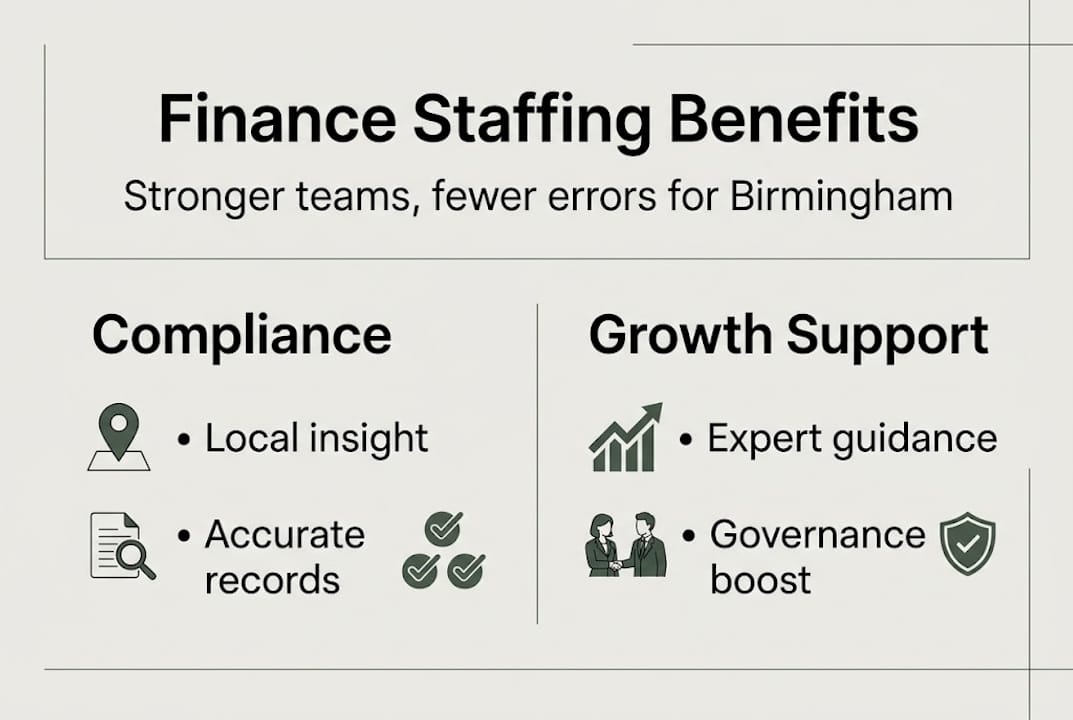
Regional and specialised hiring boosts compliance and reduces financial errors, and the evidence from Birmingham businesses supports this consistently.
| Benefit | What it means in practice |
|---|---|
| Improved compliance | Local knowledge reduces the risk of regulatory oversights specific to UK and regional requirements |
| Fewer financial errors | Specialist skills mean transactions are processed accurately from the start |
| Greater efficiency | The right hire works proactively, not just reactively, freeing up management time |
| Strategic insight | Well-qualified finance staff translate data into actionable business intelligence |
Compliance is often the most immediate benefit. A finance professional who understands Making Tax Digital, VAT obligations, and payroll legislation specific to UK businesses reduces your exposure to penalties and errors. This is especially valuable for businesses that have been managing finances informally or relying on a part-time bookkeeper without formal qualifications.
Efficiency gains are equally significant. When your finance function is staffed correctly, you stop firefighting. Invoices go out on time, reconciliations happen monthly rather than quarterly, and you have accurate data when you need it. That reliability has a knock-on effect across the whole business.
"The businesses that grow fastest are rarely the ones with the best products. They are the ones with the clearest financial picture at every stage of growth."
For finance recruitment trends in Birmingham, the direction is clear: businesses investing in permanent, qualified finance staff are outperforming those that rely on temporary fixes or underqualified hires. Understanding how staffing supports finance processes at an operational level helps explain why this investment pays off so consistently.
The businesses that benefit most from strategic finance staffing share a few traits. They are clear about what they need, they use specialised finance recruiters rather than generalist agencies, and they treat the finance hire as a long-term investment rather than a short-term fix.
Why getting finance staffing right matters more than ever
There is a pattern we see repeatedly in Birmingham's SME market. A business grows quickly, manages finances informally for too long, then faces a compliance issue or a cash flow crisis that could have been avoided with the right permanent hire in place six months earlier. The cost of that delay is almost always greater than the cost of hiring correctly from the start.
The businesses that get this right share one thing in common: they treat finance staffing as a strategic decision, not an administrative one. They use agency finance expertise to find candidates who are not just qualified on paper but genuinely suited to their business's stage and culture.
Technology has changed a great deal about how finance work is done, but it has not replaced the need for skilled people who understand how to interpret and act on financial data. The most efficient Birmingham businesses are those where the right person is using the right tools with the right level of oversight. That combination does not happen by accident. It happens through deliberate, informed finance staffing.
Meet your Birmingham finance staffing needs
If this guide has clarified what you actually need from your next finance hire, the logical next step is connecting with recruiters who specialise in exactly this area.

Ibaco Recruitment works exclusively with Birmingham businesses to place permanent bookkeepers and accountants who are vetted, qualified, and ready to contribute from day one. There are no upfront fees, and placements typically happen within two weeks. Whether you need a bookkeeper to bring order to your daily records or an accountant to handle compliance and strategic reporting, explore recruitment for bookkeepers and accountants and submit your hiring request today. Local expertise, rigorous vetting, and a process built entirely around permanent finance roles.
Frequently asked questions
What does finance staffing typically involve for small businesses?
Finance staffing for SMEs usually covers hiring bookkeepers for daily financial records and accountants for compliance and reporting, as bookkeepers and accountants serve distinct but complementary functions within a business's finance team.
How is finance staffing different from general recruitment?
Finance staffing targets roles requiring specialist qualifications, software competence, and regulatory knowledge, which means it demands far more sector-specific knowledge than a generalist recruitment approach can reliably deliver.
Why should businesses in Birmingham use finance recruiters?
Local finance recruiters understand Birmingham's regulatory environment and the specific pressures facing West Midlands SMEs, which is why regional hiring consistently boosts compliance and reduces costly financial errors.