

TL;DR:
- Hiring finance professionals requires a disciplined, structured recruitment process to mitigate risks.
- Key differences exist between recruiting bookkeepers and accountants, emphasizing skills versus qualifications.
- Birmingham's finance sector faces talent shortages, demanding efficient processes and strong employer branding.
Hiring a skilled accountant or bookkeeper sounds straightforward until you actually try it. 54% of employers report struggling to recruit qualified accountants, with newly-qualified candidates in practice roles being the hardest to find. Birmingham's finance talent market has its own pressures: a competitive local economy, rising salary expectations, and a candidate pool that knows its worth. Many HR managers and business owners assume finance recruitment follows the same rules as general hiring. It does not. This article breaks down the recruitment process for finance roles step by step, so you can hire with confidence rather than guesswork.
Table of Contents
- Understanding the recruitment process: Key concepts and terminology
- The step-by-step recruitment journey for finance professionals
- Critical differences: Hiring bookkeepers versus accountants
- Overcoming recruitment challenges in Birmingham's finance sector
- Why treating recruitment as a finance skillset pays off
- How IBACO simplifies finance recruitment in Birmingham
- Frequently asked questions
Key Takeaways
| Point | Details |
|---|---|
| Tailor recruitment to role | Bookkeepers and accountants require distinct approaches, from interviews to onboarding. |
| Local challenges affect hiring | Over half of Birmingham businesses struggle to recruit qualified finance professionals due to talent shortages. |
| Process discipline pays off | A structured, finance-driven recruitment process leads to better long-term hiring results. |
| Effective onboarding is essential | Plan for 2–4 weeks to fully integrate finance hires, ensuring access and controls are properly managed. |
Understanding the recruitment process: Key concepts and terminology
Before you post a job advert, it helps to understand what the recruitment process actually involves and why finance roles demand a more disciplined approach than most.
"Recruitment" and "hiring" are often used interchangeably, but they mean different things. Recruitment is the full process of attracting, screening, and selecting candidates. Hiring is the final act of making an offer and bringing someone on board. For finance roles, the recruitment stage carries far more weight because the wrong shortlist wastes everyone's time and can expose your business to risk.
Here are the core terms you will encounter when recruiting finance professionals:
- Job specification: A detailed document outlining the role, responsibilities, required qualifications, and software skills. For finance roles, this must include specific tools such as Xero, Sage, or QuickBooks.
- Screening: The initial review of applications to eliminate candidates who do not meet minimum criteria.
- Shortlisting: Selecting the strongest candidates from the screened pool for interview.
- Candidate experience: How applicants perceive your process. A poor experience can cause strong candidates to withdraw.
- Compliance: Finance staff handle sensitive data and funds, so background checks and reference verification are non-negotiable.
Finance recruitment carries unique requirements that general hiring does not. Trustworthiness is not just desirable, it is essential. An accountant with access to company accounts or a bookkeeper reconciling transactions daily must be vetted thoroughly. This is why the steps in hiring finance staff differ markedly from recruiting a sales or operations role.
"A structured recruitment process is not bureaucracy. For finance roles, it is your first line of financial control."
HR managers in Birmingham often underestimate how much process discipline matters here. Business owners, meanwhile, sometimes skip steps to fill a vacancy quickly, only to face costly mistakes later. The role HR managers play in finance recruitment is to enforce that discipline, even under pressure to hire fast. Getting the fundamentals right at this stage protects your business long before a new hire ever touches a spreadsheet.
The step-by-step recruitment journey for finance professionals
With the terminology clear, here is how an effective finance recruitment process actually unfolds from start to finish.
- Define the role precisely. Write a job specification that names the exact qualifications required, such as AAT, ACCA, or CIMA, and the software the candidate must know. Vague job descriptions attract unsuitable applicants and slow everything down.
- Advertise in the right places. General job boards rarely attract strong finance candidates. Use finance-specific boards, professional networks, and specialist agencies. Local Birmingham networks and West Midlands finance communities are particularly valuable.
- Screen for technical skills first. Review CVs for relevant qualifications, sector experience, and software proficiency. A candidate who lists Xero but has never used it beyond a free trial is not the same as one with three years of daily use.
- Shortlist and conduct structured interviews. Use consistent questions across all candidates. Cover both technical ability and ethical judgement. Ask how they have handled discrepancies, managed sensitive data, or flagged concerns to management.
- Complete compliance checks. Reference checks, right-to-work verification, and, where appropriate, credit checks are standard for finance roles.
- Onboard with a clear plan. Allow two to four weeks for a bookkeeper to ramp up fully. Set expectations early, assign a point of contact, and schedule check-ins.
Pro Tip: Build a scoring matrix before interviews begin. Assess each candidate against the same criteria so your final decision is based on evidence, not gut feeling.
54% of employers struggle to recruit accountants, particularly at the newly-qualified level, which means your process needs to be efficient enough to move quickly when a strong candidate appears. The bookkeeper hiring steps and the accountant recruitment process share a common structure but diverge in important ways at the screening and interview stages.
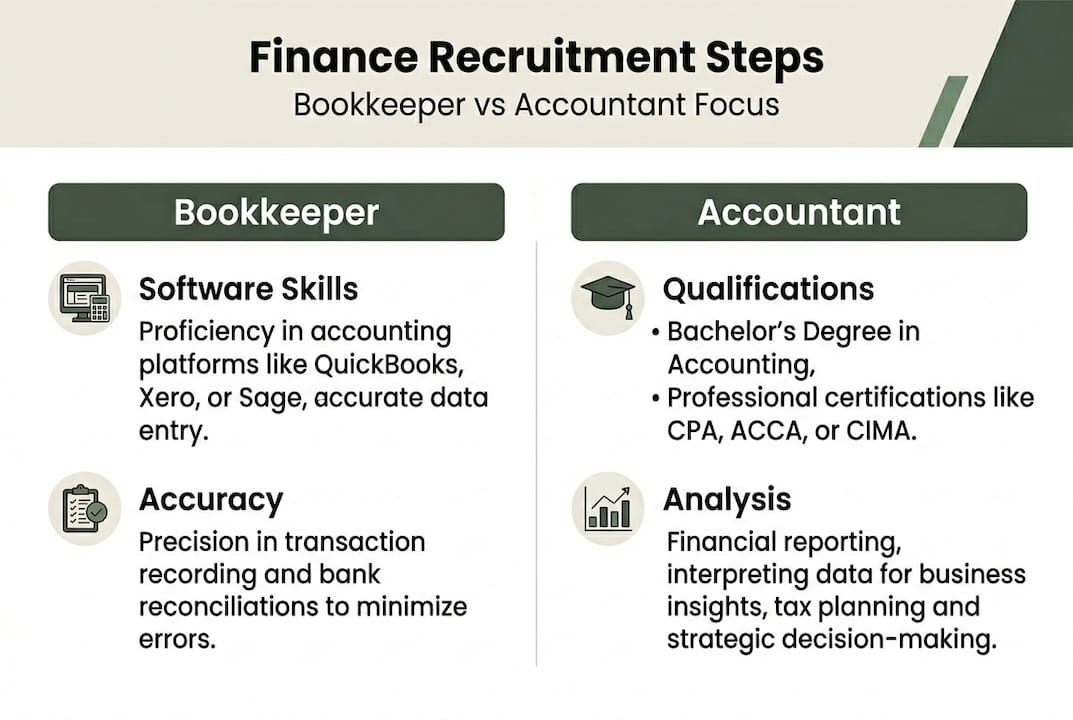
| Stage | Bookkeeper focus | Accountant focus |
|---|---|---|
| Job spec | Software skills, transactional accuracy | Qualifications, reporting scope |
| Screening | AAT level, Xero/QuickBooks experience | ACCA/CIMA/ACA, sector experience |
| Interview | Process knowledge, data handling | Analytical ability, compliance awareness |
| Onboarding | 2 to 4 weeks, system access setup | 3 to 6 weeks, reporting integration |
Critical differences: Hiring bookkeepers versus accountants
Bookkeepers and accountants are not interchangeable. Hiring for one role using the other's criteria is one of the most common and costly mistakes Birmingham businesses make.

For bookkeepers, the interview should centre on transactional accuracy and day-to-day process knowledge. Ask candidates to walk you through a bank reconciliation. Find out which version of Xero or QuickBooks they have used and how they handled errors. Practical, scenario-based questions reveal far more than a CV alone.
For accountants, the emphasis shifts to reporting, compliance, and analytical thinking. You want to understand how they approach month-end close, how they interpret management accounts, and how they have supported business decisions with financial data. Qualifications matter significantly here: ACCA, CIMA, and ACA are the benchmarks to look for.
- Bookkeeper hiring priorities: Software proficiency (Xero, QuickBooks, Sage), attention to detail, experience with VAT returns, payroll processing, and bank reconciliations.
- Accountant hiring priorities: Formal qualification level, statutory reporting experience, knowledge of UK GAAP or IFRS, and the ability to present financial information clearly.
Pro Tip: When hiring a bookkeeper, always apply the principle of least-privilege access. Grant system permissions only for the tasks they are responsible for. This is a basic financial control that many small businesses overlook until something goes wrong.
According to onboarding best practice for bookkeepers, a structured two to four week ramp-up period with a clear checklist, defined scope, and controlled system access significantly reduces errors and builds confidence on both sides. Use the bookkeeper interview questions that test real-world scenarios, and refer to a clear bookkeeper vs accountant framework when deciding which role your business actually needs.
Common pitfalls differ by role too. For bookkeepers, businesses often skip the access control step or fail to document processes clearly, leaving the new hire to guess at procedures. For accountants, the mistake is often hiring based on qualification alone without testing how they communicate financial information to non-finance colleagues.
Overcoming recruitment challenges in Birmingham's finance sector
Birmingham's finance recruitment market is competitive, and the data reflects real pressure on employers.
More than half of employers report difficulty recruiting qualified accountants, with practice roles proving harder to fill than industry positions. Newly-qualified candidates are particularly sought after, which drives up salary expectations and shortens the window you have to make an offer once you find a strong candidate.
Here are the most common challenges Birmingham businesses face and practical ways to address them:
- Talent shortage: The pool of qualified candidates is smaller than demand. Widen your search by considering candidates who are part-qualified but progressing through ACCA or CIMA, and be prepared to support their studies.
- Salary pressure: Candidates in 2026 have clear expectations. Research current market rates for Birmingham before setting your budget. Offering slightly above market rate for the right person is almost always cheaper than a prolonged vacancy.
- Slow processes: Strong candidates receive multiple offers. A recruitment process that takes six weeks will lose good people. Aim to move from first interview to offer within two weeks.
- Employer branding: Many small and medium-sized businesses in Birmingham underestimate how much their reputation matters to finance candidates. Clear values, a stable work environment, and genuine career progression attract better applicants.
- Onboarding gaps: Poor onboarding leads to early attrition. A structured first month, with clear goals and a named mentor, makes a measurable difference to retention.
Understanding UK accounting qualification benchmarks helps you assess candidates accurately and set realistic expectations for what different qualification levels can deliver. Internally upskilling existing staff is also worth considering, particularly if you have a reliable employee who could progress to a more senior finance role with the right support.
Why treating recruitment as a finance skillset pays off
Most businesses treat recruitment as an administrative task. The most successful finance teams in Birmingham treat it as a core capability, applying the same rigour they would to a financial audit or a cash flow forecast.
Think about it this way. In accountancy, you would never make a significant financial decision without evidence, process, and controls. Yet many businesses hire finance staff based on a single interview and a gut feeling. That inconsistency is where costly mistakes happen.
Data-driven recruitment, structured interviews, scoring matrices, and defined onboarding plans are not excessive formality. They are the equivalent of double-entry bookkeeping for your hiring process. They create a verifiable record of why you hired someone and give you a framework to identify what went wrong if things do not work out.
We have seen Birmingham businesses with strong finance functions that hire well consistently. The common thread is not budget or company size. It is process discipline. They treat every hire as a risk management exercise, not an administrative inconvenience. Reviewing the finance roles overview for your business before you recruit is a simple step that pays dividends throughout the process.
How IBACO simplifies finance recruitment in Birmingham
If this process sounds involved, that is because it is. Recruiting finance professionals well takes time, local knowledge, and a clear understanding of what good looks like at every stage.

At Ibaco Recruitment, we specialise exclusively in connecting Birmingham businesses with vetted bookkeepers and accountants for permanent roles. We handle the screening, qualification checks, and shortlisting so you receive candidates who are genuinely ready to contribute. There are no upfront fees, and most placements are completed within two weeks. If you are ready to take the next step, explore our 2026 finance recruitment solutions and speak with our team about your specific requirements. We know Birmingham's finance talent market because it is all we do.
Frequently asked questions
What is the difference between recruiting a bookkeeper and an accountant?
Recruiting bookkeepers requires more focus on software skills and process controls, while accountant recruitment centres on formal qualifications and analytical ability. A structured onboarding approach differs significantly between the two roles.
How long does it take to onboard a finance professional?
Typical onboarding for bookkeepers takes two to four weeks, including system training and access setup. Accountants may require three to six weeks depending on the complexity of the reporting environment.
Why do businesses in Birmingham struggle to recruit qualified accountants?
More than half of employers face shortages, especially for newly-qualified accountants, making practice roles tougher to fill than industry positions.
What qualifications should I look for when recruiting an accountant in the UK?
Look for ACCA, CIMA, or ACA credentials and recent CPD activity for up-to-date expertise. The essential recruitment steps for finance roles outline how to assess these qualifications effectively during the hiring process.