

Posting a job ad and hoping the right bookkeeper or accountant applies is not a hiring strategy. It is a gamble. For small and medium-sized businesses in Birmingham, a poor finance hire can cost far more than just the recruitment fee. It disrupts your accounts, strains your team, and pulls you away from running your business. Yet many SMEs still treat finance recruitment as a straightforward task rather than a specialist discipline. This guide covers what a finance recruiter actually does, how the process works, how it compares to hiring directly, and how to choose the right recruiter for your specific needs.
Table of Contents
- Defining the finance recruiter role
- What does a finance recruiter do for your business?
- Finance recruiter vs. direct hiring: A comparison
- Selecting the right finance recruiter in Birmingham
- Our perspective: Why SMEs need more than a CV database
- Partner with Birmingham's leading finance recruitment experts
- Frequently asked questions
Key Takeaways
| Point | Details |
|---|---|
| Specialist expertise essential | A finance recruiter brings targeted sector knowledge that general recruiters lack. |
| Integration reduces turnover | Support with onboarding minimises costly staff churn for SMEs. |
| Comparison saves resources | Using a recruiter often lowers risk and time investment versus direct hiring. |
| Selection matters | Vetting your recruiter ensures a stronger, more lasting finance team fit. |
Defining the finance recruiter role
A finance recruiter is a specialist who focuses exclusively on sourcing, screening, and placing finance professionals. That means bookkeepers, management accountants, finance assistants, and qualified accountants holding credentials such as AAT, ACCA, or CIMA. Unlike a general recruiter who might fill roles across marketing, HR, and operations in the same week, a finance recruiter lives and breathes the finance sector.
For Birmingham SMEs, this specialism matters enormously. The local finance job market has its own rhythms, salary benchmarks, and candidate expectations. A recruiter who understands finance recruiters in this context will know which candidates are genuinely qualified versus those who simply list software on a CV. They understand the difference between someone who can reconcile accounts on Xero and someone who can build a management reporting pack from scratch.
Here is what separates a finance recruiter from a generalist:
- Deep qualification knowledge: They know what AAT Level 3 actually means in practice, and whether a candidate's CIMA studies are relevant to your business stage.
- Salary benchmarking: They track real-time salary data for Birmingham and the West Midlands, so you do not overpay or lose candidates to a stronger offer.
- Passive candidate access: Many of the best finance professionals are not actively job hunting. A specialist recruiter has built relationships with them over time.
- Compliance awareness: They understand IR35, right-to-work checks, and the professional standards that apply to finance roles.
- Software fluency: They can assess whether a candidate's experience with Sage, QuickBooks, or Xero is genuine or superficial.
High turnover in finance roles and the difficulty filling newly qualified positions remain persistent challenges for Birmingham businesses, with 23% of employers reporting significant recruitment difficulties for these roles.
Using a finance recruitment guide built around local market knowledge gives you a real advantage. The specialist recruiter's network is one of their most valuable assets. Many placements never reach a public job board because the recruiter already knows the right candidate.
Pro Tip: Ask any recruiter you consider how many of their placements come from their existing candidate network rather than job board responses. A high proportion signals genuine market depth.
What does a finance recruiter do for your business?
The recruitment process is more involved than most business owners realise. A good finance recruiter does not simply send you a shortlist of CVs. They manage the entire journey from identifying your needs to supporting the new hire's first weeks in the role. Here is how the process typically unfolds:
- Discovery: The recruiter meets with you to understand your business, your team structure, your software stack, and the specific responsibilities of the role. This shapes a candidate profile that goes beyond a generic job description.
- Sourcing: Using their network, job boards, LinkedIn, and direct approaches, they identify candidates who match both the technical requirements and the culture of your business.
- Screening: They review CVs, verify qualifications, conduct initial interviews, and assess candidates against the brief. You only see people who have already been filtered.
- Shortlisting: A curated shortlist of typically two to four candidates is presented with detailed notes, not just CVs. You know why each person has been recommended.
- Interview facilitation: The recruiter coordinates interviews, prepares candidates, and gathers feedback from both sides to keep the process moving efficiently.
- Offer and negotiation: They manage the offer stage, handle salary negotiations, and reduce the risk of candidates dropping out at the last moment.
- Onboarding support: The best recruiters do not disappear after the contract is signed. They check in during the first weeks to ensure the placement is settling well.
The recruitment agency benefits at each stage compound. You save time, reduce risk, and get a better outcome than a rushed in-house process typically delivers. Following bookkeeper hiring advice that includes integration support is particularly important for smaller teams where one person's performance has an outsized impact.

As the National Accountancy Salary Guide notes, effective recruitment involves integration and coaching, not just hiring. A candidate who is technically strong but poorly onboarded will underperform and may leave within months.
Pro Tip: When briefing a recruiter, share your onboarding plan as well as the job spec. Recruiters who ask about onboarding are the ones who care about long-term placement success, not just filling the role.
Finance recruiter vs. direct hiring: A comparison
Some business owners prefer to handle recruitment themselves, and in certain situations that makes sense. But for finance roles, the risks of direct hiring are often underestimated. Here is a clear comparison to help you decide which approach suits your situation.
| Factor | Finance recruiter | Direct hiring |
|---|---|---|
| Cost | Fee on placement, no upfront cost | Advertising costs, staff time, potential re-hire costs |
| Speed | Typically two to four weeks | Often eight to twelve weeks or longer |
| Talent access | Passive and active candidates | Active candidates only |
| Screening quality | Specialist vetting of qualifications | Relies on internal expertise |
| Risk of bad hire | Lower, with replacement guarantees | Higher, with full cost absorbed internally |
| Onboarding support | Often included | Entirely internal responsibility |
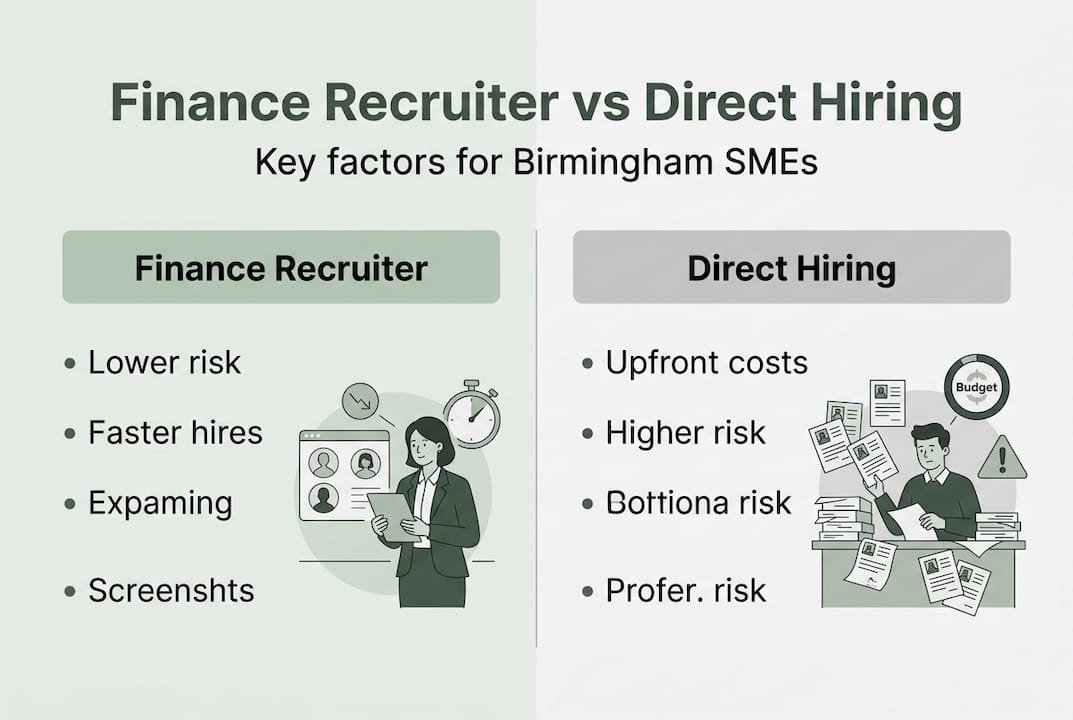
The hidden costs of direct hiring are where SMEs most often get caught out. When a hire does not work out, you face the cost of re-advertising, re-interviewing, and covering the gap. The cost of high turnover and integration can be substantial for smaller businesses, with recruitment and onboarding investment for a permanent finance role often reaching the equivalent of several months' salary.
The accountant recruitment process also demands a level of technical assessment that most HR generalists and business owners are not equipped to carry out confidently. Knowing whether a candidate's management accounts experience is relevant to your reporting needs requires finance knowledge, not just hiring experience.
Direct hiring may make sense when:
- You have an internal HR team with finance sector experience.
- You are hiring for a very senior role where a retained executive search is more appropriate.
- You have a strong internal referral network within the finance community.
For most Birmingham SMEs, a specialist recruiter delivers faster results, better candidates, and lower long-term risk.
Selecting the right finance recruiter in Birmingham
Not all finance recruiters are equal. Choosing the wrong agency can waste time and money just as surely as a bad hire. The demand for bookkeepers and finance assistants amid hybrid working arrangements has intensified competition for candidates, which means your recruiter's network and local knowledge matter more than ever.
Here is what to look for when evaluating a finance recruiter:
- Finance specialism: Do they recruit exclusively or primarily in finance, or are they a generalist with a finance desk?
- Birmingham market knowledge: Can they speak to current salary ranges, candidate availability, and employer expectations in the local market?
- Integration support: Do they offer post-placement follow-up, or do they disappear after the offer is accepted?
- Transparent process: Are they clear about timelines, fees, and what happens if a placement does not work out?
- Track record: Can they provide references from Birmingham SMEs similar to yours?
When screening accounting qualifications, a strong recruiter will explain their methodology rather than simply asserting that candidates are qualified. Ask them how they verify AAT or ACCA credentials and what their process is for assessing software proficiency.
| Criteria | Must-have | Nice-to-have |
|---|---|---|
| Finance sector specialism | Yes | |
| Local Birmingham knowledge | Yes | |
| No upfront fees | Yes | |
| Post-placement support | Yes | |
| Dedicated account manager | Yes | |
| Sector sub-specialism (e.g. manufacturing) | Yes | |
| Same-week shortlisting | Yes |
Red flags to watch for include vague answers about candidate sourcing, pressure to accept candidates quickly without adequate screening notes, and agencies that cannot name recent Birmingham placements in comparable businesses.
Our perspective: Why SMEs need more than a CV database
Most conversations about finance recruitment focus on speed and cost. Those things matter, but they miss the deeper issue. The businesses that struggle most with finance hires are not the ones who pay too much or take too long. They are the ones who treat recruitment as a transaction rather than a relationship.
A finance hire in a small business is not like filling a role in a large corporate. When your bookkeeper or accountant joins a team of ten people, their attitude, communication style, and willingness to ask questions matters as much as their technical skills. High turnover in finance roles rarely comes down to technical gaps. It comes from poor culture fit and inadequate onboarding.
Connecting with finance recruiter insights that go beyond the CV is what separates a good placement from a great one. The recruiters who ask about your team dynamics, your growth plans, and your management style are the ones worth working with. They are not filling a vacancy. They are helping you build a finance function that lasts.
Partner with Birmingham's leading finance recruitment experts
If you have read this far, you already understand that hiring the right finance professional takes more than posting a job ad. It takes local knowledge, specialist screening, and genuine support through the onboarding process.
At Ibaco Recruitment, we specialise exclusively in finance recruitment in Birmingham, connecting SMEs with vetted bookkeepers and accountants for permanent roles. There are no upfront fees, no generic shortlists, and no disappearing after the offer is signed. Whether you need a bookkeeper to manage your day-to-day accounts or a qualified accountant to lead your reporting, we can hire accountants who are the right fit for your business. Get in touch today and let us help you build a finance team you can rely on.
Frequently asked questions
What is the main difference between a finance recruiter and a general recruiter?
A finance recruiter specialises deeply in finance qualifications and industry needs, while general recruiters cover multiple sectors. This specialism means they can accurately assess whether a candidate's AAT or ACCA credentials are relevant to your role, something a generalist cannot reliably do. High turnover in finance roles underlines why this targeted expertise matters for Birmingham businesses.
How much does hiring through a finance recruiter cost on average?
Recruitment and integration costs for finance roles can be substantial, with the total cost of a permanent hire potentially reaching the equivalent of several months' salary when onboarding investment is included. Using a specialist recruiter reduces the risk of a failed placement, which is where the real cost lies.
Which finance roles are most in demand in Birmingham?
Bookkeepers and finance assistants are currently in highest demand, particularly for businesses moving to hybrid or fully permanent office setups. The demand for finance assistants has grown steadily as SMEs look to build reliable in-house finance functions rather than relying on outsourced support.
What should I look for when selecting a finance recruiter?
Look for proven finance sector experience, strong post-placement integration support, and a solid reputation within the Birmingham market. A recruiter who can explain how they verify qualifications and assess software skills will deliver far better results than one who simply forwards CVs. The growing demand for finance professionals means the best candidates are placed quickly, so recruiter responsiveness matters too.