

Many Birmingham business owners believe hiring a qualified accountant or bookkeeper is as simple as posting a job advert and waiting for applications. The reality involves navigating complex qualifications, assessing technical skills, and ensuring cultural fit whilst competing for limited talent in a demanding market. Finance recruiters bridge this gap by applying specialised expertise to connect employers with the right permanent finance professionals. This guide explains what finance recruiters do, why partnering with them benefits your business, and how they adapt to evolving recruitment trends in Birmingham's competitive landscape.
Table of Contents
- What finance recruiters do: core responsibilities and expertise
- Why partnering with finance recruiters benefits Birmingham businesses
- How finance recruiters find and evaluate permanent candidates
- Trends shaping finance recruitment in Birmingham for 2026 and beyond
- How Ibaco Recruitment supports your finance hiring needs
Key takeaways
| Point | Details |
|---|---|
| Specialised matching | Finance recruiters connect employers to qualified candidates using deep knowledge of accounting qualifications and business needs |
| Time savings | Partnering with recruiters reduces hiring time and improves candidate quality through pre-vetted talent pools |
| Market expertise | Recruiters provide strategic advantages by understanding local salary trends and candidate availability |
| Evolving practices | Modern recruitment incorporates technology, diversity priorities, and changing candidate expectations |
What finance recruiters do: core responsibilities and expertise
Finance recruiters serve as strategic partners who understand both the technical demands of accounting roles and the unique needs of Birmingham businesses. Their primary responsibility involves assessing each finance position thoroughly, from entry-level bookkeepers managing daily transactions to senior accountants overseeing complex financial reporting. This assessment goes beyond job descriptions to capture organisational culture, team dynamics, and long-term growth objectives.
Screening candidates requires more than reviewing CVs. Finance recruiters specialise in understanding accounting qualifications, industry requirements, and candidate skills to find the right match. They verify qualifications such as AAT, ACCA, and CIMA certifications whilst evaluating practical experience with software platforms like Xero, Sage, and QuickBooks. This dual focus on credentials and hands-on capability ensures candidates can contribute immediately upon joining your team.
Recruiters leverage extensive professional networks built through years of industry relationships. These connections provide access to passive candidates who aren't actively job hunting but might consider the right opportunity. Such networks prove invaluable when seeking specialists in niche areas like management accounting, financial analysis, or payroll administration where qualified professionals are scarce.
Beyond sourcing, recruiters advise employers on realistic expectations regarding candidate availability and salary benchmarks. They share insights about current market conditions, helping businesses craft competitive offers that attract top talent without overspending. This consultative approach transforms recruitment from a transactional process into a strategic business function.
Ongoing support continues throughout the interview process, offer negotiation, and onboarding stages. Recruiters coordinate schedules, provide feedback to both parties, and troubleshoot concerns that might derail successful placements. Their involvement often extends beyond the hire date to ensure smooth integration and address any early challenges.
Pro Tip: Clarify your organisation's specific finance role requirements, including technical skills, software proficiency, and team culture expectations, when engaging recruiters to ensure they source candidates who align perfectly with your needs.
Exploring bookkeeper and accountant recruitment services in Birmingham reveals how specialised agencies tailor their approach to local market conditions and business requirements.
Why partnering with finance recruiters benefits Birmingham businesses
Access to pre-vetted, qualified candidates dramatically reduces recruitment risk for Birmingham employers. Rather than sifting through hundreds of applications, businesses receive a shortlist of candidates who have already undergone rigorous screening for qualifications, experience, and cultural alignment. This filtering saves countless hours whilst minimising the chance of costly hiring mistakes.

Specialist finance recruitment agencies save employers significant time and improve hire quality in Birmingham's competitive market. Recruiters maintain current knowledge of salary trends, candidate expectations, and skills availability across the West Midlands. This intelligence helps employers position their opportunities attractively and anticipate potential challenges before they arise.
Finance recruiters act as trusted advisors who ease the administrative burden of hiring. They handle initial candidate communications, schedule interviews, conduct reference checks, and manage offer negotiations. This delegation allows HR managers and business owners to focus on core operations whilst maintaining confidence that recruitment progresses professionally.
Negotiation expertise proves particularly valuable when securing top candidates. Recruiters understand what motivates finance professionals beyond salary, including career development opportunities, flexible working arrangements, and professional certification support. They craft compelling offers that address candidate priorities whilst respecting employer budgets.
The impact on time-to-hire and employee retention cannot be overstated. Businesses working with specialist recruiters typically fill positions 40% faster than those managing recruitment internally. Better candidate matching also improves retention rates, reducing the disruption and expense of repeat hiring cycles.
Partnering with a specialist recruiter can increase finance hire success by over 30%.
Understanding the role of employee benefits in attracting and retaining finance professionals helps employers create comprehensive packages that compete effectively for talent.
- Reduced recruitment risk through thorough candidate pre-screening
- Strategic market intelligence about salary trends and candidate availability
- Professional management of all recruitment communications and logistics
- Expert negotiation that balances candidate expectations with employer budgets
- Faster hiring timelines and improved long-term employee retention
Engaging accounting recruitment agencies in Birmingham provides access to these advantages whilst benefiting from local market expertise.
How finance recruiters find and evaluate permanent candidates
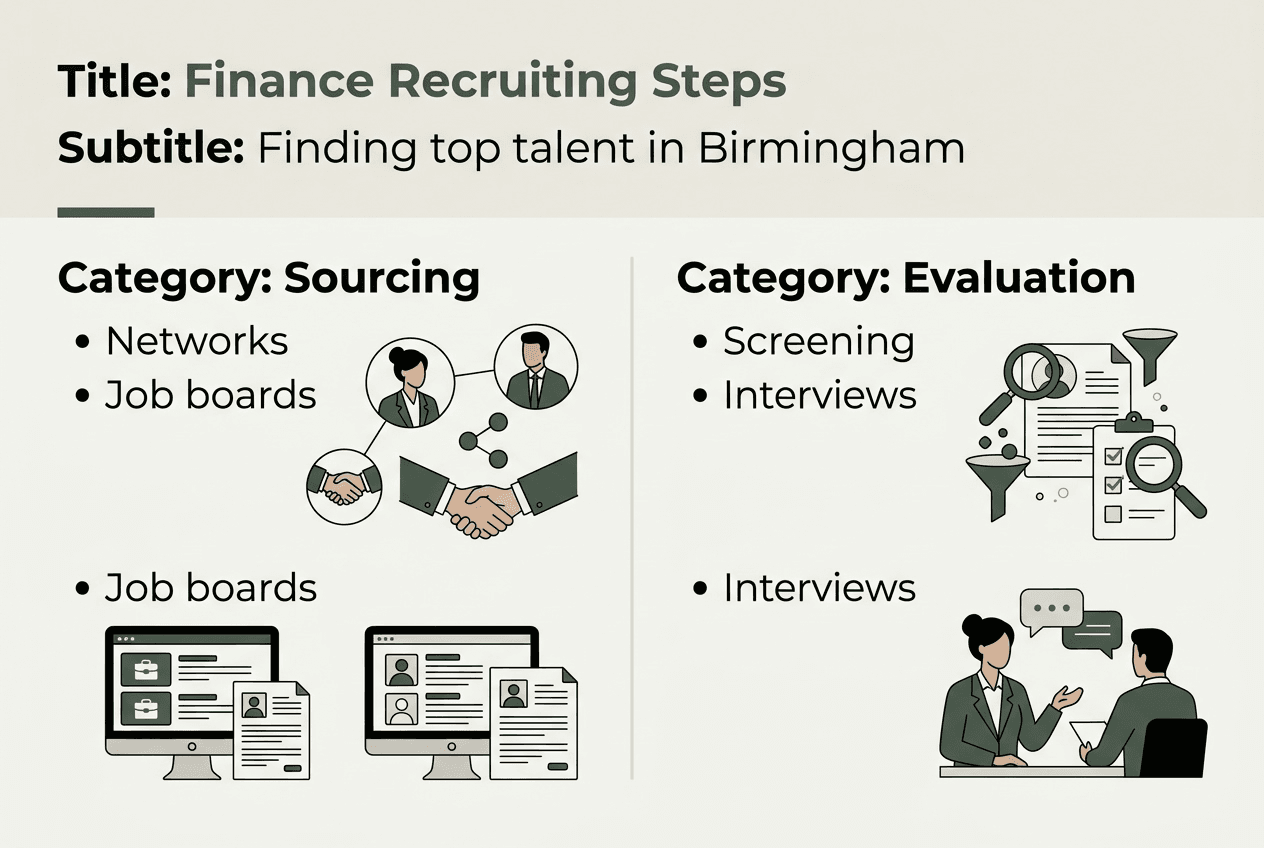
Sourcing qualified finance candidates begins with multiple channels that extend far beyond standard job boards. Recruiters maintain proprietary databases of pre-screened professionals, cultivate relationships with accounting bodies and training providers, and actively network at industry events. LinkedIn and specialist finance job platforms supplement these efforts, creating a comprehensive talent pipeline.
Structured interviews form the foundation of candidate evaluation. Recruiters conduct initial screenings that assess technical knowledge, communication skills, and career motivations. These conversations explore specific scenarios like month-end closing procedures, variance analysis, or audit preparation to gauge practical competence. Skills tests might include Excel proficiency assessments or accounting software simulations that reveal hands-on capability.
Qualification verification ensures candidates possess claimed credentials. Recruiters confirm AAT, ACCA, CIMA, or other certifications directly with issuing bodies whilst checking employment history and professional references. This due diligence protects employers from fraudulent claims and ensures candidates meet regulatory requirements.
Digital tools and in-depth candidate assessments improve recruiter efficiency and hiring precision. Applicant tracking systems organise candidate information, automate communication workflows, and track progress through recruitment stages. Psychometric assessments provide insights into personality traits, work styles, and cultural fit that complement technical evaluations.
| Sourcing channel | Evaluation technique | Strengths | Limitations |
|---|---|---|---|
| Proprietary databases | Structured interviews | Access to passive candidates | Requires ongoing relationship management |
| Professional networks | Skills testing | High-quality referrals | Limited reach for niche roles |
| Job boards | Qualification verification | Broad candidate reach | Higher volume of unqualified applicants |
| Social media platforms | Psychometric analysis | Cost-effective sourcing | Time-intensive screening required |
The recruitment process follows a systematic approach:
- Define role requirements and ideal candidate profile with employer input
- Source candidates through multiple channels and activate professional networks
- Conduct initial screenings to assess qualifications and career fit
- Administer technical assessments and verify credentials thoroughly
- Present shortlisted candidates with detailed profiles to employer
- Coordinate interviews and gather feedback from both parties
- Negotiate offers and manage acceptance process professionally
- Support onboarding and ensure smooth transition into role
Pro Tip: Keep communication transparent and prompt throughout the recruitment process to secure top finance talent before competitors make offers.
Exploring finance recruitment trends in Birmingham reveals how technology and evolving candidate expectations shape modern sourcing strategies.
Trends shaping finance recruitment in Birmingham for 2026 and beyond
Digital interviewing and remote onboarding have transformed how Birmingham businesses connect with finance talent. Video interviews allow employers to assess candidates efficiently whilst accommodating flexible schedules. Virtual onboarding programmes enable new hires to complete paperwork, access training materials, and meet team members before their first office day. These innovations expand talent pools beyond immediate geographic boundaries whilst reducing time-to-productivity.
Soft skills now carry equal weight with technical expertise in candidate evaluation. Employers seek finance professionals who communicate complex information clearly, collaborate effectively across departments, and adapt to changing business priorities. Problem-solving ability, emotional intelligence, and stakeholder management skills differentiate exceptional candidates from merely competent ones.
Diversity and inclusion have become central priorities for Birmingham finance teams. Businesses recognise that varied perspectives improve decision-making and reflect customer demographics more accurately. Recruiters actively source candidates from underrepresented backgrounds whilst helping employers create inclusive cultures that attract and retain diverse talent.
Changing candidate expectations and technology adoption are redefining recruitment practices in 2026. Salary benchmarks shift in response to cost of living increases and market competition for specialised skills. Finance professionals increasingly prioritise work-life balance, career development opportunities, and values alignment alongside compensation when evaluating opportunities.
| Aspect | Past practice | Current practice | Impact |
|---|---|---|---|
| Interview format | In-person only | Hybrid digital and in-person | Faster scheduling and broader reach |
| Skill emphasis | Technical focus | Technical plus soft skills | Better team integration |
| Diversity approach | Passive consideration | Active priority | Richer talent pools |
| Salary negotiation | Fixed offers | Flexible packages | Improved candidate acceptance |
Top five recruitment trends HR managers should evaluate:
- Adoption of artificial intelligence for initial CV screening and candidate matching
- Increased emphasis on employer branding to attract passive candidates
- Flexible working arrangements as standard rather than exceptional benefits
- Continuous recruitment rather than reactive hiring when vacancies arise
- Data analytics to measure recruitment effectiveness and optimise processes
Successful recruitment in this evolving landscape requires close collaboration between employers and recruiters. Businesses must articulate their values, culture, and growth plans clearly so recruiters can position opportunities compellingly. Regular feedback loops help refine candidate profiles and adjust strategies as market conditions change.
Staying informed about finance recruitment trends in Birmingham ensures your hiring approach remains competitive and effective.
How Ibaco Recruitment supports your finance hiring needs
Navigating Birmingham's competitive finance recruitment landscape requires expertise, networks, and dedication that many businesses lack internally. Ibaco Recruitment delivers all three through our specialised focus on permanent finance placements across the West Midlands.

Our team combines deep understanding of finance recruitment trends in Birmingham with extensive candidate networks built over years of focused practice. We know which qualifications matter for different roles, which software skills are essential, and how to assess cultural fit accurately. This expertise ensures we match the right accountant or bookkeeper to your specific business needs.
Working with accounting recruitment agencies in Birmingham like Ibaco means accessing pre-vetted talent pools and benefiting from transparent processes with no upfront fees. Our bookkeeper and accountant recruitment services streamline hiring, reduce risks, and deliver qualified professionals often within two weeks. Partner with us to build a stronger finance team whilst focusing on your core business operations.
FAQ
What qualifications do finance recruiters look for in candidates?
Recruiters prioritise recognised accounting certifications that demonstrate technical competence and professional commitment. UK accounting qualifications like AAT, ACCA, and CIMA serve as key benchmarks, though specific requirements vary by role seniority and specialisation. Practical experience with industry-standard software and demonstrable skills in financial reporting, analysis, or compliance complement formal qualifications. Recruiters also evaluate soft skills including communication ability, attention to detail, and cultural alignment with employer organisations.
How long does it typically take to hire a permanent finance professional in Birmingham?
Average hiring timelines range from six to twelve weeks depending on role complexity, seniority level, and candidate availability in the market. Senior positions requiring specialised expertise naturally take longer than entry-level bookkeeping roles. Using specialist recruiters can significantly shorten this timeframe, often delivering qualified candidates within two to four weeks through pre-vetted talent pools and streamlined processes. Understanding how long to hire an accountant in Birmingham helps businesses plan recruitment activities and set realistic expectations.
What are the most common challenges finance recruiters face?
High competition for top talent creates significant pressure, particularly for candidates with specialised skills in management accounting, financial analysis, or niche industry experience. Candidate scarcity in certain qualification levels means recruiters must maintain extensive networks and employ creative sourcing strategies. Ensuring cultural fit alongside technical competence complicates searches, requiring deep understanding of both candidate motivations and employer environments. Keeping pace with rapid changes in finance regulations, technology platforms, and compliance requirements demands ongoing recruiter training and market intelligence. Accounting recruitment agencies overcome these challenges through specialisation, dedicated resources, and continuous professional development.
How do finance recruiters assess cultural fit?
Cultural assessment begins with understanding employer values, team dynamics, and working styles through detailed client consultations. Recruiters explore these aspects during candidate interviews, asking behavioural questions about preferred work environments, communication styles, and collaboration approaches. They observe how candidates describe past workplace experiences and what motivates them professionally. Reference checks provide third-party perspectives on how candidates interact with colleagues and adapt to organisational cultures. This multi-layered approach helps predict whether candidates will thrive in specific business environments beyond their technical capabilities.