

TL;DR:
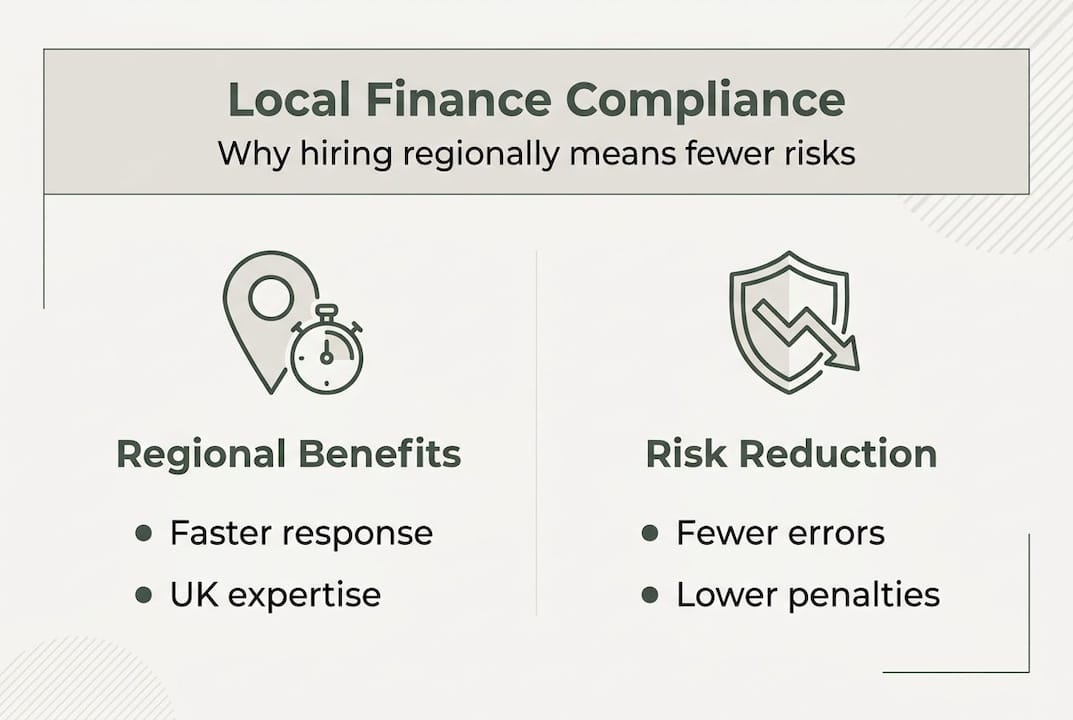
- Hiring local finance professionals enhances compliance and reduces costly errors for West Midlands SMEs.
- Regional recruitment offers faster response times, regional expertise, and stronger relationships than remote hires.
- Investing in local staff minimizes risk and supports business growth compared to outsourcing or remote solutions.
UK SMEs lose over £200 million annually through payroll and VAT errors, and for West Midlands businesses, the stakes are particularly high. Hiring the wrong finance professional, or relying on someone with no grounding in local regulations, can expose your business to HMRC penalties, missed deadlines, and reputational damage that takes years to repair. This article is written specifically for small and medium-sized businesses across the West Midlands who are considering permanent finance hires. We will walk through why local recruitment matters, what it does for your compliance, and how to navigate the hiring process with confidence.
Table of Contents
- How local finance talent ensures compliance and reduces risk
- The benefits of accessibility and personalised service
- Recruitment challenges and how local agencies offer solutions
- Why regional finance recruitment matters for West Midlands SMEs
- Our view: the uncomfortable truth about finance recruitment for SMEs
- Explore regional recruitment solutions with IBACO
- Frequently asked questions
Key Takeaways
| Point | Details |
|---|---|
| Local hires boost compliance | Local finance professionals navigate UK standards and reduce costly mistakes for West Midlands SMEs. |
| Accessibility delivers trust | In-person meetings and regional knowledge foster personalised service and rapid solutions. |
| Local agencies streamline hiring | Regional agencies leverage talent networks to overcome skill gaps and speed up recruitment. |
| Regional focus prevents productivity gaps | West Midlands firms benefit from local talent that understands regional economic trends and council rates. |
How local finance talent ensures compliance and reduces risk
With the risks established, here is how local recruitment directly addresses these compliance challenges.
Hiring a finance professional who genuinely understands UK regulations is not a luxury. It is a baseline requirement. Local accountants and bookkeepers who work within the West Midlands are already familiar with HMRC reporting expectations, VAT submission cycles, and the ongoing rollout of Making Tax Digital (MTD). That familiarity translates directly into fewer errors and fewer costly surprises.
Local accountants ensure precise compliance with UK financial standards, reducing errors and fines for businesses of all sizes. This is not abstract. When your bookkeeper already knows the MTD requirements for VAT-registered businesses, they do not need a learning curve. They get to work.
Consider what compliance errors actually cost. SMEs lose £200M+ annually to payroll and VAT mistakes without local expertise in place. The table below puts this in practical terms:
| Compliance issue | Typical fine or cost | Estimated cost with local hire |
|---|---|---|
| Late VAT submission | £200 per return | Minimal with proper oversight |
| Payroll error (PAYE) | Up to £3,000 per incident | Reduced through accurate processing |
| MTD non-compliance | Up to £400 penalty | Avoided with MTD-ready professionals |
| HMRC audit preparation | £1,500 to £5,000 in fees | Managed in-house efficiently |
Local professionals handle a broad range of compliance tasks that remote or generalist hires often struggle with:
- Submitting VAT returns accurately and on time under MTD rules
- Managing PAYE and National Insurance contributions
- Preparing year-end accounts aligned with HMRC expectations
- Flagging changes in regional business rates or council tax obligations
- Liaising directly with HMRC on your behalf when queries arise
Understanding the finance recruitment process in Birmingham helps you identify which type of professional you need. Whether you are looking for a bookkeeper or a fully qualified accountant, the distinction matters enormously for compliance. You can explore the differences between bookkeepers vs accountants before making your decision.
Pro Tip: When reviewing candidates, ask specifically about their experience with MTD submissions and HMRC correspondence. A professional who has handled HMRC queries directly is worth far more than one who has only prepared internal reports.
The benefits of accessibility and personalised service
Beyond compliance, real-world accessibility and relationship-building are what distinguishes local finance hires from remote alternatives.
When something urgent comes up, and in finance it always does, you need someone who can sit across the table from you within the hour. A remote hire in a different time zone, or even a different city, simply cannot offer that. Local finance professionals provide rapid, in-person access that resolves problems before they escalate.
In-person meetings and local accessibility foster personalised service, trust, and proactive advice on regional economic trends. That proactive element is often undervalued. A local professional who attends regional business events, understands Birmingham City Council's business rates structure, and knows how local enterprise partnerships operate brings insight that no remote hire can replicate.

Here is how local and remote finance hires compare across the dimensions that matter most to SMEs:
| Factor | Local hire | Remote hire |
|---|---|---|
| Response time | Same day or in person | Dependent on time zone and availability |
| Regional knowledge | Strong, built through experience | Limited or generic |
| Trust and relationship | Developed through regular contact | Harder to build remotely |
| Compliance awareness | Current with local and UK rules | May lack regional specifics |
| Onboarding speed | Faster with local networks | Slower without regional context |
The types of advice only a locally embedded professional can reliably provide include:
- Guidance on West Midlands Combined Authority business support grants
- Awareness of regional payroll trends and local salary benchmarks
- Insight into sector-specific financial pressures common in Birmingham's manufacturing and retail base
- Connections to local solicitors, auditors, and financial advisers when needed
Working with recruitment agencies for finance hires in Birmingham gives you access to professionals who already have these regional roots. Understanding how Birmingham finance recruiters operate will help you set realistic expectations and ask the right questions during the hiring process.
Recruitment challenges and how local agencies offer solutions
Recruitment is not just about finding candidates. It is about overcoming real-world barriers, and this is where local agencies genuinely shine.
The UK finance recruitment market is under significant pressure. 80% of UK businesses face hiring difficulties, and local agencies consistently outperform national generalist firms in reducing time-to-hire for finance roles. Speed matters because every week without a qualified bookkeeper or accountant is a week where errors can accumulate.
Common challenges SMEs face when recruiting finance professionals include:
- Identifying candidates with the right qualifications, such as AAT, ACCA, or CIMA
- Assessing proficiency in software like Xero, Sage, or QuickBooks during interviews
- Filtering out candidates who look good on paper but lack practical experience
- Managing the time burden of recruitment alongside day-to-day operations
Local agencies address each of these barriers through a structured vetting process. Here is how a quality regional agency typically works:
- Initial briefing: The agency meets with your business to understand the specific role, your compliance needs, and your team culture.
- Candidate sourcing: Using regional networks and talent pools, the agency identifies candidates already active in the West Midlands market.
- Qualification verification: Credentials such as AAT, ACCA, and CIMA memberships are confirmed directly with the awarding bodies.
- Skills assessment: Candidates are tested on relevant software and practical accounting tasks before being shortlisted.
- Cultural fit review: The agency considers how a candidate's working style aligns with your business environment.
- Shortlist presentation: You receive a curated shortlist, typically within two weeks, ready for interview.
Support for HR managers in finance recruitment is particularly valuable here, as many HR teams in SMEs lack the specialist knowledge to assess finance candidates accurately. A thorough guide to hiring finance talent can also help you prepare the right job specification from the outset.
Pro Tip: When speaking to a local agency, ask how many finance placements they have made in the West Midlands in the past 12 months and what their average time-to-hire is. Specific numbers reveal genuine regional expertise.
Why regional finance recruitment matters for West Midlands SMEs
Bringing the discussion to the West Midlands, let us see why regional recruitment makes a measurable difference.
The West Midlands is not London. Businesses here face distinct pressures, from a manufacturing-heavy economy to a higher proportion of SMEs operating on tighter margins. West Midlands SMEs face regional finance access barriers, with recruiting cited as a barrier by 18 to 29% of businesses in the region. That is a significant share of businesses struggling to find the right people.
At the same time, external finance use recovered to approximately 46% in 2023, suggesting that more SMEs are engaging with financial products and services that require competent in-house management. Without the right finance professional, navigating loan covenants, grant reporting, and investor relations becomes genuinely risky.
The small business finance market report from the British Business Bank highlights the growing complexity of financial management for regional SMEs, reinforcing why specialist local hires are increasingly essential.
| Metric | West Midlands | UK average |
|---|---|---|
| SMEs citing recruitment as a barrier | 18 to 29% | Approximately 15% |
| Finance role vacancy fill time | Longer than national average | 4 to 6 weeks |
| Proportion using external finance | ~46% (2023) | ~48% |
Hiring regionally offers advantages that go well beyond geography:
- Local professionals understand the economic rhythm of the West Midlands, including seasonal pressures in retail and manufacturing
- Regional hires are more likely to stay long-term, reducing turnover costs
- They bring existing networks of local suppliers, auditors, and advisers
- They are familiar with regional grant schemes and Combined Authority funding opportunities
Using a finance recruiter guide for SMEs tailored to the Birmingham market will help you understand what to look for. A dedicated bookkeeper recruitment guide for 2026 provides practical steps to ensure you hire the right level of professional for your current needs.
Our view: the uncomfortable truth about finance recruitment for SMEs
Having examined the evidence, here is a perspective that might challenge your assumptions about local recruitment.
Many SMEs in the West Midlands choose outsourced bookkeeping because the upfront cost looks attractive. Outsourcing can save up to 57% on staffing costs, and that figure is hard to ignore when margins are tight. But the calculation changes the moment HMRC comes knocking.
The truth is that compliance-sensitive roles carry risks that cost savings cannot offset. Time-zone lags, communication gaps, and the absence of hands-on oversight are not theoretical concerns. They are the conditions under which errors go unnoticed until they become penalties.
Local hiring reduces compliance risks in ways that are difficult to quantify but very easy to feel during an HMRC audit. As we have seen repeatedly in our work across Birmingham and the wider West Midlands, the businesses that invest in local permanent hires spend far less time firefighting and far more time growing.
The real return on investment is not a lower salary bill. It is the absence of a £3,000 penalty notice, the confidence of a clean audit, and the stability of a finance professional who genuinely understands your business. Explore finance recruitment trends Birmingham to see how the market is shifting toward permanent, locally embedded roles.
Explore regional recruitment solutions with IBACO
If you are ready to act on these insights, here is how IBACO can help you recruit local finance talent.
At IBACO, we specialise exclusively in connecting West Midlands SMEs with qualified, permanently placed finance professionals. Every candidate we present has been thoroughly vetted for qualifications, software proficiency, and regional experience. There are no upfront fees, and our typical placement time is within two weeks.

Whether you need a bookkeeper to manage day-to-day accounts or a qualified accountant to oversee compliance and reporting, our Birmingham finance recruitment solutions are built around your specific needs. Submit your hiring request today and receive a curated shortlist of local finance recruitment Birmingham candidates who are ready to contribute from day one.
Frequently asked questions
How does local finance recruitment lower compliance risks?
Local professionals ensure precise compliance with UK financial standards and can quickly identify errors before they become penalties. Their familiarity with HMRC processes and regional regulations means issues are caught and corrected early.
What makes regional agencies faster in recruiting finance talent?
Local agencies speed time-to-hire by maintaining pre-screened talent pools and regional networks that generalist firms simply cannot match. This means you receive a shortlist of qualified candidates far sooner than through a national agency.
Do in-person meetings impact finance recruitment success?
Yes. In-person accessibility fosters trust and enables the kind of personalised, proactive service that remote hires rarely deliver. Face-to-face contact also makes it easier to assess cultural fit during the hiring process.
Are remote hires riskier for finance roles than local hires?
Remote hires may reduce costs, but outsourcing savings of up to 57% do not account for the compliance risks that come with limited oversight and communication delays. For compliance-sensitive roles, local permanent hires consistently offer lower long-term risk.