

TL;DR:
- Permanent finance recruitment provides long-term stability, compliance, and business-specific knowledge.
- Core roles like bookkeepers and accountants benefit most from permanent placement.
- Working with local recruiters streamlines hiring and enhances regional compliance for Birmingham SMEs.
Many Birmingham SMEs assume that bringing in a temporary bookkeeper or a short-term contract accountant is the flexible, low-risk option. In reality, the opposite is often true. Rotating finance staff creates gaps in institutional knowledge, exposes your business to compliance errors, and quietly drives up costs in ways that never appear on a single invoice. Birmingham businesses increasingly prioritise permanent finance recruitment precisely because the risks of non-permanent solutions compound over time. This article explains what permanent finance recruitment actually means, which roles benefit most from it, and how your Birmingham SME can make a confident, compliant hire.
Table of Contents
- What is permanent finance recruitment?
- Key finance roles filled through permanent recruitment
- Why choose permanent finance hires? Benefits for Birmingham SMEs
- The permanent finance recruitment process: steps for SMEs
- The overlooked truth about permanent finance recruitment in Birmingham
- How Ibaco Recruitment streamlines your permanent finance hiring
- Frequently asked questions
Key Takeaways
| Point | Details |
|---|---|
| Permanent recruitment defined | Hiring for ongoing roles ensures legal, compliance and operational stability versus short-term contracts. |
| Best roles for permanence | Core finance functions like bookkeeping and accounting are most effective when staffed permanently. |
| SME compliance advantage | Permanent hires support regulatory compliance and reduce turnover risk for Birmingham businesses. |
| Step-by-step hiring success | A structured recruitment process is key to finding the right finance professional for your SME. |
What is permanent finance recruitment?
Permanent finance recruitment is the process of hiring a finance professional into a long-term, ongoing role within your organisation. The employee receives a full contract of employment, statutory benefits, and all rights afforded under UK employment law. This is fundamentally different from temporary or contract arrangements, where someone works for a fixed period or a defined project before moving on.
Employment status definitions matter enormously here. A temporary worker placed through an agency has a different legal relationship with your business than a permanent employee. A contractor operating through a limited company sits in a different category again. Confusing these models is one of the most common and costly mistakes SMEs make.
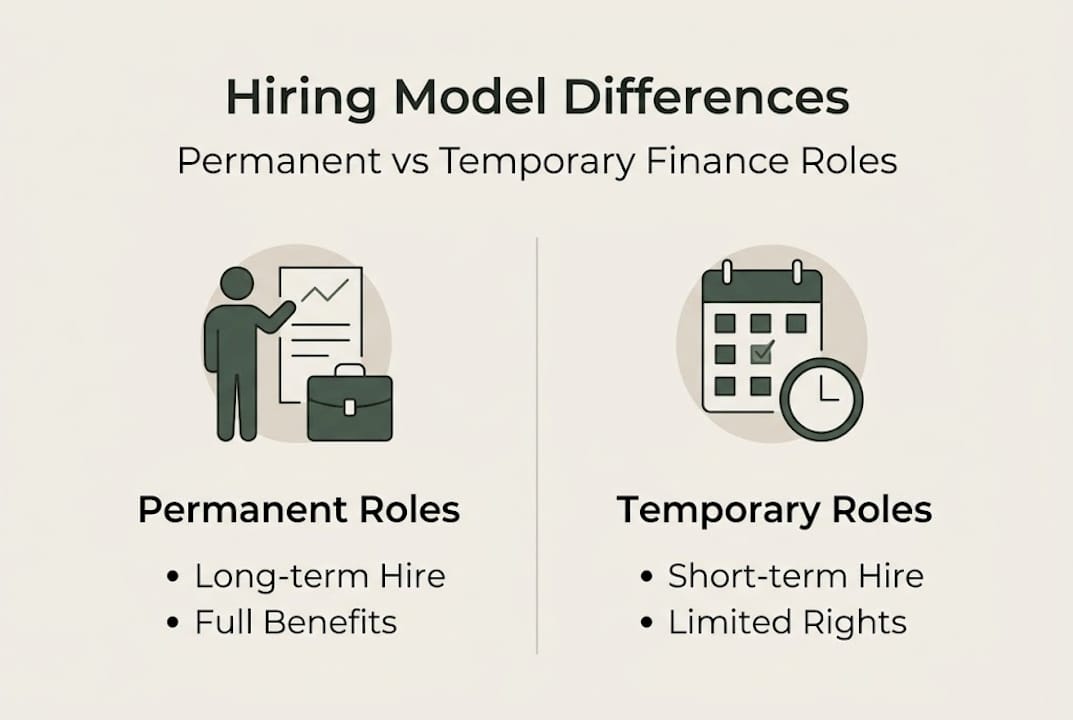
Here is a quick comparison of the three main hiring models:
| Hiring model | Contract type | Employee rights | Compliance burden | Best suited for |
|---|---|---|---|---|
| Permanent | Ongoing | Full | Employer holds responsibility | Long-term, core finance roles |
| Temporary | Fixed-term | Limited | Shared with agency | Short-term cover or peaks |
| Contract | Project-based | Minimal | Contractor holds responsibility | Specialist, time-limited projects |
For Birmingham SMEs, the risks of relying on non-permanent models in core finance functions are significant. Permanent finance roles typically offer long-term contracts, employee benefits, and compliance with UK employment law, which means the business carries clear, manageable obligations rather than ambiguous grey areas.
Key characteristics of permanent finance recruitment include:
- Ongoing employment contract with no fixed end date
- Full statutory rights including holiday pay, sick pay, and pension enrolment
- Employer responsibility for PAYE, National Insurance, and workplace compliance
- Continuity of knowledge across financial periods and reporting cycles
- Eligibility for internal development and progression
When you use finance recruitment agencies for permanent placements, you also gain access to pre-vetted candidates who have been assessed for qualifications such as AAT, ACCA, or CIMA. That shortlisting process removes significant administrative burden from your HR team. For a broader view of how to approach this, the guide to hiring finance talent covers the full landscape in practical terms.
Key finance roles filled through permanent recruitment
Not every finance role carries the same risk if filled on a temporary basis. However, bookkeepers, management accountants, and financial controllers are most commonly hired permanently by local businesses, and for good reason. These roles sit at the heart of your financial operations.
Here is a summary of the most common permanent finance roles and why stability matters for each:
| Role | Core responsibilities | Why permanence matters |
|---|---|---|
| Bookkeeper | Daily transaction recording, bank reconciliation, VAT returns | Consistency across reporting periods |
| Management accountant | Budgeting, forecasting, management reports | Builds business-specific financial insight |
| Financial controller | Oversight of finance function, statutory compliance | Accountability and regulatory continuity |
| Payroll specialist | Payroll processing, HMRC submissions, pension compliance | Errors carry immediate legal consequences |
Each of these roles accumulates business-specific knowledge over time. A bookkeeper who has processed your accounts for two years understands your supplier payment patterns, your VAT quirks, and your seasonal cash flow. A temporary replacement simply cannot replicate that depth, regardless of their technical skill.

What most SMEs miss is the distinction between a genuine finance professional and an accounts administrator. The two are not interchangeable. An accounts admin role typically handles data entry and basic processing. A qualified bookkeeper or accountant brings analytical judgement, regulatory awareness, and the ability to flag problems before they become penalties. Understanding what finance recruiters do helps you articulate the difference when writing a job brief.
Key responsibilities that benefit most from permanent staffing:
- Monthly and year-end close processes
- VAT return preparation and submission
- Management reporting and variance analysis
- Payroll and auto-enrolment compliance
- Liaison with external auditors and HMRC
Pro Tip: When briefing a recruiter, specify the software your team uses, whether Xero, Sage, or QuickBooks, and the qualifications you require. Vague briefs attract vague candidates. HR managers involved in finance hiring consistently report that precise role briefs reduce time-to-hire significantly. For a thorough breakdown of common finance roles and their typical responsibilities, the ICAEW provides a useful reference point.
Why choose permanent finance hires? Benefits for Birmingham SMEs
The business case for permanent hiring is stronger than most SME owners realise. Permanent hires reduce compliance risks and turnover costs, and support cultural fit within teams. That last point is underappreciated. A finance professional who understands your business culture is far more likely to raise concerns proactively rather than simply process transactions and move on.
The benefits of permanent finance staff extend well beyond simple continuity:
- Reduced compliance risk: A permanent employee learns your specific regulatory obligations and applies them consistently
- Lower error rates: Familiarity with your systems and processes reduces processing mistakes
- Succession planning: Permanent staff can be developed for more senior roles over time
- Fraud deterrence: Consistent oversight from a known, accountable individual reduces opportunity for undetected errors
- Cost predictability: Salary costs are fixed and foreseeable, unlike agency day rates that fluctuate
"The hidden cost of finance staff turnover is rarely calculated until it is too late. Every handover between temporary staff members carries the risk of lost context, missed deadlines, and compliance gaps that only surface during an audit."
Birmingham SMEs also face a specific regional consideration. Local finance recruitment connects you with professionals who understand West Midlands business practices, local authority requirements, and the regional network of accountancy bodies. That local awareness is genuinely valuable and not something a nationally sourced temporary worker typically brings.
Pro Tip: Calculate your true cost of turnover before assuming temps are cheaper. Include agency fees, induction time, error correction, and the productivity loss during handover periods. Most SMEs find the bookkeeper recruitment investment pays back within six months. UK finance hiring trends confirm that retention and compliance are now the primary drivers of permanent hiring decisions across the sector.
The permanent finance recruitment process: steps for SMEs
A structured approach to recruitment maximises your chance of a good hire and simplifies compliance. Here is a practical step-by-step process designed for Birmingham SMEs:
-
Conduct a needs analysis. Before writing a job description, map out exactly what the role needs to deliver. Which tasks are currently unmanaged? What qualifications are genuinely required versus merely desirable?
-
Write a precise job description. Include the software the candidate must know, the qualifications expected (AAT, ACCA, CIMA), the reporting line, and the key deliverables. Vague descriptions attract unsuitable applications.
-
Choose your advertising channels. A specialist finance recruitment agency will have an existing pool of vetted, locally based candidates. This is faster and more reliable than posting on generic job boards.
-
Screen applications against your criteria. Filter for qualifications first, then experience with your specific software and sector. Discard applications that do not meet the minimum criteria, regardless of how well-written they are.
-
Conduct structured interviews. Use consistent questions across all candidates so you can compare responses fairly. Include at least one scenario-based question relevant to your finance function.
-
Carry out thorough vetting. Check references, verify qualifications, and complete all employer checks required under UK law, including right-to-work verification.
-
Onboard methodically. Provide a structured induction covering your accounting systems, reporting calendar, key contacts, and compliance obligations. A well-onboarded hire reaches full productivity far sooner.
Common mistakes to avoid:
- Skipping the needs analysis and hiring reactively
- Accepting candidates who lack the specific software skills your team uses
- Rushing the reference check stage to fill a vacancy quickly
- Failing to provide a structured induction, leaving the new hire to figure things out alone
Working with a specialist finance recruiter removes several of these risks by handling screening, vetting, and shortlisting on your behalf.
The overlooked truth about permanent finance recruitment in Birmingham
Most guides on finance recruitment focus on process. Very few address the underlying mindset problem: too many SME owners treat finance hiring as a cost to minimise rather than an investment to optimise.
The real cost of turnover and compliance errors rarely appears on a single line of a profit and loss statement. It hides in overtime, in penalty notices, in the time your directors spend untangling a predecessor's records. Temporary finance staff, however skilled, rarely develop the business-specific awareness that prevents these problems.
Birmingham has its own commercial ecosystem. Locally sourced permanent hires bring awareness of regional tax considerations, local authority processes, and the professional networks that matter here. That is not something you can recruit from a national pool and expect to arrive on day one.
Smart SMEs treat permanent recruitment as a resilience strategy. They are not just filling a vacancy. They are building a finance function that can withstand audits, scale with growth, and protect the business during difficult periods. Local recruitment expertise is the practical mechanism that makes this possible, and it is consistently undervalued until something goes wrong.
How Ibaco Recruitment streamlines your permanent finance hiring
If you are ready to make a permanent finance hire, Ibaco Recruitment gives Birmingham SMEs a direct route to thoroughly vetted, locally based bookkeepers and accountants.

We work exclusively in finance recruitment across Birmingham and the West Midlands, which means every candidate we present has been assessed for the qualifications, software skills, and compliance awareness your business actually needs. There are no upfront fees, and most placements complete within two weeks. Whether you are hiring your first bookkeeper or replacing a financial controller, we handle the shortlisting, vetting, and coordination so you can focus on making the right decision. Explore available finance talent for Birmingham SMEs or submit your role directly through our permanent finance hiring support page to get started.
Frequently asked questions
How is permanent finance recruitment different from temporary or contract hiring?
Permanent roles come with ongoing contracts and full legal benefits, while temporary or contract work is time-limited and carries fewer employment rights for the individual.
Which finance roles should be permanent in a small business?
Bookkeepers and accountants are most beneficially hired on a permanent basis, as these roles require continuity of knowledge across reporting periods and compliance cycles.
Why is local recruitment important for finance roles in Birmingham?
Regional recruitment supports full compliance with local requirements and connects you with professionals who understand Birmingham's specific commercial and regulatory environment.
What steps should SMEs follow for successful permanent finance recruitment?
A careful, multi-step process covering needs analysis, job description, advertising, screening, interviewing, reference checks, and structured onboarding gives you the best chance of a successful long-term hire.