

TL;DR:
- HR managers are central to designing and managing effective finance recruitment processes.
- Structured, quick hiring with clear criteria reduces costs and improves long-term retention.
- Using specialized agencies can fill in gaps and speed up sourcing of qualified finance professionals.
Hiring a bookkeeper or accountant feels straightforward until you are three months in, the role is still vacant, and your finance function is held together with spreadsheets and goodwill. Most HR managers underestimate how much influence they hold over the outcome. This is not simply about posting a job advert and waiting. Finance recruitment is a strategic process, and the decisions made at each stage directly affect business performance, team stability, and long-term growth. With time-to-hire averaging 46 days in financial services, every week of delay carries a real cost. This guide breaks down what effective finance recruitment actually looks like for Birmingham businesses.
Table of Contents
- Understanding the HR manager's role in finance recruitment
- Key challenges in hiring finance professionals
- Effective strategies for attracting and retaining finance talent
- The HR manager's blueprint: End-to-end finance recruitment process
- Our perspective: What most guides get wrong about finance recruitment
- How IBACO supports finance recruitment in Birmingham
- Frequently asked questions
Key Takeaways
| Point | Details |
|---|---|
| HR’s strategic role | HR managers are crucial drivers of successful finance recruitment, shaping outcomes far beyond basic administration. |
| Costs of delay and poor hire | A long or flawed process can dramatically increase hiring costs and staff turnover in finance roles. |
| Tactics that work | Actionable strategies include clear role definitions, employer branding, and structured hiring to boost candidate quality and retention. |
| Birmingham-specific insights | Unique challenges and solutions exist in the Birmingham market, requiring localised recruitment expertise. |
Understanding the HR manager's role in finance recruitment
There is a persistent misconception that HR managers are administrators in the hiring process, processing paperwork while finance directors make the real decisions. The reality is quite different. HR managers are the architects of the entire recruitment experience, from the first job description to the moment a new hire completes their probationary period. Understanding finance recruiter roles properly means recognising that influence stretches well beyond shortlisting.
In practice, an HR manager's responsibilities in finance recruitment include:
- Workforce planning: Identifying when a finance role is genuinely needed, not just when someone has left
- Job design: Writing role profiles that reflect real business requirements rather than recycled templates
- Employer branding: Shaping how your business is perceived by candidates in Birmingham's competitive finance market
- Collaboration with finance leads: Translating technical requirements from CFOs or finance directors into clear, attractive job criteria
- Offer management: Structuring compensation packages that are competitive without blowing the budget
- Onboarding oversight: Ensuring new hires integrate successfully, which directly affects whether they stay
Retention is where the HR manager's influence becomes most visible. The retention target for finance roles sits above 85 percent at 12 months, and reaching that benchmark depends almost entirely on decisions made before the contract is signed. Poor onboarding, misaligned expectations, or a rushed hire all erode that figure quickly.
Looking at accounting role examples across Birmingham, the businesses that consistently hire well share one thing: their HR managers are involved early and stay involved throughout. They are not handed a shortlist to process. They shape the criteria, manage the timeline, and own the outcome.
Pro Tip: Schedule a 30-minute briefing with the hiring manager before writing any job description. The gap between what finance leads think they need and what will actually attract strong candidates is often significant.
Key challenges in hiring finance professionals
Birmingham's finance talent market is competitive. Qualified accountants and bookkeepers with relevant experience, whether holding AAT, ACCA, or CIMA qualifications, have options. That creates real pressure for HR managers trying to move quickly without compromising on quality.
The average time-to-hire in financial services is 46 days, and if the process drags past 40 days, cost-per-hire climbs sharply. Strong candidates do not wait around. They accept other offers, and you start again.
The most common challenges HR managers face include:
- Salary inflation: Finance professionals know their market value, and underpaying signals that the business does not
- Qualification mismatch: Asking for ACCA when AAT would do, or vice versa, filters out strong candidates unnecessarily
- Cultural fit assessment: Technical skills are easy to test; whether someone will thrive in your team is harder to evaluate
- Regulatory awareness: Finance roles carry compliance responsibilities, and candidates need to understand UK-specific standards
- Speed versus quality: Rushing to fill a vacancy often produces a poor hire, which is far more expensive than a longer search
A poor hire in a finance role can cost up to 213 percent of that position's annual salary when lost productivity, management time, and re-hiring costs are factored in.
This is why the guide to hiring finance talent consistently emphasises structured processes over reactive hiring. The businesses that treat every finance vacancy as urgent but not desperate tend to make better decisions.
| Challenge | In-house risk | Agency advantage |
|---|---|---|
| Candidate sourcing | Limited network | Pre-built talent pools |
| Speed to shortlist | 2 to 4 weeks | Often under 1 week |
| Technical screening | Relies on finance lead | Specialist knowledge |
| Market salary data | Often outdated | Current benchmarks |
| Compliance awareness | Variable | Built into process |
Understanding why finance recruitment agencies add value becomes clearer when you map these gaps. It is not about outsourcing responsibility. It is about filling the gaps where in-house teams are structurally limited.
Effective strategies for attracting and retaining finance talent
The best finance recruitment strategies are not complicated. They are simply executed consistently, and that consistency is what most businesses lack.
- Write job descriptions that reflect reality: Avoid inflated requirements. If you need a bookkeeper who can manage accounts payable and run Xero reports, say that clearly. Vague descriptions attract vague candidates.
- Lead with your employer brand: Birmingham's finance professionals talk to each other. Your reputation as an employer matters. Highlight team culture, flexibility, and growth opportunities alongside salary.
- Use structured interviews: Unstructured conversations favour confident candidates, not necessarily competent ones. Prepare consistent questions that test both technical ability and cultural alignment.
- Move quickly at decision points: Delays between interview and offer are where good candidates are lost. Set internal deadlines and stick to them.
- Invest in the first 90 days: Onboarding is not administrative. It is the period where a hire decides whether they have made the right choice. A structured 90-day plan significantly improves 12-month retention.
Poor hire costs can reach 213 percent of annual salary, which makes every step of the selection process worth doing properly. That figure is not abstract. For a bookkeeper earning £30,000, a failed hire could cost your business over £60,000 in real terms.

Pro Tip: Ask candidates how they have handled a specific accounting error or discrepancy in a previous role. The answer reveals both technical competence and professional integrity, two qualities that are difficult to assess from a CV alone.
For bookkeeper recruitment best practices and guidance on building accountant talent pools in the West Midlands, the approach is the same: clarity, speed, and structured assessment produce better outcomes than reactive, gut-feel hiring.
The HR manager's blueprint: End-to-end finance recruitment process
With strategies in place, here is a practical framework for running finance recruitment from start to finish in Birmingham.
- Define the need: Work with the finance lead to establish whether this is a replacement, a new role, or a restructured position. The answer changes everything about how you recruit.
- Set the brief: Agree on qualifications, software experience (Xero, Sage, QuickBooks), salary range, and non-negotiables before writing a single word of the job description.
- Choose your sourcing approach: Decide early whether to run this in-house, use a specialist agency, or combine both. Senior finance hires via retained search take 8 to 14 weeks, so timing matters.
- Shortlist with discipline: Aim for no more than five candidates at first interview. More than that usually signals the brief was too broad.
- Conduct structured interviews: Two rounds for most roles. First round for technical and competency assessment, second for cultural fit and team interaction.
- Make the offer promptly: Do not let internal approval processes kill your offer. Pre-agree sign-off authority before you reach this stage.
- Onboard with intention: Assign a buddy, set 30, 60, and 90-day goals, and schedule regular check-ins through the first quarter.
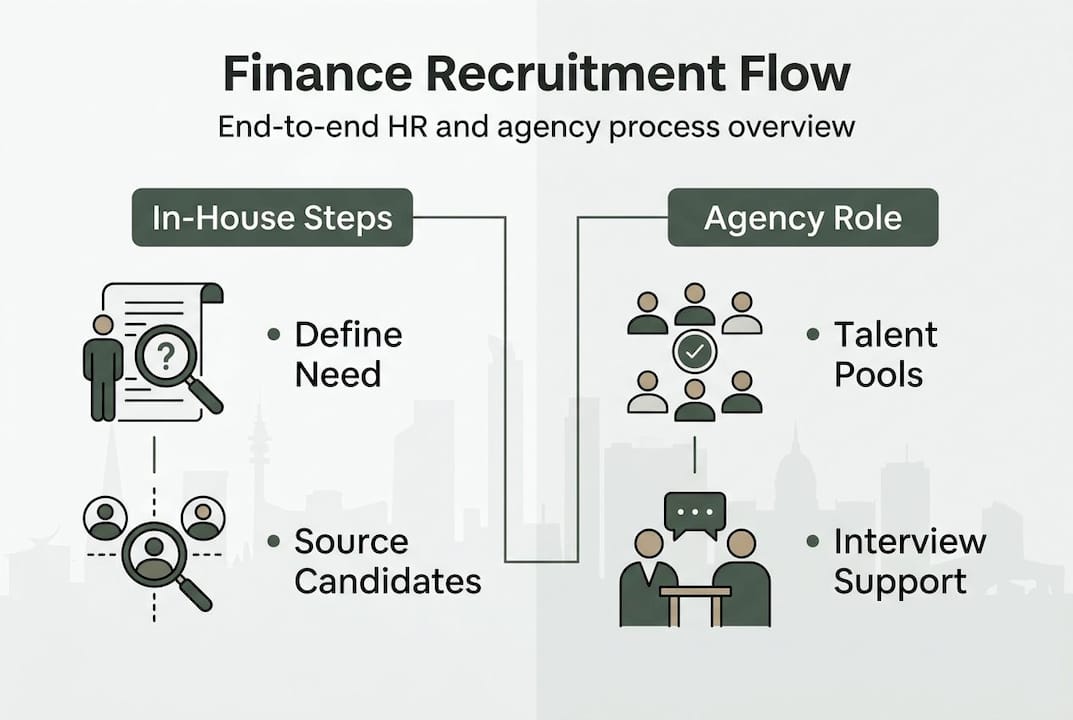
| Stage | In-house approach | Agency support |
|---|---|---|
| Defining the need | HR and finance lead | Consultative brief |
| Sourcing | Job boards, LinkedIn | Pre-vetted talent pool |
| Shortlisting | HR screens CVs | Agency delivers matched candidates |
| Interview support | Internal panel | Interview guidance and scheduling |
| Offer and onboarding | HR manages | Agency supports negotiation |
For a detailed walkthrough of the stepwise finance recruitment process tailored to Birmingham businesses, each stage has specific considerations that are worth reviewing before you begin.
Our perspective: What most guides get wrong about finance recruitment
Most articles on finance recruitment focus heavily on technical screening. Can the candidate use Xero? Do they hold ACCA? Have they managed a similar-sized ledger? These are important questions, but they are not the hardest ones.
The harder question is whether this person will still be with you in 18 months. And the answer to that has very little to do with their qualifications.
In our experience working with Birmingham SMEs, the hires that fail rarely fail because of technical gaps. They fail because of misalignment: the candidate expected more autonomy, the team expected more structure, or the business changed direction and the hire was never part of the conversation. Smaller businesses often copy the hiring frameworks of larger firms, which are built for volume and standardisation, not for the nuanced dynamics of a team of eight.
Understanding finance recruiters means recognising that the best ones are not just matching CVs to job descriptions. They are assessing fit across multiple dimensions. Speed matters, but not at the expense of that assessment. When a vacancy feels urgent, the instinct is to move faster. Often, the smarter move is to slow down at the brief stage and accelerate at the offer stage.
How IBACO supports finance recruitment in Birmingham
If this guide has clarified the complexity of finance recruitment, the next step is knowing where to get practical support.

IBACO's Birmingham finance recruitment service is built specifically for businesses like yours. We work exclusively with finance roles, which means our candidate pool, our screening process, and our market knowledge are all focused on accountants and bookkeepers in the West Midlands. There are no upfront fees, and most clients receive vetted candidate matches within two weeks. Whether you need to hire qualified accountants for a permanent role or want to understand your options before committing, IBACO's finance services are designed to make the process faster and more reliable. Get in touch to discuss your next finance hire.
Frequently asked questions
What are the main responsibilities of HR managers in finance recruitment?
HR managers lead the recruitment process from defining requirements and sourcing candidates through to shortlisting, interviewing, and supporting onboarding for finance roles. Their influence on retention outcomes is particularly significant.
How long does it typically take to hire accountant or bookkeeper roles?
The average time-to-hire in financial services is 46 days, while senior roles filled via retained search may require 8 to 14 weeks.
Why is cultural fit so important when hiring finance professionals?
Cultural fit supports long-term retention and ensures finance professionals align with company values and team dynamics, which are factors that technical screening alone cannot reliably predict.
What's the financial risk of making a poor hire in finance?
A poor hire can cost up to 213 percent of the position's annual salary when lost productivity, management time, and re-hiring costs are included.
What is a good 12-month retention target for finance roles?
Retention above 85 percent at 12 months is considered strong performance for finance hires and reflects effective recruitment and onboarding practices.