

Hiring the wrong finance professional is a surprisingly common and costly mistake for Birmingham businesses. Many owners assume a bookkeeper can handle everything from daily invoicing to filing Corporation Tax, or conversely, pay accountant rates for tasks a skilled bookkeeper could manage at a fraction of the cost. Getting this wrong creates compliance gaps, inflated fees, and operational headaches. This guide cuts through the confusion, clearly defining what each role covers, what qualifications to demand, and how to structure your finance function so that every pound you spend on staffing actually works for your business.
Table of Contents
- Clarifying finance roles: bookkeeper versus accountant
- Typical tasks and responsibilities: what each role covers
- Qualifications and professional standards: what to look for
- When to hire: assigning the right role for your needs
- Key risks and legal boundaries: avoid common hiring pitfalls
- Our perspective: what most businesses in Birmingham miss about finance hiring
- Find your next finance professional with IBACO
- Frequently asked questions
Key Takeaways
| Point | Details |
|---|---|
| Bookkeepers manage daily records | Bookkeepers focus on transactional detail, payroll, invoicing, and bank reconciliation. |
| Accountants offer strategy and compliance | Accountants handle tax, filings, high-level reporting, and business growth advice. |
| Check relevant qualifications | Verify AAT, ICB, ACCA, ACA, or CIMA credentials directly as job titles are not protected in the UK. |
| Both roles are complementary | Hiring both minimises costs and ensures finance management accuracy for Birmingham businesses. |
| Legal boundaries matter | Only registered agents or accountants should submit tax returns and give HMRC advice. |
Clarifying finance roles: bookkeeper versus accountant
These two roles are genuinely different, even though they work closely together. Think of it this way: a bookkeeper keeps the engine running day to day, while an accountant tells you whether the engine is taking you in the right direction.
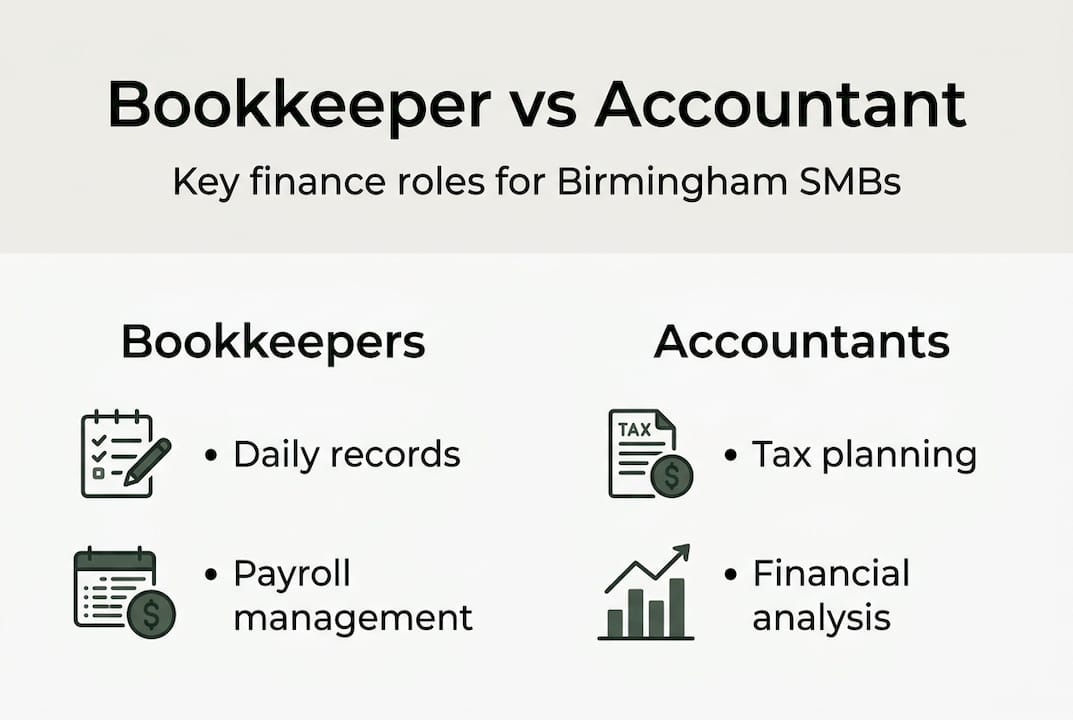
Bookkeepers focus on daily transactional recording including invoicing, bank reconciliations, expense logging, payroll, and VAT preparation, ensuring your records are accurate and up to date. This is the foundation everything else rests on. Without clean, consistent bookkeeping, an accountant is essentially guessing.
Accountants provide strategic analysis, tax planning, compliance filing such as Corporation Tax and Annual Accounts to Companies House, financial reporting, and business growth advice using the data bookkeepers produce. They translate numbers into decisions.
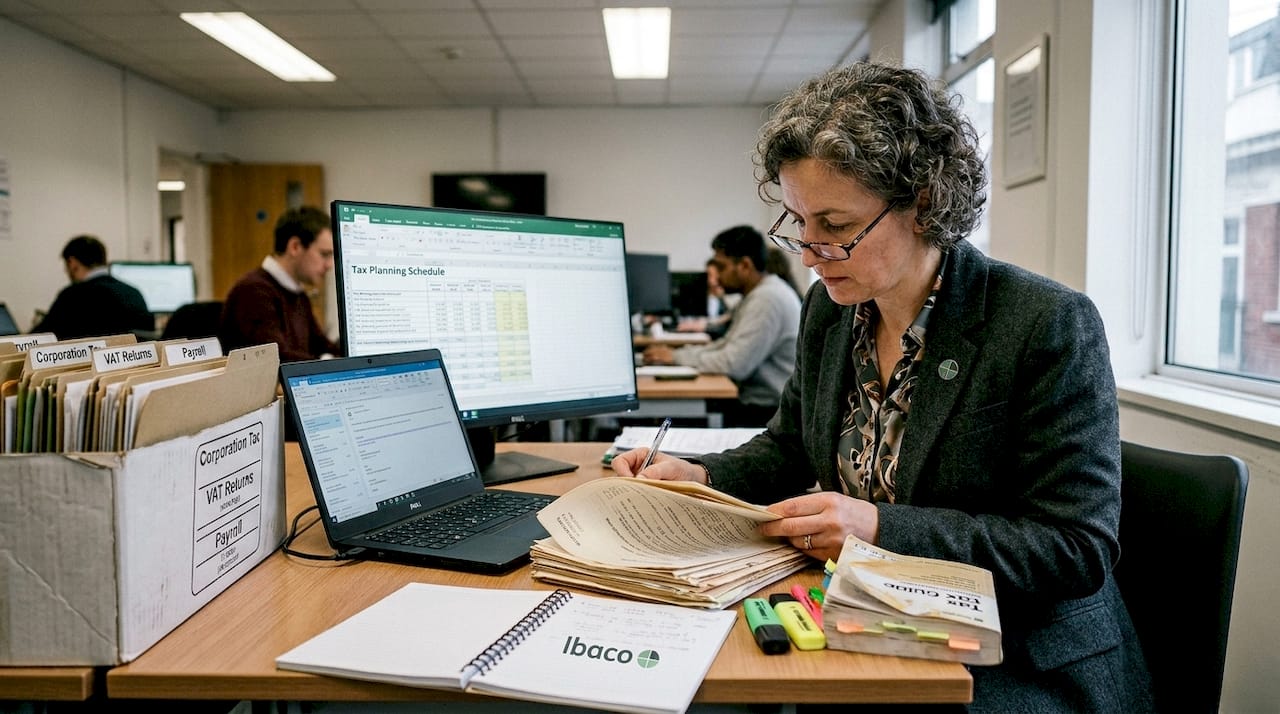
The overlap is real but manageable. Understanding the bookkeeper vs accountant distinction helps you avoid paying premium rates for routine data entry, or worse, expecting a bookkeeper to advise on tax strategy.
| Task | Bookkeeper | Accountant |
|---|---|---|
| Daily transaction recording | ✓ | ✗ |
| Bank reconciliation | ✓ | ✗ |
| Payroll processing | ✓ | ✗ |
| VAT preparation | ✓ | ✗ |
| Corporation Tax filing | ✗ | ✓ |
| Companies House submissions | ✗ | ✓ |
| Strategic financial advice | ✗ | ✓ |
| Financial reporting | ✗ | ✓ |
The role of bookkeepers in SMEs is often underestimated. A competent bookkeeper frees your accountant to focus on higher-value work, which directly reduces your accountancy bill. Meanwhile, understanding how accountants add value helps you use their expertise strategically rather than reactively. Both roles are grounded in sound corporate finance basics, but they operate at very different levels of complexity.
"A business with clean books pays less for accountancy. A business with messy books pays twice: once to fix the records, once for the advice."
Typical tasks and responsibilities: what each role covers
Having defined the core differences, here is a closer look at what each professional actually does on a practical, day-to-day basis.
What a bookkeeper typically handles:
- Processing sales and purchase invoices
- Reconciling bank statements weekly or monthly
- Running payroll and managing PAYE submissions
- Preparing and submitting VAT returns
- Logging expenses and maintaining petty cash records
- Chasing outstanding debts and managing aged creditors
What an accountant typically handles:
- Preparing and filing annual accounts with Companies House
- Submitting Corporation Tax returns to HMRC
- Providing management accounts and financial forecasts
- Advising on tax efficiency and business structure
- Supporting audits and regulatory compliance
- Offering strategic guidance during growth or acquisition
It is worth noting that bookkeepers prepare data and schedules for tax but cannot submit returns or give tax advice unless they are separately registered to do so. This is a legal boundary, not just a professional convention.
The benefits of hiring bookkeepers for Birmingham SMBs are significant. A permanent, in-house bookkeeper keeps your financial data current and accurate, meaning your accountant spends less time correcting errors and more time advising. For guidance on building a full finance team, the bookkeeper recruitment guide for 2026 is a useful starting point. Solid business documentation guidance also supports both roles in maintaining compliant, well-organised records.
Pro Tip: If your accountant regularly spends time correcting your records before they can start their actual work, that is a strong signal you need a dedicated bookkeeper.
Qualifications and professional standards: what to look for
Beyond tasks, hiring the right person depends on knowing what credentials to demand. This is where many Birmingham employers get caught out.
In the UK, neither 'accountant' nor 'bookkeeper' titles are protected. Anyone can legally call themselves an accountant or bookkeeper without formal training. This makes verification essential, not optional.
For bookkeepers, look for:
- AAT (Association of Accounting Technicians) Level 2, 3, or 4
- ICB (Institute of Certified Bookkeepers) membership
- Active membership in a recognised professional body
- Demonstrated experience with Xero, Sage, or QuickBooks
For accountants, look for:
- ACCA (Association of Chartered Certified Accountants)
- ACA (Associate Chartered Accountant, via ICAEW)
- CIMA (Chartered Institute of Management Accountants)
- Active membership and up-to-date continuing professional development
Understanding UK accounting qualifications in depth helps you ask the right questions at interview. For practical guidance on candidate evaluation, assessing bookkeeping skills and screening accounting qualifications are both worth reviewing before you begin shortlisting.
The AAT qualification is widely regarded as the benchmark for bookkeeping competency in the UK. An AAT-qualified bookkeeper has demonstrated practical skills across payroll, VAT, and financial records, not just theoretical knowledge.
Pro Tip: Always ask candidates to provide their membership number and verify it directly with the relevant professional body. Fraudulent credentials are rare but not unheard of.
When to hire: assigning the right role for your needs
Now that you know what the qualifications imply, here is how to apply this to real hiring decisions.
- Assess your transaction volume. If your business processes more than 50 invoices per month, a dedicated bookkeeper is almost certainly cost-effective.
- Identify your compliance obligations. If you are VAT-registered, run payroll, or have complex expenses, bookkeeping support is not optional.
- Map your accountancy spend. If your accountant bills you for time spent organising records, redirect that budget to a permanent bookkeeper.
- Plan for growth. As turnover increases, the complexity of your finances grows. Hire ahead of the curve rather than in response to a crisis.
- Decide on structure. Most Birmingham SMEs benefit from a permanent bookkeeper supported by a qualified accountant on a periodic or retained basis.
HR and business owners should hire bookkeepers for ongoing records to minimise accountant cleanup costs. Both roles are complementary for SMEs, not interchangeable.
For practical guidance on selecting qualified bookkeepers in Birmingham, and understanding accounting qualifications for SMEs, there are dedicated resources to support your decision. Solid business planning support can also help you forecast when additional finance resource becomes necessary.
Pro Tip: Do not wait until year-end chaos to hire. Bringing a bookkeeper on board mid-year almost always costs less than the accountancy bill for untangling a year of disorganised records.
Key risks and legal boundaries: avoid common hiring pitfalls
Choosing the right finance professional is not just about efficiency. It is also about avoiding regulatory trouble.
The legal boundaries are clear but frequently misunderstood by employers:
- A bookkeeper cannot submit Corporation Tax returns unless separately registered as a tax agent
- A bookkeeper cannot represent your business in an HMRC dispute
- A bookkeeper cannot legally provide tax planning advice without specific authorisation
- Only a regulated accountant or tax adviser can sign off on statutory accounts
- Using an unqualified person for regulated tasks exposes your business to fines and penalties
Advanced bookkeepers at AAT Level 4 or MAAT blur the lines considerably, but they still lack audit rights and the authority to provide tax advice. For HMRC disputes or complex tax planning, a qualified accountant is not a luxury. It is a legal necessity.
"Asking a bookkeeper to handle your tax affairs without the right registration is like asking a paramedic to perform surgery. The knowledge overlaps, but the authorisation does not."
For a clear breakdown of where each role begins and ends, the bookkeeper vs accountant guide covers the key distinctions in practical terms. You can also consult financial advisory services for guidance on structuring your finance function compliantly.
Our perspective: what most businesses in Birmingham miss about finance hiring
From years of placing finance professionals across the West Midlands, we have seen a consistent pattern: most SMEs overuse accountants and underuse skilled bookkeepers. It is an expensive habit.
The assumption is that a qualified accountant is the safer choice for everything finance-related. In reality, paying accountant rates for routine data entry is wasteful, and it often means your accountant is too stretched to provide the strategic input you actually need from them.
The businesses that manage their finances most effectively tend to follow a simple structure: a permanent, qualified bookkeeper handling day-to-day records, supported by a chartered accountant who reviews, advises, and files on a periodic basis. This combination delivers transparency, keeps costs predictable, and means your financial data is always ready when decisions need to be made.
Understanding how accountants genuinely add value to Birmingham SMBs makes it easier to use them well. The goal is not to choose between the two roles. It is to use both correctly.
Find your next finance professional with IBACO
Ready to take action on your next finance hire? Let IBACO simplify the process.
At IBACO, we specialise in finance recruitment in Birmingham, connecting local businesses with thoroughly vetted bookkeepers and accountants for permanent roles. Every candidate we put forward has been screened for qualifications, software proficiency, and cultural fit. Whether you need to hire accountants with ACCA or CIMA credentials, or find a reliable AAT-qualified bookkeeper, our bookkeeper and accountant recruitment service covers both. No upfront fees, no guesswork, and placements typically completed within two weeks. Talk to us about your requirements today.
Frequently asked questions
How do I verify a bookkeeper's qualifications?
Check for AAT or ICB certifications and verify membership directly with the relevant professional body using the candidate's membership number. Do not rely on a CV alone.
Can a bookkeeper submit tax returns for my company?
Only if they are also a registered tax agent. Otherwise, tax submissions and planning must be handled by a qualified accountant.
What financial tasks should I assign to bookkeepers only?
Bookkeepers should manage daily transactional recording including invoicing, payroll, expense tracking, VAT preparation, and bank reconciliations. These are their core competencies.
Why do some bookkeepers have higher-level qualifications?
Advanced bookkeepers at AAT Level 4 can handle more complex records and management accounts, but they still cannot conduct audits or provide regulated tax advice without additional registration.