

Hiring a bookkeeper in Birmingham requires more than scanning CVs for qualifications. You need to verify that candidates possess genuine UK-specific competencies, from processing journals to managing VAT returns. Many HR managers struggle to distinguish between candidates who simply list credentials and those who can deliver accurate, compliant bookkeeping. This guide walks you through a structured assessment process tailored to Birmingham's finance recruitment landscape, covering standardised tests, qualification verification, software proficiency evaluation, and result interpretation to help you make confident hiring decisions.
Table of Contents
- Key Takeaways
- Understanding UK bookkeeping qualifications and their significance
- Utilising standardised UK bookkeeping tests for skill evaluation
- Assessing software proficiency and practical bookkeeping experience
- Interpreting test results and verifying candidate capabilities
- How IBACO recruitment supports hiring qualified bookkeepers in Birmingham
- How to assess bookkeeping skills faq
Key Takeaways
| Point | Details |
|---|---|
| UK qualification checks | Verify that candidates hold recognised UK bookkeeping qualifications such as ICB, IAB and AAT and ensure certificates are current. |
| Skills testing essential | Combine credential verification with practical skills testing to obtain a complete assessment of capability. |
| Standardised tests with benchmarks | Accountests UK Bookkeeper Test provides benchmarked scoring to compare candidates against defined competency levels. |
| Software proficiency assessment | Evaluate software proficiency and practical experience through tests and samples to verify real world capability. |
| Local Birmingham relevance | Tailor assessment processes to Birmingham's market needs to reflect local hiring expectations. |
Understanding UK bookkeeping qualifications and their significance
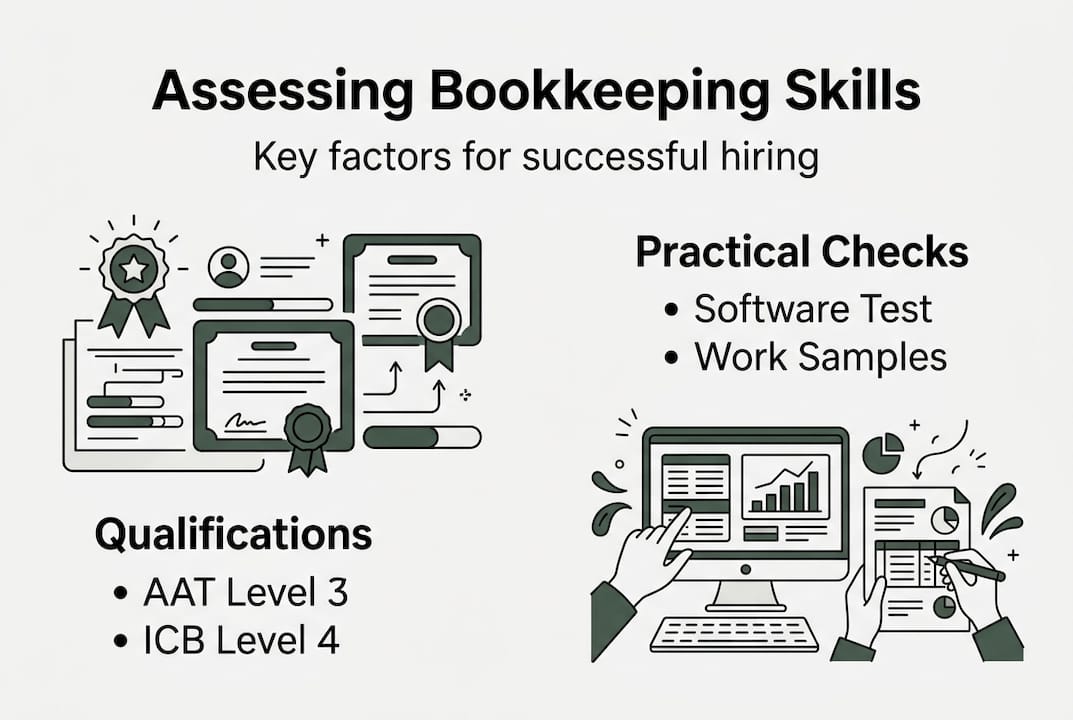
UK bookkeeping qualifications follow a clear progression that signals candidate capability. The Institute of Certified Bookkeepers (ICB) and International Association of Bookkeepers (IAB) offer Levels 1 through 4, whilst the Association of Accounting Technicians (AAT) provides Level 3 certification. Each level represents distinct competencies.
Level 1 covers basic clerical tasks like data entry and filing. Level 2 introduces double-entry bookkeeping, processing invoices, and reconciling bank statements. Level 3 candidates handle VAT returns, payroll basics, and month-end procedures. Level 4 bookkeepers manage complex transactions, prepare financial statements, and advise on compliance matters.
Employers seek Level 2+ qualifications for technical bookkeeping roles, with IAB/ICB Levels 1 to 4 and AAT Level 3 serving as standard benchmarks. Birmingham businesses typically require at least Level 2 for entry positions and Level 3 for senior bookkeeping roles. Verifying these credentials ensures candidates can handle your specific accounting requirements.
When reviewing qualifications, check that certificates are current and issued by recognised bodies. Ask candidates to explain what they learned at each level. Someone with genuine Level 3 competency should articulate VAT regulations and financial reporting processes without hesitation. This conversation reveals whether they simply passed exams or truly absorbed the material.
Qualifications alone don't guarantee performance. A candidate might hold Level 4 certification yet struggle with practical application. That's why combining credential verification with skills testing creates a complete assessment picture. Consider qualifications as your baseline filter, then validate capabilities through the testing methods outlined in subsequent sections.
For Birmingham employers, local market knowledge matters. Partnering with recruitment services in Birmingham who understand regional qualification standards streamlines your vetting process and connects you with candidates who meet West Midlands business needs.
Utilising standardised UK bookkeeping tests for skill evaluation
Standardised tests provide objective data that CVs and interviews cannot. The Accountests UK Bookkeeper Test comprises 40 questions administered over 40 minutes in a proctored environment, covering Processing & Journals, Accounting Concepts, Business Support, and Taxation & Payroll. These areas align with real-world bookkeeping responsibilities in UK businesses.
Benchmarked scoring lets you compare candidates against established competency levels. A score in the 75th percentile indicates stronger skills than three-quarters of test-takers. This percentile ranking removes guesswork from candidate comparison. You can set minimum thresholds based on role complexity: entry-level positions might require 50th percentile scores, whilst senior roles demand 80th percentile or higher.
Test results validate CV claims. A candidate listing "expert in double-entry bookkeeping" should score well in Processing & Journals. Discrepancies between stated expertise and test performance reveal skill gaps or exaggerated qualifications. This evidence-based approach protects you from costly hiring mistakes.
| Test section | Skills measured | Typical question format |
|---|---|---|
| Processing & Journals | Transaction recording, journal entries | Scenario-based calculations |
| Accounting Concepts | GAAP principles, accruals | Multiple choice theory |
| Business Support | Report generation, analysis | Interpretation questions |
| Taxation & Payroll | VAT, PAYE basics | Regulatory compliance |
Integrating tests into your recruitment process requires minimal effort. Schedule assessments after initial CV screening but before final interviews. This sequence filters candidates efficiently, ensuring you only interview those with verified skills. Most testing platforms deliver results within hours, accelerating your hiring timeline.
Pro Tip: Review detailed score breakdowns, not just total scores. A candidate might achieve an acceptable overall score whilst showing weakness in Taxation & Payroll. If VAT management is crucial for your role, that specific gap matters more than the aggregate result.
Standardised tests complement your existing evaluation methods. Use them alongside qualification checks and interviews for a comprehensive assessment framework. For additional guidance on structuring your bookkeeper recruitment process, explore our hiring guide for bookkeepers Birmingham.
Assessing software proficiency and practical bookkeeping experience
Modern bookkeeping centres on accounting software mastery. QuickBooks and Xero dominate the UK market, and candidates must demonstrate genuine proficiency beyond basic familiarity. Software skills directly impact efficiency, accuracy, and your ability to access real-time financial data.

Testing software competency requires hands-on evaluation. Simulation tests present candidates with realistic scenarios: processing supplier invoices, reconciling bank feeds, or generating VAT reports. Time-limited tasks reveal whether candidates can navigate software quickly under pressure. A bookkeeper who takes 20 minutes to reconcile a simple bank statement lacks the fluency you need.
Administering software proficiency tests and requesting work samples or hypothetical tasks checks practical bookkeeping skills beyond theoretical knowledge. Ask candidates to complete a trial task using your preferred software. Provide anonymised transaction data and request specific outputs: aged debtor reports, profit and loss summaries, or journal adjustments. Review their work for accuracy, formatting, and attention to detail.
Key software skills to evaluate include:
- Bank reconciliation speed and accuracy
- Invoice processing and payment allocation
- VAT return preparation and submission
- Financial report generation and customisation
- Multi-currency transaction handling
- Integration with payroll and inventory systems
Data entry accuracy matters as much as software navigation. Combine software tests with numerical skills assessments that measure typing speed and error rates. A candidate who enters figures quickly but makes frequent mistakes creates more problems than they solve. Look for balanced performance: reasonable speed with minimal errors.
Pro Tip: Observe how candidates troubleshoot issues during software tests. When they encounter an unfamiliar feature, do they explore systematically or give up immediately? Problem-solving ability predicts long-term success better than memorised procedures.
Work samples provide context that tests cannot. Request examples of previous work: reconciliations they've completed, reports they've generated, or process improvements they've implemented. Genuine samples show real-world application and reveal the complexity level they've handled. Be wary of generic templates that could belong to anyone.
Practical assessment shouldn't end at hiring. Consider probationary period evaluations where new bookkeepers complete supervised tasks. This ongoing verification ensures capabilities translate into consistent performance. For expert support in evaluating bookkeeping candidates, connect with accounting recruitment services Birmingham specialists who understand local software requirements.
Interpreting test results and verifying candidate capabilities
Test scores become actionable when you understand what they reveal. Total scores provide a headline figure, but topic breakdowns expose specific strengths and weaknesses. A candidate scoring 72% overall might excel at Accounting Concepts (85%) whilst struggling with Taxation & Payroll (58%). This granular view informs whether their skills match your role requirements.
Benchmark comparisons contextualise individual performance. Accountests reports provide candidate score breakdowns against benchmark percentiles, helping identify experts through practitioner-validated assessments. A 90th percentile score in Processing & Journals indicates exceptional transaction recording skills. Conversely, a 25th percentile result suggests fundamental gaps requiring additional training.
| Performance indicator | High performer signs | Red flags |
|---|---|---|
| Overall score | 80th percentile or above | Below 40th percentile |
| Topic consistency | Balanced across all sections | Large variance between topics |
| Time management | Completes within time limit | Rushes or leaves questions blank |
High performers typically demonstrate three characteristics. First, consistent scores across all test sections show well-rounded competency rather than narrow expertise. Second, they complete assessments within time limits without sacrificing accuracy. Third, their performance aligns with stated experience levels: someone claiming five years' experience should score in upper percentiles.
Common red flags include significant score variance between topics, indicating gaps in foundational knowledge. Candidates who score well on theoretical questions but poorly on practical scenarios may lack hands-on experience. Extremely fast completion times often correlate with guessing rather than careful consideration. These patterns warrant deeper investigation during interviews.
Verification extends beyond test results. Contact previous employers to confirm employment dates, responsibilities, and performance quality. Ask specific questions: "How accurately did this candidate reconcile accounts?" or "Did they require supervision for VAT submissions?" Vague references like "They were fine" provide little value.
Scenario-based interview questions complement test data. Present realistic bookkeeping challenges: "A client's bank reconciliation shows a £500 discrepancy. Walk me through your investigation process." Strong candidates articulate systematic approaches, checking recent transactions, uncleared cheques, and bank errors. Weak candidates offer generic responses lacking procedural detail.
Onboarding procedures should include fraud prevention controls. Implement segregation of duties, require dual authorisation for payments above thresholds, and schedule regular reconciliation reviews. The bookkeeper onboarding and fraud controls guide outlines essential safeguards that protect your business whilst verifying ongoing competency.
Key verification steps:
- Cross-reference test scores with qualification certificates and employment history
- Conduct scenario-based interviews that probe problem-solving approaches
- Contact references with specific performance questions
- Implement probationary assessments during the first three months
- Establish internal controls that prevent errors and detect issues early
Test results inform decisions but shouldn't dictate them exclusively. Consider the complete candidate profile: qualifications, test performance, practical demonstrations, references, and cultural fit. A candidate scoring in the 65th percentile who shows exceptional problem-solving skills and eagerness to learn might outperform a 85th percentile scorer lacking motivation.
For comprehensive support in evaluating bookkeeping candidates and accessing pre-vetted professionals, explore employer resources Birmingham bookkeeping services designed for local businesses.
How IBACO recruitment supports hiring qualified bookkeepers in Birmingham
Finding bookkeepers who meet Birmingham's specific business needs requires local market expertise and rigorous vetting processes. IBACO Recruitment specialises in connecting West Midlands businesses with qualified finance professionals who possess verified UK credentials and practical software skills.
Our understanding of finance recruitment trends Birmingham ensures you access candidates familiar with regional compliance requirements and local business practices. We pre-screen applicants using the assessment frameworks outlined in this guide, verifying qualifications, testing software proficiency, and checking references before presenting candidates to you.
Partnering with a specialised agency accelerates hiring whilst reducing risk. Instead of managing multiple assessment stages yourself, you receive pre-qualified candidates ready for final interviews. Our recruitment services in Birmingham streamline the process from initial brief to successful placement, typically within two weeks. When you need to hire qualified accountants Birmingham or bookkeepers, our local knowledge and candidate network deliver results efficiently.
How to assess bookkeeping skills faq
Which UK bookkeeping qualification is best for hiring?
AAT Level 3 and ICB/IAB Level 3 qualifications provide the strongest foundation for most bookkeeping roles. These certifications cover VAT, payroll basics, and financial statement preparation. For senior positions requiring management responsibilities, consider AAT Level 4 or candidates progressing toward ACCA qualification.
How often should I update bookkeeping skills assessments?
Reassess bookkeeping skills annually or when regulatory changes occur. Major updates to VAT rules, Making Tax Digital requirements, or accounting software platforms warrant immediate evaluation. Regular assessments ensure your team maintains current competencies and identifies training needs early.
What are effective ways to test software proficiency?
Create timed practical tasks using your actual accounting software with anonymised data. Ask candidates to reconcile bank statements, process invoices, and generate specific reports. Observe their navigation speed, accuracy, and problem-solving approach. Simulation tests reveal genuine proficiency better than self-reported skill levels.
Can test results alone guarantee candidate reliability?
Test results measure technical competency but cannot assess reliability, work ethic, or cultural fit. Combine standardised testing with reference checks, scenario-based interviews, and probationary evaluations. A comprehensive assessment approach reduces hiring risk more effectively than relying on any single metric.
Why is software proficiency testing important alongside qualifications?
Qualifications demonstrate theoretical knowledge, whilst software tests verify practical application. A candidate might understand double-entry bookkeeping principles yet struggle to execute them in QuickBooks or Xero. Testing both areas ensures candidates can perform actual job responsibilities efficiently. For expert guidance on bookkeeper assessment and hiring, visit our bookkeeper hiring guide Birmingham resource.