

Hiring the right bookkeeper can make or break compliance for Birmingham SMBs. Many local businesses struggle to identify candidates who genuinely understand UK accounting standards, leading to costly errors, regulatory headaches, and wasted recruitment time. The difference between a qualified bookkeeper and an underqualified one often determines whether your financial records meet HMRC requirements or expose you to penalties. This guide walks you through every step of selecting, evaluating, and verifying bookkeeping candidates to ensure you hire someone who brings real value and keeps your business compliant with UK regulations.
Table of Contents
- Key Takeaways
- Understanding what makes a bookkeeper qualified
- Preparing your business to hire a qualified bookkeeper
- Step-by-step hiring process to select the right bookkeeper
- Verifying qualifications and ensuring continued compliance
- How Ibaco supports Birmingham businesses with finance recruitment
- Frequently asked questions
Key Takeaways
| Point | Details |
|---|---|
| Qualification criteria | Clear criteria and understanding of bookkeeping qualifications are crucial for identifying candidates who genuinely understand UK accounting standards. |
| Verify credentials | Always verify qualifications directly with issuing bodies and cross check original certificates to prevent costly hiring mistakes. |
| Structured recruitment | Structured hiring processes reduce risks and improve compliance by using multiple evaluation steps including interviews, screening and reference checks. |
| Practical competencies | Candidates should demonstrate accuracy and attention to detail and possess proficiency in Sage, Xero or QuickBooks along with knowledge of Making Tax Digital and tax deadlines. |
Understanding what makes a bookkeeper qualified
Qualification standards separate competent bookkeepers from those who simply claim experience. For Birmingham SMBs, accounting qualifications form the foundation of reliable financial management. Recognised certifications demonstrate formal training and adherence to professional standards that protect your business.
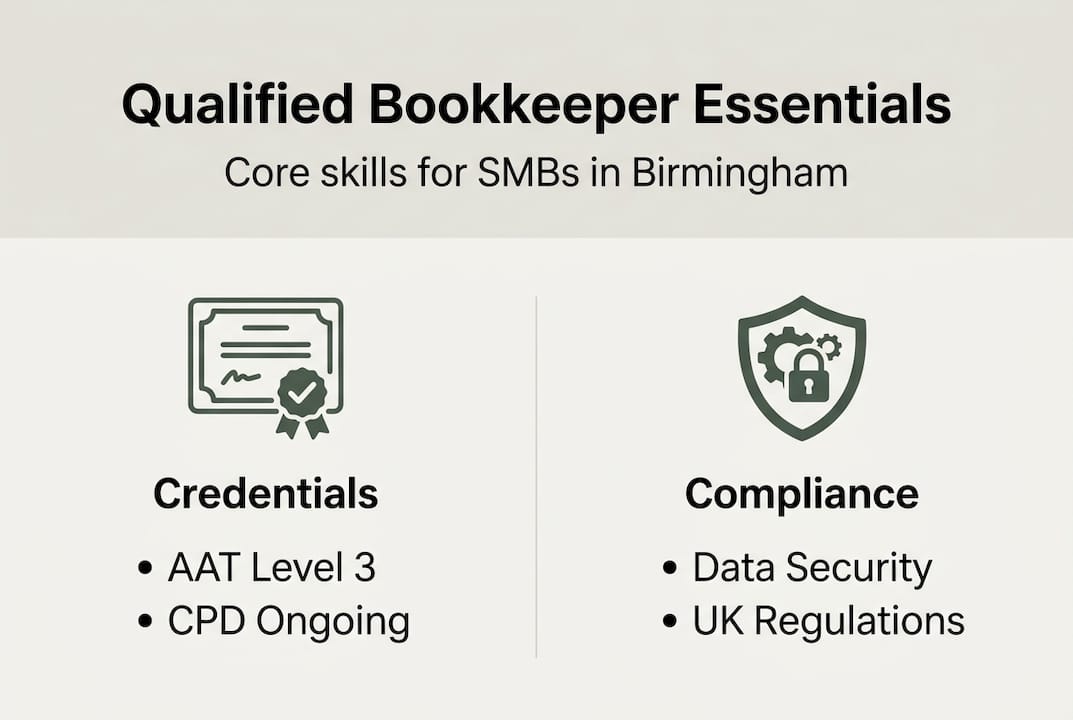
The Association of Accounting Technicians (AAT) qualification represents the gold standard for bookkeeping roles in the UK. AAT-qualified professionals understand double-entry bookkeeping, VAT returns, payroll processing, and year-end procedures specific to UK regulations. CIMA certificates and ACCA foundations also indicate strong technical grounding, though these often signal candidates aiming for higher accounting roles. For permanent bookkeeping positions, AAT Level 2 provides basic competency, whilst Level 3 or 4 candidates bring the depth most SMBs need for complex compliance tasks.
Beyond certificates, practical competencies determine day-to-day effectiveness. Your ideal candidate should demonstrate:
- Accuracy in data entry and reconciliation, with proven attention to detail
- Proficiency in accounting software commonly used by Birmingham businesses, particularly Sage, Xero, or QuickBooks
- Understanding of Making Tax Digital requirements and digital record-keeping obligations
- Knowledge of UK tax deadlines, VAT schemes, and PAYE procedures relevant to SMBs
- Strong communication skills to explain financial positions to non-finance stakeholders
Compliance knowledge extends beyond technical skills. Qualified bookkeepers must understand confidentiality obligations, ethical standards set by professional bodies, and the legal responsibilities surrounding financial record-keeping. They should recognise when situations require escalation to chartered accountants and maintain professional scepticism when reviewing transactions.
Pro Tip: Always verify qualifications directly with issuing bodies like AAT or through their online verification systems. Request original certificates during interviews and cross-reference membership numbers. Many candidates exaggerate qualification levels or claim credentials they never completed, and this verification step prevents expensive hiring mistakes that compromise your compliance position.
Continuous professional development (CPD) status reveals commitment to staying current. Qualified bookkeepers should complete annual CPD hours and demonstrate awareness of recent changes to UK accounting standards, tax legislation, and digital compliance requirements. Ask candidates about recent training and how they keep knowledge updated in a rapidly evolving regulatory environment.
Preparing your business to hire a qualified bookkeeper
Successful recruitment starts long before you post a job advert. Internal preparation determines whether you attract qualified candidates who fit your specific compliance needs and business culture. The bookkeeper recruitment guide emphasises tailoring your approach to your organisation's unique circumstances rather than using generic templates.
Your job description must reflect actual responsibilities and compliance requirements specific to your business size and sector. A manufacturing SMB needs different bookkeeping expertise than a retail operation or professional services firm. Define precisely what the role entails, including transaction volumes, reporting frequency, software systems, and interaction with external accountants or HMRC. Vague descriptions attract unsuitable applicants and waste everyone's time.
Key role requirements to specify include:
- Minimum qualification level (AAT Level 3 recommended for most SMB roles)
- Years of relevant experience in similar business environments
- Specific software proficiency required from day one
- Understanding of your industry's particular compliance challenges
- Reporting relationships and communication expectations
- Whether the role involves payroll, VAT returns, or management accounts
Budget realistic salary expectations for the Birmingham market. Qualified bookkeepers with AAT Level 3 and three years' experience typically command £25,000 to £32,000 annually in Birmingham, depending on responsibilities and sector. Offering below-market rates attracts underqualified candidates or those with limited options, whilst competitive packages draw professionals who deliver genuine value. Research current salary benchmarks through local recruitment data and professional body surveys.
Prepare your evaluation framework before applications arrive. Develop interview questions that test practical knowledge rather than theoretical recall. Create scenarios reflecting actual challenges your bookkeeper will face, such as handling a VAT inspection query or reconciling discrepancies in supplier statements. Decide which skills you will test through practical exercises versus interview discussions.

Pro Tip: Prepare a short practical test using anonymised data from your actual accounting system. Ask candidates to identify errors in a bank reconciliation or explain how they would process a complex transaction. This reveals far more about capability than any interview question and helps you assess whether they can handle your specific compliance environment effectively.
Promote your vacancy through channels where qualified professionals actively search. Professional body job boards, local finance networks, and specialist recruitment platforms reach candidates with verified credentials. Generic job sites attract volume but often lack the targeted reach needed for qualified finance roles. Consider your employer brand and what makes your business attractive to experienced bookkeepers seeking permanent positions.
Step-by-step hiring process to select the right bookkeeper
Executing a structured evaluation process separates candidates who look good on paper from those who deliver results. The assess bookkeeping skills approach combines multiple evaluation methods to build a complete picture of capability and cultural fit.
Follow this proven sequence:
- Post your vacancy with clear qualification requirements and role specifics across targeted channels
- Screen CVs against your defined criteria, immediately rejecting those lacking minimum qualifications
- Conduct phone screenings to verify basic software proficiency and availability
- Administer practical skills tests to shortlisted candidates before investing in interviews
- Hold structured interviews using scenario-based questions that reveal compliance knowledge
- Check references thoroughly, asking specific questions about accuracy, reliability, and technical competence
- Verify qualifications directly with professional bodies before making offers
- Negotiate terms and conduct final compliance checks including right-to-work verification
| Evaluation method | Strengths | Limitations | Best use |
|---|---|---|---|
| CV review | Quickly filters unqualified candidates | Easy to exaggerate or fabricate | Initial screening only |
| Practical test | Reveals actual capability with real tasks | Time-consuming to administer | Shortlist candidates |
| Scenario interviews | Assesses problem-solving and compliance thinking | Requires skilled interviewers | Final selection |
| Reference checks | Provides third-party validation of performance | References may be biased | Pre-offer verification |
Scenario-based interview questions for bookkeepers uncover how candidates apply knowledge under realistic conditions. Ask them to walk through processing a complex expense claim, explain how they would handle a supplier query about payment timing, or describe their approach to preparing for a VAT inspection. Listen for structured thinking, awareness of compliance requirements, and practical problem-solving rather than textbook answers.
Pro Tip: Present candidates with a genuine compliance dilemma you have faced, such as conflicting invoice dates or unclear expense categorisation. Strong candidates will ask clarifying questions, reference relevant regulations, and explain their reasoning process. Weak candidates will guess or provide oversimplified answers that ignore compliance implications and risk management considerations.
Reference checking requires specific questions beyond generic performance enquiries. Ask previous employers about the candidate's accuracy rate, ability to meet deadlines during peak periods, and how they handled complex compliance situations. Enquire whether they required significant supervision or worked autonomously. Confirm they left on good terms and whether the employer would rehire them if an opportunity arose.
Verifying qualifications and ensuring continued compliance
Credential verification protects your business from fraudulent claims and confirms candidates possess the expertise they advertise. The screen accounting qualifications process requires diligence but prevents expensive hiring mistakes that compromise your compliance position.
Professional bodies like AAT provide online verification systems where you can confirm membership status and qualification levels using the candidate's membership number. Request original certificates during final interviews and compare details against verification results. Check that qualifications are current and not suspended due to disciplinary issues or lapsed membership.
Ongoing compliance maintenance extends beyond the hiring decision. Establish clear expectations in employment contracts regarding:
- Maintaining professional memberships and CPD requirements
- Adhering to confidentiality and ethical standards
- Staying current with UK accounting regulation changes
- Escalating unusual transactions or compliance concerns immediately
- Participating in periodic performance reviews focused on accuracy and compliance
Schedule quarterly reviews during the first year to assess performance against compliance benchmarks. Monitor error rates in reconciliations, timeliness of statutory submissions, and quality of supporting documentation. Address issues promptly through additional training or process improvements rather than allowing problems to compound.
Pro Tip: Implement a compliance calendar that tracks all statutory deadlines, VAT return dates, payroll submissions, and year-end requirements. Review this monthly with your bookkeeper to ensure nothing falls through gaps. This simple tool dramatically reduces missed deadlines and demonstrates your commitment to maintaining high standards throughout the employment relationship.
Continuous professional development keeps skills sharp as regulations evolve. Budget for annual training courses, software updates, and professional membership fees. Encourage your bookkeeper to attend relevant seminars on Making Tax Digital changes, new reporting requirements, or industry-specific compliance updates. Investing in their development protects your business and improves retention of qualified staff.
Maintain open communication channels for resolving bookkeeping questions quickly. Regular check-ins create opportunities to discuss unclear transactions, unusual circumstances, or process improvements before they become compliance issues. Foster a culture where asking questions is valued over making assumptions that could lead to errors.
Periodic external reviews by your chartered accountant provide independent validation of bookkeeping quality. Schedule annual or semi-annual audits where your accountant samples transactions, reviews reconciliations, and confirms compliance with current standards. This catches drift before it becomes serious and reassures you that your bookkeeper maintains expected standards.
How Ibaco supports Birmingham businesses with finance recruitment
Finding qualified bookkeepers who genuinely understand Birmingham's business environment requires local expertise and deep finance sector knowledge. Ibaco Recruitment specialises exclusively in connecting West Midlands SMBs with pre-vetted finance professionals who meet rigorous qualification and experience standards.
Our streamlined process eliminates the time-consuming screening, verification, and evaluation steps that drain internal resources. We verify qualifications directly with professional bodies, assess practical skills through standardised testing, and match candidates to your specific compliance requirements and business culture. Most placements complete within two weeks, and our local market knowledge ensures you receive competitive yet realistic salary guidance. Explore current finance recruitment trends in Birmingham to understand how the market has evolved, review our comprehensive bookkeeper and accountant recruitment services tailored for SMBs, or discover how we help you hire qualified accountants who drive business success through exceptional compliance and financial management.
Frequently asked questions
What qualifications should I look for in a bookkeeper?
UK-recognised certifications like AAT Level 3 or higher represent the minimum standard for most SMB bookkeeping roles, ensuring candidates understand double-entry bookkeeping, VAT procedures, and UK compliance requirements. Beyond certificates, verify proven experience with businesses similar to yours in size and sector, plus proficiency in the specific accounting software your business uses daily. Strong candidates combine formal qualifications with practical application skills demonstrated through references and skills testing.
How can I verify a bookkeeper's compliance knowledge before hiring?
Use scenario-based interview questions that require candidates to explain how they would handle realistic compliance situations like VAT inspection queries or conflicting transaction documentation. Check references specifically about their accuracy, deadline management during peak periods, and ability to navigate complex regulatory requirements independently. Confirm professional memberships through body verification systems and review their CPD records to ensure they maintain current knowledge of evolving UK accounting standards and digital compliance obligations.
What are common mistakes to avoid during the bookkeeping hiring process?
Hiring without verifying qualifications directly with issuing bodies exposes you to fraudulent credentials and underqualified candidates who compromise compliance. Neglecting clear role definition leads to mismatched expectations and attracts unsuitable applicants who waste recruitment time and resources. Skipping thorough reference checks means missing critical performance information about accuracy, reliability, and technical competence that only previous employers can provide. Rushing the process to fill vacancies quickly often results in expensive rehiring cycles when the wrong candidate fails to meet compliance standards.
How do I maintain bookkeeping compliance after hiring?
Regular quarterly audits during the first year monitor error rates, reconciliation quality, and statutory submission timeliness to catch issues before they become serious compliance problems. Continuous training through professional development courses, software updates, and regulation change seminars keeps skills current as UK accounting requirements evolve. Clear communication channels with scheduled check-ins create opportunities to discuss unclear transactions and resolve questions promptly rather than allowing assumptions to lead to errors. Annual external reviews by your chartered accountant provide independent validation that bookkeeping standards remain consistently high and aligned with current regulatory expectations.