

Many SMEs underestimate the critical importance of accurate bookkeeping, exposing themselves to costly tax penalties, cash flow crises, and missed funding opportunities. A single bookkeeping error can cascade into regulatory non-compliance and financial instability. This guide clarifies the vital role bookkeepers play in SME financial health, demonstrating how their expertise transforms daily transaction management into strategic advantage. You'll discover how professional bookkeepers support compliance, enhance cash flow visibility, and enable informed business decisions that drive growth and stability in 2026.
Table of Contents
- What bookkeepers do: managing day-to-day financial records
- Bookkeeping methods and financial accuracy for SMEs
- Leveraging technology and expert skills to improve financial management
- The strategic impact of bookkeepers on SME financial health
- Explore finance recruitment services in Birmingham
- Frequently asked questions
Key takeaways
| Point | Details |
|---|---|
| Accurate records prevent penalties | Proper bookkeeping helps SMEs avoid tax penalties and improves funding access by 20%. |
| Cash flow management reduces stress | Bookkeepers monitor expenses and income streams, cutting financial stress by 10%. |
| Software adoption boosts efficiency | Implementing accounting software reduces manual data entry time by 25%. |
| Strategic insights drive decisions | Reliable financial reports enable better planning and informed business choices. |
What bookkeepers do: managing day-to-day financial records
Bookkeepers form the foundation of SME financial management by maintaining systematic records of every transaction. Bookkeeping is the systematic process of recording and organising a business's financial transactions, including income, expenses, and assets. This meticulous work creates the reliable data foundation that accountants later use for analysis and strategic planning.
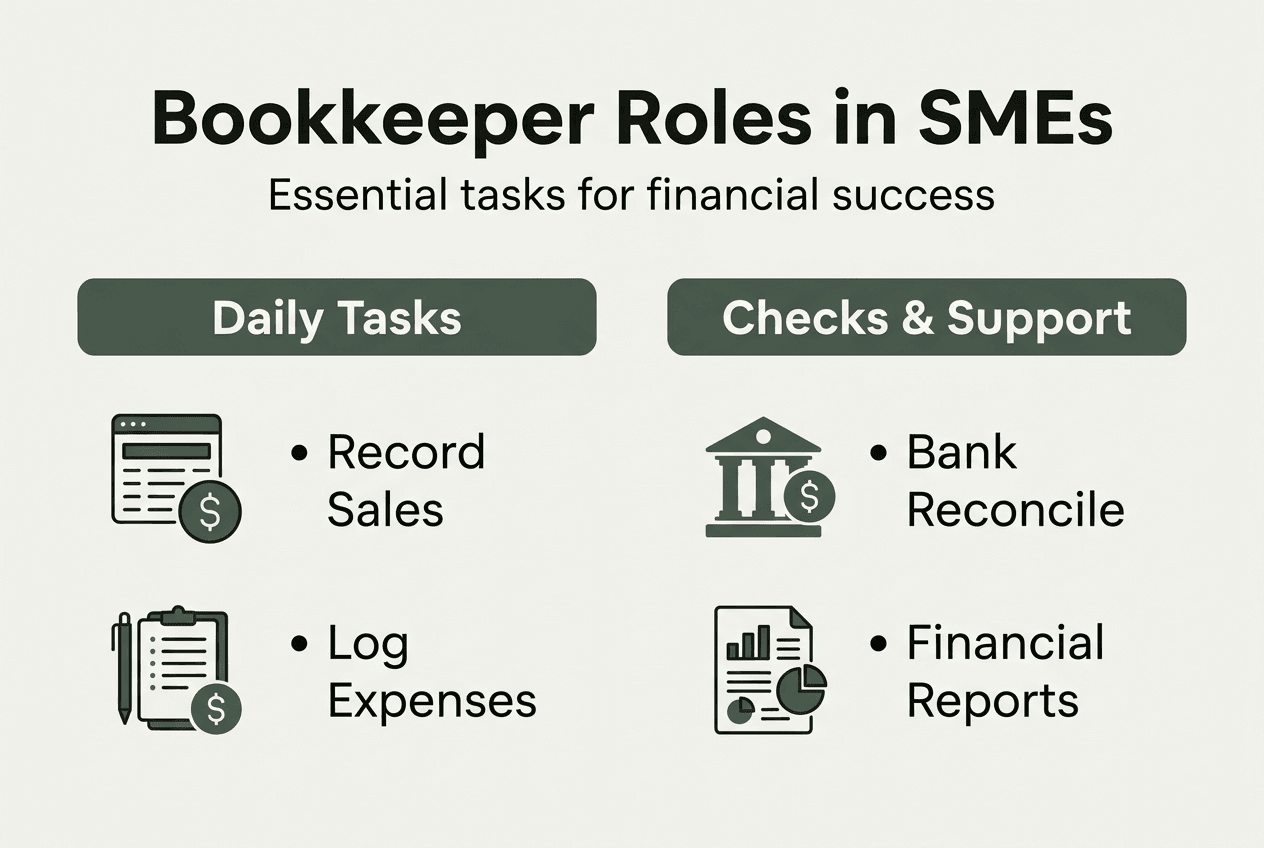
The daily responsibilities of bookkeepers centre on transaction accuracy and organisation. Bookkeepers spend time logging financial transactions such as income from selling goods or services, salary payments, and other expenses. They track every invoice issued, bill paid, and asset purchased, ensuring nothing slips through the cracks. This comprehensive logging creates an audit trail that protects SMEs during tax reviews and financial audits.
Reconciliation represents another crucial bookkeeping function that safeguards financial integrity. Bookkeepers compare recorded transactions against bank statements, credit card records, and supplier invoices to identify discrepancies immediately. This process catches errors before they compound, whether from duplicate entries, missed payments, or fraudulent activity. Regular reconciliation builds confidence in financial reports and prevents costly surprises at year end.
Understanding the distinction between bookkeeping and accounting helps SMEs appreciate each role's value. Bookkeepers focus on accurate recording and organisation of financial data, whilst accountants interpret this data to provide strategic insights and tax planning. Both roles complement each other, but bookkeepers handle the essential groundwork that makes accounting analysis possible. Learn more about these distinctions in our bookkeeper vs accountant comparison.
Successful bookkeepers bring specific qualities that elevate their work beyond simple data entry. Meticulousness ensures every transaction is recorded correctly, whilst integrity maintains confidentiality and ethical standards. Time management skills allow bookkeepers to meet deadlines for payroll, tax submissions, and financial reporting without compromising accuracy. These bookkeeper responsibilities require both technical proficiency and strong organisational abilities.
Pro Tip: Schedule bank reconciliations weekly rather than monthly to catch errors whilst transactions are fresh in memory. Daily reconciliation for high-volume businesses prevents small discrepancies from becoming major headaches and builds trust in your financial reports.
Bookkeeping methods and financial accuracy for SMEs
Choosing appropriate bookkeeping methods directly impacts financial accuracy and regulatory compliance. SMEs must understand the fundamental approaches available and how each affects their financial reporting capabilities. The right method depends on business size, transaction volume, and specific regulatory requirements in your industry.
Single-entry bookkeeping offers simplicity for very small businesses with straightforward transactions. This method records each transaction once, similar to maintaining a cheque book register. Whilst easy to understand and implement, single-entry bookkeeping provides limited financial oversight and makes error detection difficult. It works for sole traders with minimal transactions but becomes inadequate as businesses grow.
Double-entry bookkeeping provides comprehensive financial tracking by recording each transaction in two accounts, maintaining the fundamental accounting equation. Double-entry bookkeeping provides a comprehensive view of a company's financial health, reducing errors by 15%. This method creates built-in error checking because debits must always equal credits, making discrepancies immediately apparent. Most SMEs benefit from double-entry bookkeeping as it supports detailed financial analysis and regulatory compliance.

The choice between cash and accrual accounting significantly affects how SMEs report income and expenses:
| Method | When to recognise | Best for | Compliance |
|---|---|---|---|
| Cash accounting | When money changes hands | Small businesses under VAT threshold | Simpler tax reporting |
| Accrual accounting | When obligations occur | Growing SMEs, stock-based businesses | Required above VAT threshold |
| Hybrid approach | Mix based on transaction type | Transitioning businesses | Requires careful management |
Choosing between cash vs accrual accounting affects tax and financial reporting significantly. Cash accounting shows immediate cash position but may misrepresent profitability. Accrual accounting matches revenue with related expenses, providing accurate profit pictures but requiring more sophisticated tracking. Professional bookkeepers guide SMEs in selecting methods aligned with business models, growth plans, and regulatory requirements.
Accurate bookkeeping reduces financial risks that plague many SMEs. Proper record keeping helps businesses avoid tax penalties by ensuring timely, accurate submissions to HMRC. It also improves funding access because lenders and investors require reliable financial statements to assess creditworthiness. SMEs with organised books can respond quickly to funding opportunities instead of scrambling to compile historical data.
Common bookkeeping errors undermine financial accuracy and create compliance risks:
- Recording duplicate transactions that inflate expenses or revenue figures
- Miscategorising transactions that distort financial reports and tax calculations
- Failing to reconcile accounts regularly, allowing errors to compound undetected
- Mixing personal and business expenses, creating tax complications and audit risks
- Neglecting to record small cash transactions that accumulate into significant amounts
Explore our guide on bookkeeping best practices 2026 for Birmingham SMEs to implement robust financial management systems. Professional bookkeepers establish controls that prevent these errors through systematic processes, regular reviews, and appropriate use of accounting software. Their expertise in bookkeeping methods ensures SMEs maintain accurate, compliant financial records.
Leveraging technology and expert skills to improve financial management
Modern accounting software transforms bookkeeping from tedious manual work into streamlined, accurate financial management. Platforms like Xero, QuickBooks, and Sage automate repetitive tasks, reduce human error, and provide real-time financial visibility. These tools integrate with bank accounts, automatically importing transactions and categorising them based on established rules. The efficiency gains free bookkeepers to focus on analysis and strategic support rather than data entry.
Professional bookkeepers maximise software benefits through proper setup and ongoing maintenance. They audit charts of accounts to ensure transaction categories align with business operations and reporting needs. They configure bank rules that automatically categorise recurring transactions, reducing manual intervention whilst maintaining accuracy. This systematic approach prevents the chaos that occurs when businesses implement software without proper structure.
Companies using accounting software report a 25% reduction in time spent on manual data entry and a 10% improvement in reporting accuracy. These gains compound over time as businesses scale, making software adoption a strategic investment rather than an operational expense. The data quality improvements enable faster month-end closes, more frequent financial reviews, and quicker responses to emerging financial issues.
The impact of professional bookkeeping combined with appropriate technology shows measurable results:
| Metric | Manual bookkeeping | Software with professional bookkeeper | Improvement |
|---|---|---|---|
| Time on data entry | 15 hours/month | 11 hours/month | 25% reduction |
| Reporting accuracy | 85% | 94% | 10% improvement |
| Month-end close time | 10 days | 5 days | 50% faster |
| Error detection speed | 30 days | 3 days | 90% faster |
Qualified bookkeepers bring essential skills that technology alone cannot replicate:
- Attention to detail that catches anomalies automated systems might miss
- Numerical aptitude for quickly identifying calculation errors or unusual patterns
- Software proficiency across multiple platforms to adapt as businesses change systems
- Analytical thinking to interpret data trends and flag issues requiring management attention
- Communication skills to explain financial positions clearly to non-financial stakeholders
Outsourced bookkeeping teams use systematic approaches to maintain accuracy, including locking periods and reconciliation schedules. They implement controls like period locks that prevent accidental changes to closed months, maintaining audit trail integrity. Regular reconciliation schedules ensure discrepancies are caught and resolved promptly, preventing error accumulation that undermines financial confidence.
Pro Tip: Never delete transactions in accounting software, even obvious errors. Use the 'Remove and Redo' or reversal functions to maintain complete audit trails. This practice protects you during tax reviews and helps track down discrepancies when reconciling accounts months later.
Our bookkeeper recruitment guide 2026 helps Birmingham SMEs identify candidates with the right mix of technical and software skills. The combination of human expertise and technological efficiency creates financial management systems that scale with business growth whilst maintaining accuracy and compliance. Understanding Xero bookkeeping mistakes helps businesses avoid common pitfalls during software implementation.
The strategic impact of bookkeepers on SME financial health
Accurate bookkeeping extends far beyond transaction recording to enable strategic business decisions and sustainable growth. The financial clarity that professional bookkeepers provide transforms how SMEs operate, plan, and respond to opportunities. This strategic value often remains invisible until businesses experience the consequences of poor financial management.
The strategic benefits of professional bookkeeping create measurable business advantages:
- Tax compliance improves dramatically, with businesses with accurate bookkeeping being 30% more likely to avoid tax penalties through timely, accurate submissions to HMRC.
- Funding access increases as lenders and investors gain confidence in reliable financial statements, with well-maintained books improving approval rates by 20%.
- Financial insights emerge from organised data, revealing profit patterns, expense trends, and cash flow cycles that inform pricing and investment decisions.
- Stress reduction occurs when business owners trust their financial position, with businesses that actively manage cash flow seeing 15% higher operational efficiency and 10% less financial stress.
- Strategic planning becomes possible when accurate historical data reveals seasonal patterns, growth trends, and financial capacity for expansion.
Bookkeepers' reports provide the foundation for informed decision making across all business areas. Monthly financial statements reveal whether pricing strategies generate adequate margins. Cash flow projections identify periods requiring additional working capital before crises emerge. Expense analysis highlights cost-saving opportunities and inefficient spending patterns. This visibility transforms reactive management into proactive strategy.
Bookkeepers ensure accurate financial record-keeping, which is essential for SMEs to make informed decisions and comply with tax regulations, creating the foundation for sustainable business growth and financial stability.
The relationship between bookkeepers and accountants illustrates how different financial roles complement each other strategically. Bookkeepers maintain the daily records and produce financial statements that accountants then analyse for strategic insights. Accountants use bookkeepers' work to identify tax planning opportunities, assess business performance against industry benchmarks, and recommend strategic adjustments. Both roles prove essential, but bookkeepers provide the data foundation that makes accounting analysis possible.
Understanding this distinction helps SMEs build appropriate finance teams. Small businesses might start with a bookkeeper handling daily transactions and use an accountant quarterly for strategic review and tax planning. Growing businesses often employ both roles, with bookkeepers managing ongoing records whilst accountants focus on analysis, forecasting, and strategic advisory. This division of labour ensures both operational accuracy and strategic insight without role confusion or duplicated effort.
Birmingham SMEs seeking to strengthen their finance teams can explore our guide on how to hire qualified bookkeepers Birmingham 2026 for local market insights. Professional bookkeepers transform financial management from a compliance burden into a strategic asset. Their work enables the financial clarity that separates thriving SMEs from those struggling with cash flow crises and regulatory problems. The benefits of bookkeepers extend throughout organisations, supporting better decisions at every level.
Explore finance recruitment services in Birmingham
Building a strong finance team starts with finding qualified professionals who understand your business needs and local market dynamics. IBACO Pro specialises in connecting Birmingham SMEs with experienced bookkeepers and accountants who bring the skills and qualifications your business requires. Our deep knowledge of the West Midlands market and UK accounting standards ensures candidates match your specific requirements, from software proficiency to industry experience.

Our streamlined recruitment process delivers vetted candidates quickly, often within two weeks, so you can strengthen your finance function without lengthy hiring delays. We understand the qualifications that matter, from AAT credentials to experience with Xero, Sage, and QuickBooks. Whether you need a part-time bookkeeper or a full finance team, our bookkeeper and accountant recruitment services provide transparent, efficient hiring support tailored to Birmingham businesses.
Explore current finance recruitment trends Birmingham to understand the local talent market and salary expectations for 2026. Our expertise helps you hire qualified accountants Birmingham who complement your bookkeeping team, creating comprehensive financial management capability. Let us help you build the finance team that drives your business success.
Frequently asked questions
What qualifications should a bookkeeper in Birmingham have?
Bookkeepers typically hold qualifications from recognised bodies like AAT (Association of Accounting Technicians), demonstrating their understanding of accounting principles and practices. Practical experience using accounting software such as Xero, Sage, or QuickBooks proves equally important, as these tools form the backbone of modern bookkeeping. Employing qualified bookkeepers Birmingham ensures compliance with UK accounting standards and accurate financial management.
How do bookkeepers differ from accountants in SMEs?
Bookkeepers manage daily financial records, including transaction logging, reconciliation, and basic financial reporting. Accountants focus on analysis, strategy, tax planning, and interpreting financial data to provide business insights. Both roles complement each other but differ significantly in scope and expertise. Understanding the difference between bookkeepers and accountants helps SMEs build appropriate finance teams with clear role definitions.
What bookkeeping software is recommended for SMEs?
Xero, QuickBooks, and Sage are commonly recommended for SMEs due to their ease of use, bank integration, and comprehensive reporting capabilities. These platforms automate transaction imports, categorisation, and reconciliation whilst maintaining audit trails. Professional bookkeepers help implement and audit these systems to prevent errors and maximise efficiency. Our bookkeeping software recommendations guide includes setup best practices for Birmingham businesses.
How often should SMEs reconcile their accounts?
Weekly reconciliation works well for most SMEs, catching errors whilst transactions remain fresh and preventing small discrepancies from compounding. High-volume businesses benefit from daily reconciliation to maintain accurate cash positions and quickly identify fraudulent activity. Monthly reconciliation represents the minimum frequency, though this increases error detection time and complicates corrections. Regular reconciliation builds confidence in financial reports and supports better decision making.