

Hiring qualified accountants and bookkeepers requires more than reviewing CVs and trusting certificates at face value. UK accounting qualifications vary widely in level, scope, and relevance to different roles, making verification essential to avoid costly mis-hires. Without structured screening processes, businesses risk employing candidates whose credentials don't match their claimed expertise or role requirements. This guide provides HR managers and business owners in the West Midlands with clear, practical steps to verify qualifications, assess experience, and evaluate soft skills effectively. You'll learn how to distinguish between entry-level and chartered qualifications, prepare comprehensive screening criteria, execute verification processes, and avoid common pitfalls that lead to recruitment failures.
Table of Contents
- Key Takeaways
- Understanding essential accounting qualifications in the UK
- Preparing to screen accounting candidates effectively
- Step-by-step guide to screening accounting qualifications and experience
- Verifying screening outcomes and avoiding common pitfalls
- Find expert accounting recruitment support in Birmingham
- How to screen accounting qualifications FAQ
Key Takeaways
| Point | Details |
|---|---|
| Balanced screening approach | Effective screening combines verification of qualifications with assessment of practical experience and soft skills to ensure candidates can deliver real value. |
| Structured verification reduces hiring risk | Structured verification reduces hiring risk by 30 to 50 per cent. |
| Key UK qualifications | Understanding AAT, ACCA, ACA, CIMA and CIPFA helps match candidates to role requirements. |
| Stepwise screening process | Using structured steps with professional judgement streamlines screening whilst maintaining rigour. |
Understanding essential accounting qualifications in the UK
The UK accounting profession offers several qualification pathways, each suited to different career levels and specialisations. Knowing these qualifications helps you set realistic expectations and match candidates to your business needs accurately.
The Association of Accounting Technicians (AAT) provides entry to intermediate level qualifications ideal for bookkeeping and accounts assistant roles. AAT-qualified candidates typically handle day-to-day financial transactions, payroll processing, and basic reporting. The Association of Chartered Certified Accountants (ACCA) offers a globally recognised chartered qualification suited to management accounting, financial reporting, and audit roles. ACCA members demonstrate comprehensive knowledge across taxation, corporate finance, and international standards. The Institute of Chartered Accountants in England and Wales (ICAEW) awards the ACA qualification, which requires 450 days practical experience alongside rigorous examinations. ACA-qualified accountants excel in audit, assurance, and advisory services. The Chartered Institute of Management Accountants (CIMA) focuses on strategic management accounting, making CIMA members valuable for businesses needing financial planning, analysis, and decision support. The Chartered Institute of Public Finance and Accountancy (CIPFA) specialises in public sector accounting, relevant if you work with government contracts or public services.
| Qualification | Level | Typical experience | Best suited for |
|---|---|---|---|
| AAT | Entry to intermediate | 1-3 years | Bookkeeping, accounts assistants |
| ACCA | Chartered | 3-5 years | Management accounting, financial reporting |
| ACA | Chartered | 3-5 years | Audit, assurance, advisory |
| CIMA | Chartered | 3-5 years | Strategic management accounting |
| CIPFA | Chartered | 3-5 years | Public sector finance |
Recognising the distinction between entry-level and chartered qualifications prevents mismatched expectations. Entry-level qualifications validate foundational knowledge and practical skills for routine tasks. Chartered qualifications demonstrate advanced expertise, professional judgement, and the ability to handle complex financial challenges. Each certificate validates specific competencies, from technical accounting standards to ethical decision-making and strategic thinking. Understanding what each qualification represents helps you assess whether candidates possess the depth of knowledge your role demands.
Pro Tip: Combine qualification checks with probing candidates about their practical application and ethical reasoning. Ask how they've applied technical knowledge to solve real business problems or handled ethical dilemmas. This reveals whether they can translate credentials into workplace value and demonstrates their professional maturity beyond certificates alone.
For detailed comparisons of UK accounting qualifications explained recruitment 2026 and guidance on accounting qualifications birmingham smb hiring 2026, explore these resources to deepen your understanding of qualification pathways and their relevance to Birmingham businesses.
Preparing to screen accounting candidates effectively
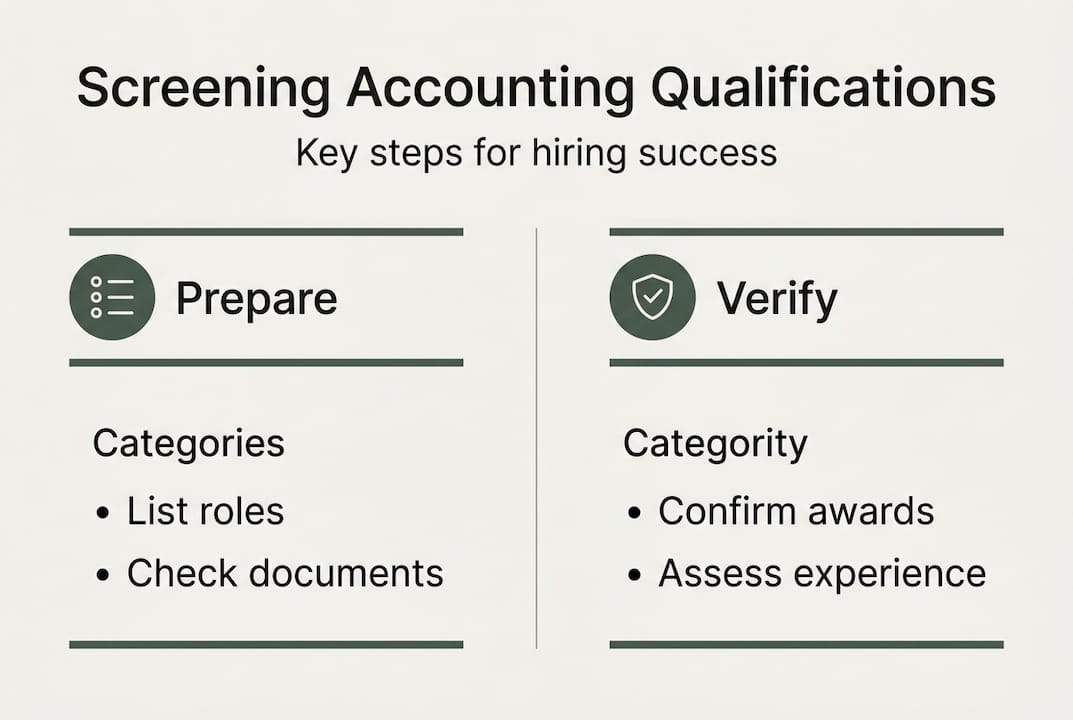
Effective screening begins before you meet candidates. Preparation ensures consistency, reduces bias, and helps you gather the right evidence to make informed hiring decisions.
Define role-specific qualification and experience requirements clearly before screening. Document the minimum qualifications, preferred certifications, and essential experience levels for your vacancy. Specify whether you need AAT for bookkeeping or ACCA for management accounting roles. Clarify experience requirements such as software proficiency in Xero, Sage, or QuickBooks, and industry-specific knowledge relevant to your sector. Clear criteria prevent scope creep and keep screening focused on genuine role needs.
Collect original or certified qualification documents to verify authenticity. Request candidates provide certificates, transcripts, or membership confirmation from professional bodies. Original documents allow you to check security features, whilst certified copies from awarding bodies confirm legitimacy. Never rely solely on photocopies or digital images without verification, as these can be easily manipulated.

Use checklists and standardised verification forms to ensure consistency across all candidates. Create a screening checklist covering qualification verification, experience assessment, and soft skill evaluation. Standardised forms help you compare candidates objectively and document your decision-making process for compliance and audit purposes. Consistency reduces the risk of overlooking critical information or applying different standards to different candidates.
Plan to assess practical work experience quantitatively. For ACA candidates, confirm they've completed the required 450 days of practical experience in relevant roles. For other qualifications, verify experience aligns with the level and scope of certification claimed. Quantitative assessment prevents candidates from overstating their experience and ensures they've gained sufficient hands-on exposure to apply their knowledge effectively.
Include soft skill assessments focused on ethics and analytical ability. Technical qualifications alone don't guarantee workplace success. Assess candidates' communication skills, problem-solving approaches, and ethical reasoning through structured interviews or scenario-based questions. Soft skills determine how well candidates collaborate, handle pressure, and maintain professional standards in challenging situations.
Follow these pre-screening documentation and criteria checklist steps:
- Document minimum and preferred qualifications for the role clearly.
- List required experience levels, software skills, and industry knowledge.
- Request original or certified qualification certificates from candidates.
- Prepare standardised verification forms and screening checklists.
- Plan structured interview questions to assess soft skills and ethical reasoning.
- Schedule time to cross-check certificates with awarding bodies or official registers.
These preparation steps create a foundation for rigorous, consistent screening that reduces mis-hire risk by 30% to 50% through structured processes. Learn more about comprehensive screening approaches in our bookkeeper recruitment guide 2026 hire finance professionals and accountant recruitment process birmingham 2026 resources.
Step-by-step guide to screening accounting qualifications and experience
Executing a systematic screening process ensures you verify credentials thoroughly whilst assessing candidates' practical abilities and professional behaviours. Follow these steps to screen accounting qualifications and experience effectively.
-
Verify qualification certificates with awarding bodies or official registers. Contact the ICAEW, ACCA, CIMA, or AAT directly to confirm membership status and qualification completion dates. Most professional bodies maintain online member directories or verification services. Cross-checking prevents fraudulent claims and confirms candidates hold current, valid qualifications. Request candidates provide their membership numbers to expedite verification.
-
Evaluate practical experience quantitatively. For ACA candidates, confirm they've completed 450 days practical experience in relevant accounting roles. Review employment history to ensure experience aligns with qualification requirements. Ask candidates to describe specific projects, responsibilities, and outcomes from their practical training. Quantitative assessment reveals whether candidates have sufficient hands-on exposure to apply technical knowledge effectively in your business context.
-
Assess analytical, ethical, and communication skills via structured interviews or assessments. Use behavioural interview questions to explore how candidates approach complex problems, handle ethical dilemmas, and communicate financial information to non-financial stakeholders. Scenario-based questions reveal their thought processes and professional judgement. Evaluate their ability to explain technical concepts clearly, listen actively, and collaborate with colleagues. Soft skills determine whether candidates can translate qualifications into workplace value and maintain professional standards under pressure.
-
Compare candidate profiles considering qualification levels, experience, and soft skills. Use your standardised screening forms to score candidates objectively across all criteria. Balance technical credentials with practical experience and interpersonal abilities. Consider cultural fit, career aspirations, and alignment with your business values. Comprehensive comparison prevents over-weighting qualifications at the expense of other critical success factors.
| Screening method | Merits | Limitations |
|---|---|---|
| Document verification | Confirms authenticity, prevents fraud | Doesn't assess practical application |
| Experience assessment | Reveals hands-on competence | Can be subjective without clear metrics |
| Structured interviews | Evaluates soft skills and judgement | Time-intensive, requires skilled interviewers |
| Reference checks | Provides third-party validation | May be biased or incomplete |
Pro Tip: Avoid common mistakes like overvaluing certificates without assessing real-world application. A candidate with an ACCA qualification but limited practical experience may struggle more than an AAT-qualified candidate with five years of hands-on bookkeeping. Balance credentials with demonstrated competence and soft skills to identify candidates who can deliver results from day one.
For role-specific screening guidance, explore accounting qualifications birmingham smb hiring 2026 and accounting roles birmingham businesses 2026 to understand how qualifications map to different finance positions in West Midlands businesses.
Verifying screening outcomes and avoiding common pitfalls
Confirming the reliability of your screening results and learning from common mistakes improves hiring decisions and reduces future mis-hires. Verification and continuous improvement are essential for long-term recruitment success.
Confirm authenticity by cross-checking official credit registers or databases maintained by professional bodies. The ICAEW, ACCA, CIMA, and AAT all provide member verification services online or via telephone. Cross-checking ensures certificates are genuine and membership remains current. Some candidates may hold lapsed memberships or incomplete qualifications, which cross-checking reveals immediately.
Beware of falsified documents and request direct confirmation from professional bodies when in doubt. Fraudulent certificates can appear convincing, especially high-quality forgeries. If you suspect falsification, contact the awarding body directly with the candidate's details and request confirmation. Never proceed with hiring until you've verified credentials through official channels.
Common pitfalls include relying solely on qualifications without experience or soft skill checks. Certificates prove technical knowledge but don't guarantee workplace competence or professional behaviour. Over-reliance on credentials leads to hiring candidates who struggle with practical application, communication, or ethical decision-making. Balance qualification verification with experience assessment and soft skill evaluation to avoid this trap.
Track mis-hire incidents and use feedback to refine screening procedures. Document cases where hired candidates underperformed or misrepresented credentials. Analyse what screening steps failed to detect issues and adjust your processes accordingly. Continuous improvement based on real outcomes strengthens your screening effectiveness over time.
Avoid these pitfalls and mitigate risks:
- Accepting photocopied certificates without verification: Always request originals or certified copies and cross-check with awarding bodies.
- Overlooking practical experience requirements: Confirm candidates meet quantitative experience thresholds like 450 days for ACA.
- Ignoring soft skills and ethical reasoning: Use structured interviews to assess communication, problem-solving, and professional judgement.
- Failing to check membership currency: Verify qualifications remain current and candidates maintain continuing professional development.
- Rushing screening due to time pressure: Allocate sufficient time for thorough verification to prevent costly hiring mistakes.
Pro Tip: Use specialised recruitment agencies for complex screening challenges. Agencies with finance sector expertise handle verification, experience assessment, and soft skill evaluation on your behalf. They maintain relationships with professional bodies and access verification tools that streamline the process. Partnering with specialists reduces your administrative burden whilst ensuring rigorous screening standards.
Structured verification processes reduce mis-hire risk by 30% to 50%, making systematic screening an investment that pays dividends through better hiring outcomes and reduced turnover costs.
For additional support navigating finance recruitment complexities, explore understanding finance recruiters birmingham businesses to learn how specialist agencies enhance screening effectiveness and hiring success.
Find expert accounting recruitment support in Birmingham
Screening accounting qualifications thoroughly requires time, expertise, and access to verification resources. IBACO Recruitment specialises in finance recruitment birmingham, offering West Midlands businesses expert support to hire qualified accountants and bookkeepers with confidence. Our team understands UK accounting standards, qualifications like AAT, ACCA, and CIMA, and the practical experience required for different finance roles.
We handle qualification verification, experience assessment, and soft skill evaluation on your behalf, delivering thoroughly vetted candidates matched to your specific requirements. Our bookkeeper and accountant recruitment services streamline hiring, reducing time-to-hire whilst maintaining rigorous screening standards. With deep local knowledge of Birmingham and West Midlands markets, we connect you with finance professionals who understand regional business needs and can deliver immediate value. Contact IBACO today to simplify your accounting recruitment and access the latest insights into Birmingham's finance talent landscape.
How to screen accounting qualifications FAQ
What are the most recognised UK accounting qualifications for hiring?
The most recognised UK accounting qualifications are AAT for entry to intermediate roles, ACCA and ACA for chartered accountants, CIMA for management accountants, and CIPFA for public sector finance. AAT suits bookkeeping and accounts assistant positions, whilst ACCA, ACA, and CIMA qualify candidates for senior financial management, audit, and strategic advisory roles.
How can I verify if an accounting qualification is genuine?
Verify accounting qualifications by contacting the awarding body directly using their official member verification services. Request the candidate's membership number and qualification completion date, then cross-check with ICAEW, ACCA, CIMA, or AAT registers. Always request original or certified certificates and confirm membership remains current.
Should I prioritise practical experience over certifications?
Balance certifications with practical experience rather than prioritising one over the other. Qualifications prove technical knowledge, but practical experience demonstrates the ability to apply that knowledge effectively. For roles requiring strategic thinking or complex problem-solving, prioritise candidates with both relevant qualifications and substantial hands-on experience.
What soft skills are important when screening accounting candidates?
Critical soft skills for accounting candidates include analytical thinking, ethical reasoning, clear communication, attention to detail, and problem-solving ability. Assess how candidates explain technical concepts to non-financial stakeholders, handle ethical dilemmas, and collaborate with colleagues. These skills determine whether candidates can translate qualifications into workplace value.
Can recruitment agencies help with screening and verification?
Specialised recruitment agencies streamline screening and verification by handling qualification checks, experience assessment, and soft skill evaluation on your behalf. Agencies with finance sector expertise maintain relationships with professional bodies and access verification tools that expedite the process. Partnering with agencies reduces your administrative burden whilst ensuring rigorous screening standards and faster hiring outcomes.