

TL;DR:
- Proper vetting of accountants is essential to prevent compliance risks and protect business reputation.
- Verifying qualifications, ongoing CPD, professional indemnity insurance, and practice experience is crucial.
- Using specialist recruitment agencies can streamline verification and improve hiring confidence in Birmingham's competitive market.
Hiring the wrong accountant for a permanent role can quietly unravel your business. Compliance failures, incorrect filings, and reputational damage are not abstract risks — they are the real consequences of skipping a proper vetting process. Birmingham businesses face a particularly competitive hiring landscape, where the label "accountant" carries no legal protection and anyone can use it without formal qualifications. This guide walks you through exactly what to check, what to ask, and how to make a confident, evidence-backed hiring decision that protects your business for the long term.
Table of Contents
- What you need before starting the vetting process
- Step-by-step vetting process for accountants
- Birmingham-specific considerations and local vetting tactics
- Compliance, red flags and common mistakes when vetting
- Why rigorous vetting matters now more than ever
- How Ibaco Recruitment can help vet your next accountant
- Frequently asked questions
Key Takeaways
| Point | Details |
|---|---|
| Verify core qualifications | Always check candidates’ memberships with bodies like ICAEW, ACCA, or CIMA using official registers. |
| Assess compliance and insurance | Require up-to-date professional indemnity insurance and proof of compliance with UK accounting standards. |
| Use trusted Birmingham recruiters | Local agencies pre-screen for the right qualifications and sector experience, saving you time and risk. |
| Watch for red flags | Avoid candidates with unverifiable credentials, manual-only processes, or consistently poor feedback. |
What you need before starting the vetting process
Before you review a single CV, you need to be clear on what you are actually hiring for. Rushing into candidate assessment without a defined brief is one of the most common and costly mistakes Birmingham employers make.
Start by identifying the specific qualifications your role requires. For most SME accounting positions, you will be looking at candidates holding key practice qualifications such as ACA, ACCA, CIMA, or AAT. Each qualification reflects a different level of specialism and experience. ACA and ACCA are chartered designations suited to complex accounts and audit work, while AAT is an excellent foundation for bookkeeping and transactional finance roles.
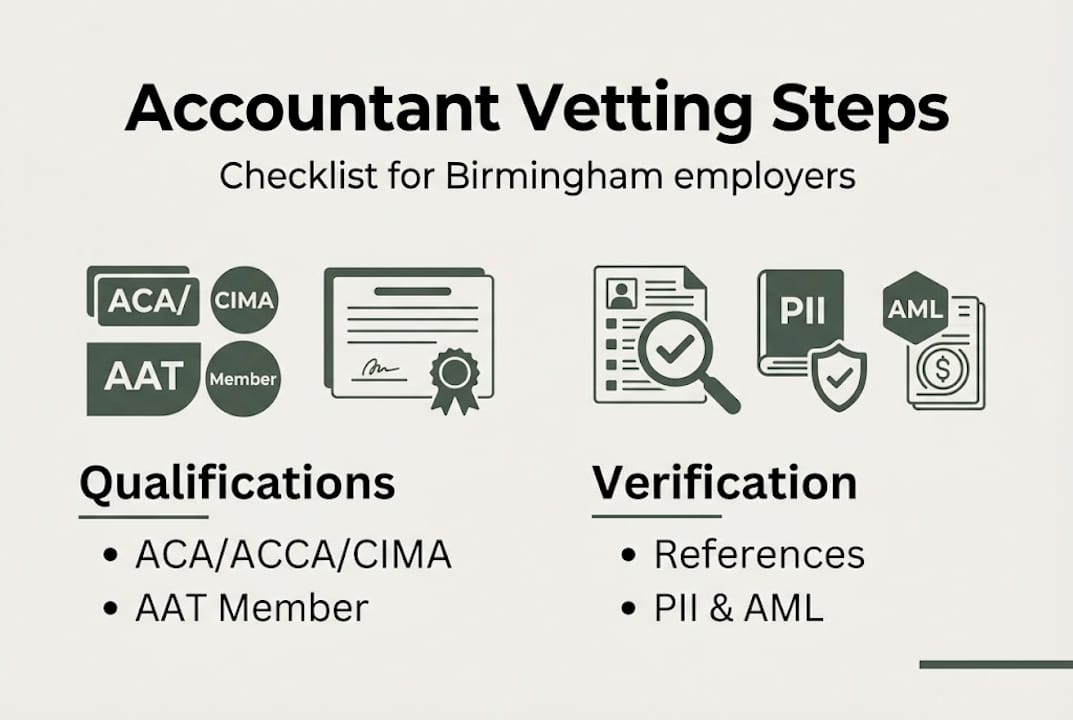
You should also confirm that any candidate you consider is listed on a public membership register. As ICAEW hiring guidance makes clear, verifying qualifications from recognised UK bodies such as ICAEW, ACCA, and CIMA via their public registers is a non-negotiable first step.
Before you open the role, gather the following:
- Required qualifications: ACA, ACCA, CIMA, or AAT depending on role complexity
- Scope of work: tax, payroll, management accounts, audit, or a combination
- Software requirements: MTD-compatible tools such as Xero, Sage, or QuickBooks
- Budget and fee structure: fixed salary vs contract, and any benefits package
- Sector-specific compliance: for example, construction CIS, retail VAT, or charity SORP
- Professional indemnity insurance (PII): confirm this is in place before shortlisting
| Preparation area | What to confirm |
|---|---|
| Qualifications | ACA, ACCA, CIMA, or AAT membership verified |
| Insurance | Active PII policy in place |
| Software | Familiarity with MTD-compatible platforms |
| Budget | Salary benchmarked to Birmingham market rates |
| Compliance scope | Sector-specific regulatory requirements identified |
Pro Tip: Shortlist candidates with direct UK practice experience rather than those who have only worked in-house. Practice-trained accountants tend to have broader technical exposure and a stronger understanding of HMRC requirements.
Step-by-step vetting process for accountants
With your brief in place, you can move into a structured vetting process. This is where most businesses either succeed or lose time to poor hires.
- Confirm chartered status. Check the candidate's membership number against the ICAEW, ACCA, or CIMA register. This takes minutes and removes any ambiguity about their credentials.
- Review PII and CPD records. Ask for written confirmation of their professional indemnity insurance and evidence of recent continuing professional development. Both signal an active, compliant professional.
- Check references and reviews. Client reviews and references on platforms such as Google and Trustpilot, combined with direct reference calls, give you a rounded picture of real-world performance.
- Evaluate practical skills. Test sector knowledge, software proficiency, and the ability to communicate financial information clearly. A technically strong candidate who cannot explain a P&L to a non-finance director is a poor fit for most SME environments.
- Compare fee and service scope. As guidance on choosing an accountant confirms, fee structure and services included, along with communication expectations and technology use, should all be discussed explicitly before any offer is made.
- Assess overall business fit. Consider your company's size, complexity, and growth trajectory. An accountant experienced in large corporate environments may not suit a 20-person Birmingham SME with lean processes.
| Vetting factor | Fixed-fee candidate | Hourly-rate candidate |
|---|---|---|
| Cost predictability | High | Variable |
| Scope clarity | Clear from outset | Can expand unexpectedly |
| Best suited to | Ongoing permanent roles | Project-based or interim work |
For permanent roles, specialists in hiring accountants in Birmingham note that the benefits of accredited accountants extend well beyond technical competence — they include regulatory confidence and reduced audit risk.

Pro Tip: If you do not have the internal capacity to conduct deep vetting, use a specialist recruiter who can run technical assessments and reference checks on your behalf before you meet a single candidate.
Birmingham-specific considerations and local vetting tactics
Birmingham is not a generic hiring market. The city has its own salary norms, a dense pool of finance professionals across sectors from manufacturing to professional services, and a growing number of SMEs competing for the same qualified candidates.
For semi-senior ACA or ACCA qualified candidates, Birmingham salary benchmarks sit at approximately £33,000 to £39,000, depending on firm size and specialism. Offering below this range without compensating benefits will cost you strong candidates to competitors.
Local recruiters familiar with the Birmingham recruitment process add genuine value here. Agencies such as Birmingham accounting recruiters and firms like Robert Half recruitment pre-screen for UK practice experience, qualification status, and sector fit before candidates reach your desk.
"Over half of UK employers plan increased permanent hires in 2026, intensifying competition for qualified finance professionals across regional markets including Birmingham."
Watch for these red flags specific to Birmingham hiring:
- Candidates unable to name their professional body or membership number
- No evidence of MTD-compatible software experience
- Gaps in employment that cannot be explained by verifiable CPD or study
- References that are personal contacts rather than professional supervisors
- Reluctance to provide written PII confirmation
| Candidate level | Typical Birmingham salary | Key verification step |
|---|---|---|
| AAT qualified | £24,000 to £30,000 | AAT membership and AML supervision |
| ACCA part-qualified | £28,000 to £34,000 | ACCA student register and supervisor reference |
| ACA/ACCA fully qualified | £35,000 to £45,000 | Chartered register and PII confirmation |
| CIMA qualified | £38,000 to £50,000 | CIMA membership and management accounts portfolio |
Compliance, red flags and common mistakes when vetting
Vetting is not just about finding someone capable. It is about ensuring the person you hire meets the legal and professional standards your business depends on.
Here are the compliance requirements every Birmingham employer must verify:
- UK GAAP and FRS compliance. Confirm the candidate understands the relevant financial reporting standards for your business size. Smaller companies typically fall under FRS 102 or FRS 105.
- MTD for VAT readiness. HMRC's MTD requirements mean any accountant handling VAT must be using compatible digital software and maintaining digital records.
- AML supervision. If the candidate operates as a sole practitioner or has previously done so, they must be registered with an AML supervisory body. AML supervision and sector experience are frequently overlooked, yet their absence is a serious red flag.
- CPD currency. Chartered bodies require ongoing CPD. A candidate who cannot demonstrate recent training may be out of touch with current standards.
- Sector-specific knowledge. An accountant who has only worked in retail may struggle with construction CIS or charity reporting requirements.
Common mistakes Birmingham employers make:
- Relying solely on word-of-mouth recommendations without independent verification
- Failing to check CPD records, assuming qualifications remain current automatically
- Neglecting to confirm AML supervision status for candidates with practice backgrounds
- Skipping a structured interview in favour of informal conversations
With 58% of UK employers planning permanent hires in 2026, the competition for compliant, qualified candidates is intense. Cutting corners in vetting now creates far greater costs later.
Pro Tip: Always request written confirmation of PII and ask candidates to show you their professional body's online register entry during the interview. It takes 60 seconds and removes all doubt.
Why rigorous vetting matters now more than ever
Here is something most hiring guides will not tell you plainly: the word "accountant" is entirely unprotected in the UK. Anyone can print it on a business card. There is no legal requirement to hold any qualification to call yourself one. That single fact should change how seriously you take the vetting process.
We see businesses in Birmingham make the same error repeatedly. They treat vetting as a formality rather than a filter. They skim a CV, have a pleasant conversation, and make an offer based on instinct. Then, six months later, they are dealing with a VAT return filed incorrectly, payroll errors, or an HMRC inquiry.
As ICAEW guidance clearly states, chartered over non-chartered status is the only reliable filter available to employers. Chartered accountants are bound by a code of ethics, subject to ongoing oversight, and required to maintain their knowledge. Non-chartered individuals face none of these obligations.
In 2026, with automation reshaping transactional finance and hybrid skills increasingly in demand, the gap between a good hire and a poor one is wider than ever. An unvetted hire does not just create compliance risk. It affects team morale, erodes client confidence, and can take months to unwind. Understanding time to hire in Birmingham helps set realistic expectations, but no timeline justifies skipping rigorous vetting. A thorough process is not slow. It is simply the right standard.
How Ibaco Recruitment can help vet your next accountant
If this guide has shown you anything, it is that thorough vetting requires time, local knowledge, and access to verified candidate data that most businesses simply do not have in-house.

Ibaco Recruitment specialises exclusively in finance recruitment expertise for Birmingham and the West Midlands. Every candidate we present has been screened for qualification status, PII, CPD currency, and sector fit before you see their profile. There are no upfront fees, and most placements complete within two weeks. If you are ready to move forward with qualified accountant hiring, our team handles the rigorous checks so you can focus on choosing the right person for your business, with full confidence in their credentials.
Frequently asked questions
What are essential qualifications to vet in a UK accountant?
Essential qualifications include membership with ICAEW (ACA), ACCA, or CIMA, all of which can be verified on public registers maintained by each professional body.
How do I check an accountant's compliance with UK regulations?
Request written proof of PII, AML supervision, and recent CPD records, and confirm the candidate understands UK GAAP and FRS requirements relevant to your business size.
Why use a specialist recruitment agency for accountant vetting?
Specialist agencies verify credentials, run technical assessments, and check references before you meet a candidate, significantly reducing the risk that unvetted claims slip through your hiring process.
What salary should I expect to offer an ACA/ACCA semi-senior in Birmingham?
Typical salaries range from £33,000 to £39,000 depending on experience, firm size, and the specific scope of the role.