

Recruiting accountants in Birmingham has become increasingly complex for small to medium-sized businesses. Many business owners face uncertainty about which qualifications to prioritise, how to assess cultural fit alongside technical skills, and whether traditional interview methods truly identify candidates who will thrive long-term. With businesses holding off on final hiring decisions due to rising employment costs and regulatory concerns, understanding the complete recruitment process is essential. This guide walks you through each stage of hiring qualified finance professionals, from defining job specifications to making competitive offers that attract top talent in Birmingham's competitive market.
Table of Contents
- Current challenges in recruiting accountants in Birmingham
- The recruitment process for accountants: key stages explained
- Attracting top accounting talent through ethical and mission-driven branding
- Common pitfalls in the accountant recruitment process and how to avoid them
- How Ibaco Recruitment supports Birmingham businesses hiring accountants
- Frequently asked questions
Key takeaways
| Point | Details |
|---|---|
| Market competition remains intense | Despite more candidates available, demand for quality accounting talent stays high in Birmingham SMEs. |
| Traditional methods fall short | Simple interviews and psychometric tests often fail to assess long-term suitability and cultural alignment. |
| Ethics attract better candidates | Finance professionals increasingly choose employers based on ethical stance, sustainability policies, and mission beyond profit. |
| Strategic planning reduces risks | Thorough recruitment processes decrease turnover and compliance issues whilst improving hire quality. |
Current challenges in recruiting accountants in Birmingham
Birmingham's finance recruitment landscape in 2026 presents unique obstacles for business owners and HR managers. Economic uncertainty has created a paradox where businesses hesitate on final hiring decisions despite having more accounting candidates theoretically available. Rising employment costs, including National Insurance contributions and pension obligations, make each hiring decision carry greater financial weight. Regulatory complexity around employment law and financial compliance adds another layer of caution.
Yet the reality is that competition for high-quality accounting talent remains fierce. Whilst candidate numbers may have increased slightly, the proportion of truly qualified professionals with relevant UK certifications and local market knowledge stays limited. Birmingham SMEs find themselves competing not only with each other but also with larger corporations offering generous packages and flexible working arrangements. This creates pressure to move quickly whilst simultaneously needing thorough vetting processes.
Understanding finance recruitment trends Birmingham helps contextualise these challenges. The current environment demands strategic thinking rather than reactive hiring. Rushed decisions often lead to poor fits, whilst overly cautious approaches risk losing strong candidates to competitors.
Key challenges facing Birmingham businesses include:
- Cost pressures from rising employment expenses and benefits expectations
- Regulatory demands requiring specialised knowledge of UK accounting standards
- Competition for skilled staff with ACCA, CIMA, or ACA qualifications
- Candidates' elevated expectations regarding company ethics and purpose
- Balancing speed with thoroughness in assessment processes
- Identifying cultural fit alongside technical competence
"The accounting profession has evolved beyond technical skills alone. Today's finance professionals seek employers whose values align with their own, making cultural assessment as critical as qualification verification."
These complexities mean that successful recruitment requires more than posting job advertisements and conducting standard interviews. Business owners must adopt structured approaches that address both immediate hiring needs and long-term organisational fit.
The recruitment process for accountants: key stages explained
A systematic recruitment process helps Birmingham businesses navigate the complexities of hiring qualified accountants whilst avoiding costly mistakes. Breaking down the journey into distinct stages ensures nothing gets overlooked and candidates receive consistent, professional treatment throughout.
-
Job specification creation: Begin by defining precisely what skills, qualifications, and ethical standards you require. Specify whether you need AAT-qualified bookkeepers for day-to-day transactions or ACCA-certified accountants for strategic financial planning. Include software proficiencies such as Xero, Sage, or QuickBooks. Clarify reporting lines, growth opportunities, and how the role supports your business objectives. This clarity prevents mismatched applications and sets realistic expectations.
-
Candidate sourcing: Advertise strategically through channels where qualified finance professionals actively search. Consider specialist accounting recruitment agencies Birmingham that maintain databases of pre-vetted candidates familiar with local market conditions. Leverage LinkedIn for passive candidates and professional accounting bodies' job boards for active seekers. Tailor your employer value proposition to highlight what makes your Birmingham business distinctive.
-
Initial screening: Review CVs and applications focusing on relevant UK accounting qualifications and experience levels. Verify that claimed certifications match role requirements. Look for career progression patterns that suggest ambition and reliability. Phone screenings can quickly assess communication skills and salary expectations before investing time in formal interviews.
-
Interviews and assessments: This stage requires particular attention because recruitment processes often remain simplistic, relying solely on interviews and basic psychometric tests. Combine behavioural questions exploring past situations with technical scenarios testing accounting knowledge. Include practical tasks such as reviewing sample financial statements or explaining complex regulations. Assessment centres for senior roles provide insights into leadership and decision-making under pressure.
-
Reference and background checks: Verify employment history, qualifications, and professional standing with regulatory bodies. Contact previous employers to confirm performance, reliability, and reasons for leaving. For roles handling sensitive financial data, consider enhanced background checks to ensure regulatory compliance and protect your business from potential risks.
-
Offer and negotiation: Research competitive salary ranges for similar roles in Birmingham's market. Be prepared to negotiate on flexible working, professional development budgets, or additional benefits if base salary flexibility is limited. Candidates with strong qualifications often have multiple offers, so responsiveness and clarity during this stage matter significantly.
| Recruitment Stage | Typical Practice | Best Practice |
|---|---|---|
| Interviews | Single interview, basic questions | Multiple interviews, behavioural + technical + practical |
| Assessment | CV review only | CV + psychometric tests + practical tasks |
| References | Tick-box exercise | Detailed performance discussions |
| Cultural fit | Assumed from interview | Structured values assessment |
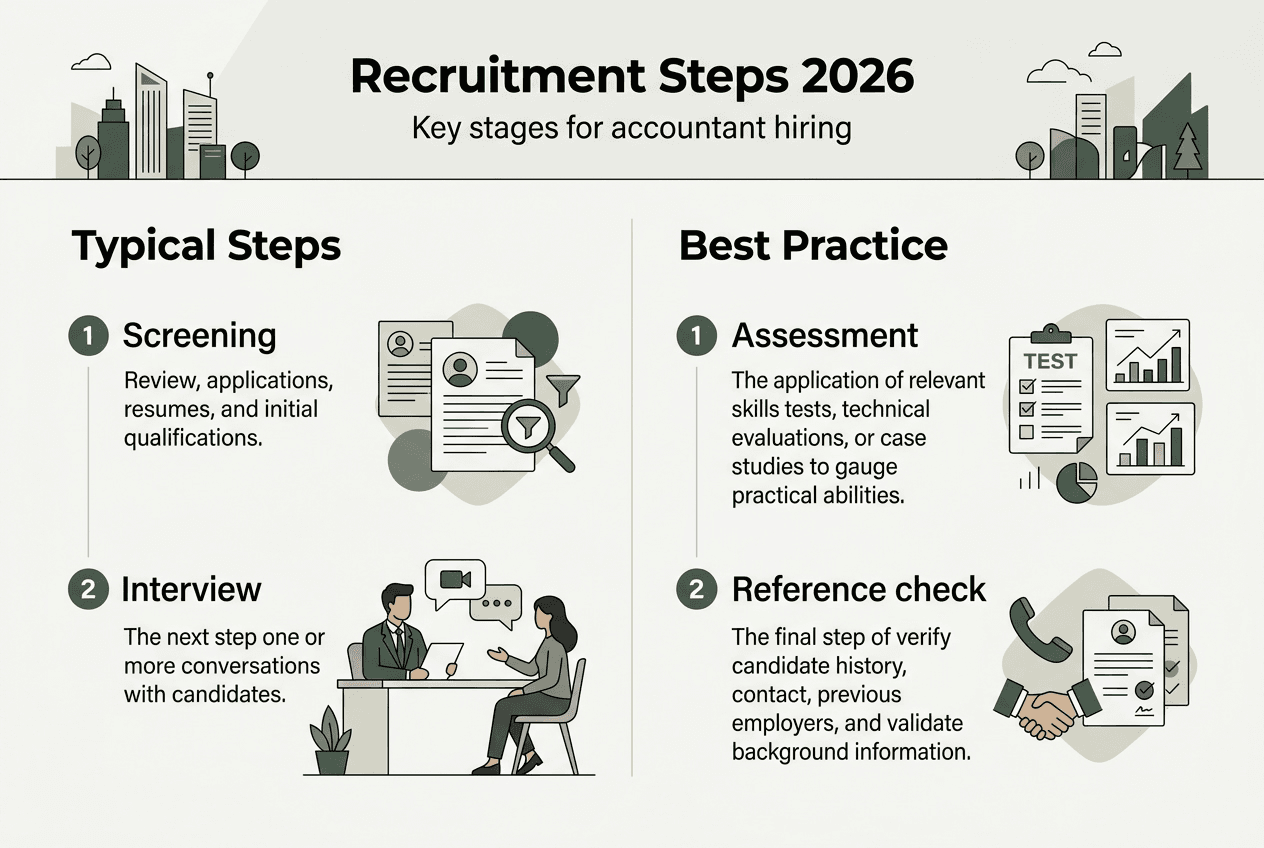
Pro Tip: Avoid relying solely on interviews for candidate evaluation. Include assessment centres or practical tasks that simulate real-world accounting challenges your business faces. Watching candidates work through actual scenarios reveals problem-solving approaches and attention to detail that interviews alone cannot capture.
Attracting top accounting talent through ethical and mission-driven branding
The modern accounting recruitment landscape extends far beyond salary negotiations and job descriptions. Finance professionals increasingly consider ethical stance, sustainability policies, and mission beyond profitability when choosing employers. This shift reflects broader societal changes where professionals seek meaningful work aligned with personal values. Birmingham businesses that recognise and respond to this trend gain significant competitive advantages in attracting higher-calibre candidates.

Building a credible ethical brand requires more than superficial statements. Candidates research potential employers thoroughly, examining everything from community involvement to environmental commitments. Authenticity matters enormously because finance professionals possess the analytical skills to spot inconsistencies between stated values and actual practices. Your ethical positioning must be genuine, documented, and visible throughout your organisation.
Understanding finance recruitment ethics Birmingham helps contextualise why this matters locally. Birmingham's business community increasingly values corporate responsibility, with many SMEs actively contributing to local causes and sustainable practices. Highlighting these commitments during recruitment demonstrates alignment with candidates' priorities whilst differentiating your business from competitors focused purely on financial metrics.
Actions to enhance ethical appeal to accounting candidates:
- Develop transparent policies on diversity, environmental impact, and community engagement
- Create community impact statements showing tangible local contributions
- Implement sustainability commitments with measurable targets and progress reports
- Communicate ethical mission through authentic storytelling across recruitment materials
- Showcase employee volunteering programmes and charitable partnerships
- Highlight ethical decision-making frameworks used in financial management
"Businesses that successfully articulate their ethical identity and demonstrate genuine commitment to values beyond profit consistently attract more applications from qualified accounting professionals and experience lower turnover rates."
Authentic storytelling proves particularly effective in communicating culture and ethics. Consider creating employer branding videos featuring current team members discussing why they chose your business and what values matter in their daily work. Video content humanises your organisation and provides candidates with realistic previews of workplace culture. Short clips showcasing community projects, team dynamics, or problem-solving approaches create emotional connections that job descriptions alone cannot achieve.
Pro Tip: Use authentic storytelling and employer branding videos to communicate ethics and culture effectively to potential candidates. Feature real employees discussing genuine experiences rather than scripted corporate messages. Candidates value transparency and can distinguish between authentic culture and manufactured marketing.
The investment in ethical branding pays dividends beyond recruitment. Employees who join organisations aligned with their values demonstrate higher engagement, longer tenure, and greater advocacy. For Birmingham SMEs competing against larger corporations with bigger budgets, ethical differentiation provides a powerful equaliser in the talent market.
Common pitfalls in the accountant recruitment process and how to avoid them
Even experienced business owners make predictable mistakes when hiring accountants, often due to time pressures or unfamiliarity with finance recruitment nuances. Recognising these pitfalls helps you avoid costly errors that lead to poor hires, extended vacancies, or compliance risks. Each mistake has straightforward solutions that improve outcomes without dramatically increasing recruitment complexity.
-
Rushing hiring decisions: Pressure to fill vacant positions quickly often leads to compromised standards and poor long-term fit. Candidates hired hastily may lack essential qualifications, struggle with company culture, or leave within months, restarting the expensive recruitment cycle. Solution: Build talent pipelines before urgent needs arise. Maintain relationships with recruitment agencies and passive candidates so you can move efficiently when positions open without sacrificing thoroughness.
-
Overreliance on simplistic interview questions: Recruitment processes involving only interviews and potentially psychometric tests fail to assess candidates' long-term suitability comprehensively. Generic questions about strengths and weaknesses reveal little about actual accounting competence or problem-solving ability. Solution: Develop structured interview frameworks combining behavioural questions, technical scenarios, and practical assessments. Ask candidates to review sample financial statements, explain regulatory changes, or propose solutions to real business challenges.
-
Ignoring cultural and ethical fit: Technical qualifications alone do not guarantee success. Accountants misaligned with company values create friction, resist collaboration, and often leave prematurely despite strong credentials. Solution: Assess values alignment through structured discussions about workplace scenarios, ethical dilemmas, and team dynamics. Include current team members in interview processes to evaluate interpersonal compatibility and communication styles.
-
Failing to factor in competitive market demands: Offering below-market salaries or rigid working arrangements whilst expecting top talent creates unrealistic expectations. Birmingham's accounting market remains competitive, with qualified professionals holding leverage in negotiations. Solution: Research current salary benchmarks for specific qualifications and experience levels. Build flexibility into packages through professional development budgets, flexible working options, or performance bonuses if base salary constraints exist.
-
Neglecting employer branding: Candidates evaluate potential employers as thoroughly as businesses assess candidates. Poor online presence, negative reviews, or unclear value propositions deter quality applicants before they even apply. Solution: Invest in professional job descriptions, maintain updated company profiles on recruitment platforms, and actively manage your reputation through employee testimonials and engagement initiatives.
-
Inadequate onboarding planning: Recruitment does not end when candidates accept offers. Poor onboarding experiences create immediate regret and early departures. Solution: Develop structured onboarding programmes covering systems training, team introductions, and clear performance expectations for the first 90 days.
Pro Tip: Engage specialist recruitment agencies early to access quality candidates and manage hiring complexity. Agencies familiar with Birmingham's finance market provide pre-vetted candidates, market intelligence on salary expectations, and expertise navigating offer negotiations. Their fees often prove cost-effective compared to extended vacancies or poor hires.
Thorough recruitment processes reduce turnover significantly whilst improving compliance outcomes. The time invested in proper vetting, cultural assessment, and structured onboarding pays returns through longer employee tenure, higher productivity, and reduced regulatory risks. For hiring accountants Birmingham, these best practices separate successful recruitments from expensive mistakes.
How Ibaco Recruitment supports Birmingham businesses hiring accountants
Navigating the complexities of accountant recruitment becomes significantly easier with specialist support tailored to Birmingham's unique market conditions. Ibaco Recruitment connects local SMEs with qualified finance professionals who match both technical requirements and cultural fit. Our deep understanding of Birmingham and West Midlands markets, combined with expertise in UK accounting standards and qualifications such as AAT, ACCA, and CIMA, helps businesses save time whilst improving hiring quality.
We maintain databases of thoroughly vetted candidates familiar with common financial software including Xero, Sage, and QuickBooks. Our streamlined process involves submitting your hiring request, receiving matched candidate profiles, and facilitating interviews through to onboarding. Most placements complete within two weeks, addressing urgent business needs without compromising quality. Explore our resources on finance recruitment trends Birmingham, detailed guidance for hiring accountants Birmingham, and specialist accounting recruitment agencies Birmingham to continue building your recruitment knowledge and connect with qualified finance professionals efficiently.
Frequently asked questions
What qualifications should I look for when hiring an accountant?
Look for UK recognised qualifications such as ACCA, CIMA, or ACA depending on the role's complexity and seniority. AAT qualifications suit bookkeeping and accounts assistant positions, whilst chartered certifications indicate strategic financial management capability. Ensure qualifications align with regulatory requirements and your specific business needs, including industry-specific accounting knowledge if relevant.
How long does the accountant recruitment process typically take?
The recruitment process often takes 6 to 12 weeks depending on seniority and candidate availability in Birmingham's market. Senior positions requiring chartered qualifications typically take longer due to smaller candidate pools and more extensive assessment requirements. Planning ahead and early engagement with specialist agencies can significantly reduce delays. Understanding typical accountant hiring timelines Birmingham helps set realistic expectations and plan coverage for vacant positions.
What are effective ways to assess a candidate's fit beyond technical skills?
Use behavioural interviews exploring past situations, scenario-based questions testing decision-making under pressure, and values alignment discussions about workplace ethics. Consider psychometric testing to understand personality traits and working styles. Trial projects or practical assessments provide insights into real-world problem-solving approaches. Including current team members in interview processes helps evaluate interpersonal compatibility and communication effectiveness.
Why is ethical branding important in recruiting accountants?
Finance professionals increasingly consider ethical stance, sustainability policies, and mission beyond profitability when choosing employers. Ethical branding attracts higher-quality candidates who seek meaningful work aligned with personal values, creating competitive differentiation in tight talent markets. Businesses demonstrating genuine commitment to ethical practices experience lower turnover, higher engagement, and stronger employer reputations that facilitate ongoing recruitment success.