
Hiring an accountant feels straightforward until you discover that anyone in the UK can legally call themselves an accountant without any qualifications, training, or oversight. For Birmingham SMBs navigating complex tax obligations and financial reporting, this unregulated landscape creates serious compliance risks. Accredited accountants bring verified expertise, professional insurance, and regulatory accountability that unqualified individuals simply cannot match. This article explains how accreditation protects your business, drives measurable growth, and ensures you meet HMRC requirements without costly mistakes.
Table of Contents
- Key takeaways
- What makes an accredited accountant different?
- The business benefits of hiring accredited accountants
- Risks and challenges of hiring unqualified accountants
- How to choose and hire accredited accountants in Birmingham
- Find accredited accountants for your Birmingham business
- Frequently asked questions
Key Takeaways
| Point | Details |
|---|---|
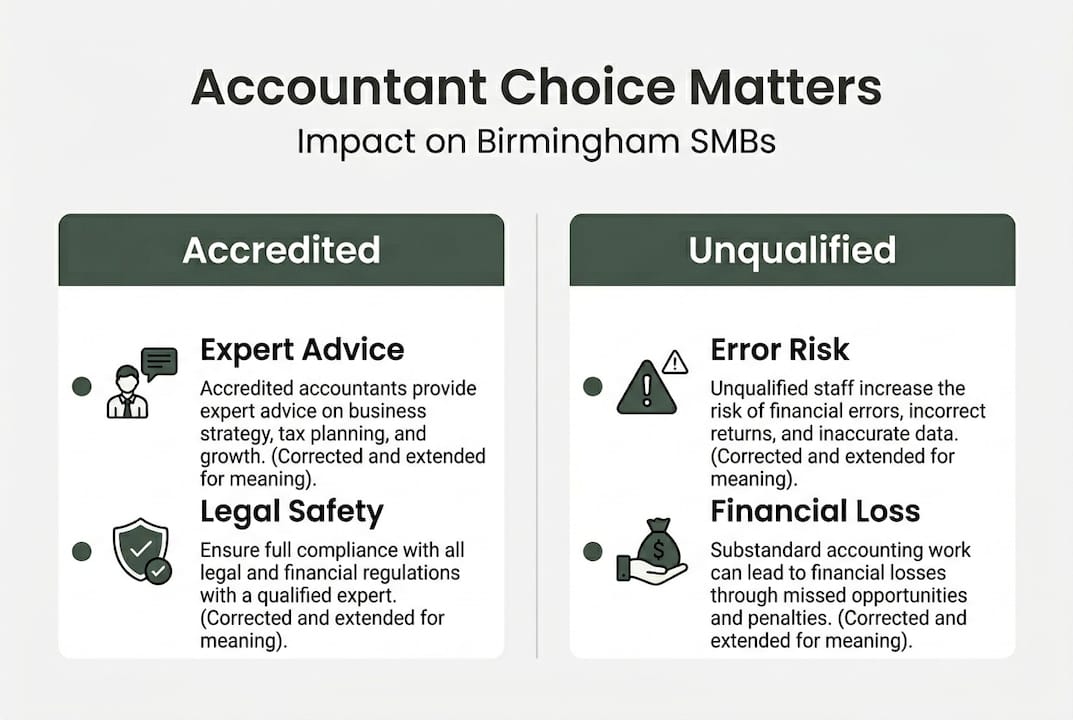
| Verified expertise and regulation | Accredited accountants are trained through demanding programmes and regulated by professional bodies, providing verified expertise and accountability that unqualified individuals cannot match. |
| Indemnity insurance | Accredited accountants carry professional indemnity insurance, typically up to £2 million, protecting clients against penalties and corrections arising from mistakes. |
| Regulatory oversight | Ethical codes and regulatory oversight govern accredited professionals, with bodies investigating complaints and enforcing standards to maintain public trust. |
| Business performance | UK SMBs employing accredited accountants report higher revenue and improved financial performance, with an 11.5 per cent increase in annual revenue. |
What makes an accredited accountant different?
Accredited accountants earn their credentials through demanding programmes administered by recognised professional bodies. The Institute of Chartered Accountants in England and Wales (ICAEW), Association of Chartered Certified Accountants (ACCA), and Chartered Institute of Management Accountants (CIMA) set rigorous standards that separate qualified professionals from individuals who simply use the accountant title.
Accredited accountants undergo minimum 3 years of structured training combining academic study with practical workplace experience. Candidates must pass comprehensive examinations covering taxation, audit, financial reporting, and business strategy. This foundation ensures they understand UK accounting standards, HMRC requirements, and sector-specific regulations that Birmingham businesses face daily.
Professional indemnity insurance represents a critical distinction. Accredited accountants carry coverage up to £2m+ to protect clients against errors or omissions. If a mistake occurs during tax filing or financial reporting, this insurance covers resulting penalties and corrections. Unqualified accountants operate without this safety net, leaving your business exposed to potentially devastating financial consequences.
Ethical codes govern every accredited professional's conduct. These frameworks mandate:
- Integrity in all financial dealings and client relationships
- Objectivity when providing advice or preparing reports
- Professional competence maintained through continuing education
- Confidentiality protecting sensitive business information
- Professional behaviour upholding industry reputation
Regulatory oversight adds another layer of accountability. Professional bodies investigate complaints, enforce standards, and can revoke membership for misconduct. Understanding UK accounting qualifications helps you recognise which credentials carry genuine weight versus meaningless certificates.
Unqualified individuals face no such scrutiny. They can operate indefinitely without training, insurance, or consequences for poor advice. This creates an unlevel playing field where Birmingham SMBs struggle to distinguish competent professionals from those who simply claim expertise.
"The difference between accredited and unqualified accountants isn't just credentials. It's the entire infrastructure of training, insurance, ethics, and accountability that protects your business when financial decisions carry serious consequences."
Continuing professional development requirements ensure accredited accountants stay current with legislative changes. Tax rules evolve constantly, and professionals must complete annual training hours to maintain their status. This commitment to ongoing learning means your accountant understands the latest HMRC guidance, Making Tax Digital requirements, and compliance updates affecting Birmingham businesses.
The business benefits of hiring accredited accountants
Empirical research demonstrates that professional accounting support directly correlates with business performance. UK SMBs with professional accountants achieve measurably better financial outcomes than those relying on informal bookkeeping or unqualified staff.
11.5% higher annual revenue separates SMBs using professional accountants from those without this expertise. This revenue uplift stems from improved financial visibility, better cash flow management, and strategic tax planning that preserves working capital. Accredited accountants identify deduction opportunities, optimise expense timing, and structure transactions to minimise tax liability within legal boundaries.
Financial reporting quality improves dramatically with accredited professionals. They implement proper controls, reconcile accounts accurately, and produce management reports that actually inform decision making. Business owners gain clear visibility into profitability by product line, customer segment, or service offering. This granular insight enables strategic choices about where to invest resources for maximum return.
Stress reduction represents an often overlooked benefit. The 2024 SMB economy study found that professional accountants significantly reduce owner anxiety around compliance and financial management. Birmingham business owners report sleeping better knowing qualified professionals handle their tax obligations, VAT returns, and year-end accounts.
Time savings compound these benefits. Owners reclaim hours previously spent wrestling with spreadsheets, HMRC portals, and confusing tax guidance. This recovered time flows into revenue-generating activities like business development, product innovation, or customer service improvements. Understanding the role of bookkeepers clarifies how qualified finance teams support overall business success.
Key improvements SMBs experience include:
- Accurate monthly management accounts delivered on consistent schedules
- Proactive tax planning reducing surprise liabilities at year end
- Streamlined expense tracking and receipt management
- Confident responses to HMRC enquiries or audit requests
- Professional financial statements supporting loan applications
95% of UK SMBs recommend their professional accountants to other business owners, reflecting exceptional satisfaction with the value delivered. This recommendation rate far exceeds typical professional service benchmarks, indicating that businesses view their accountant relationship as genuinely transformative rather than merely transactional.
Stakeholder confidence strengthens when accredited professionals prepare your financial statements. Investors, lenders, and potential acquirers trust accounts bearing professional credentials. This credibility can mean the difference between securing growth capital or facing rejection due to unreliable financial information.
Risks and challenges of hiring unqualified accountants
Compliance failures represent the most immediate danger when relying on unqualified accounting support. HMRC does not accept ignorance or poor advice as reasonable excuses for late submissions, incorrect calculations, or missed deadlines. Penalties accumulate regardless of who prepared your returns.

A revealing tribunal case demonstrated how reliance on unqualified staff fails as a reasonable excuse for VAT errors. The business argued they trusted their financial controller, but HMRC successfully contended that hiring someone without proper qualifications constituted negligence. The penalties stood, costing the business thousands in avoidable charges.
Systematic weaknesses emerge when unqualified individuals manage your finances:
- Missing tax deductions that reduce your liability legally
- Incorrect VAT treatment causing cascading errors across quarters
- Poor record keeping that cannot withstand HMRC scrutiny
- Delayed month-end closes preventing timely business decisions
- Inaccurate financial statements misleading strategic planning
Reputational damage extends beyond immediate financial costs. When auditors, lenders, or investors discover unreliable financial records, they question your business judgment and operational competence. Rebuilding this trust requires years of consistent, professional financial management.
The absence of professional indemnity insurance leaves you personally liable for any errors. If your unqualified accountant miscalculates corporation tax, files incorrect VAT returns, or misapplies accounting standards, you bear the full cost of corrections and penalties. No insurance policy covers these mistakes because the individual carried no professional coverage.
HMRC enquiries become far more stressful without qualified representation. Accredited accountants understand how to respond to information requests, negotiate settlements, and present your position effectively. Unqualified individuals often escalate situations through poor communication or inadequate documentation.
Pro Tip: Before hiring any accountant, verify their credentials through professional body registers. ICAEW, ACCA, and CIMA maintain searchable databases showing current members in good standing. Request proof of professional indemnity insurance and check coverage limits match your business risk profile. Understanding why local Birmingham accountants matter helps you prioritise both qualifications and market knowledge.
Opportunity costs compound these direct risks. While you spend time correcting errors, chasing missing documentation, or responding to HMRC queries, competitors with qualified accounting support focus on growth initiatives. This distraction tax silently erodes your competitive position.
How to choose and hire accredited accountants in Birmingham
Verifying credentials forms the foundation of any accountant hiring process. Check membership status with recognised professional bodies through their online registers. Current membership confirms the individual maintains continuing education requirements and adheres to ethical standards.
Essential qualifications to prioritise:
- ICAEW Chartered Accountant status for comprehensive training
- ACCA membership demonstrating international accounting expertise
- CIMA qualification if management accounting is priority
- AAT certification for bookkeeping and accounts preparation roles
Professional indemnity insurance requires careful verification. Request a certificate of currency showing coverage limits, policy period, and any exclusions. Minimum coverage should reflect your business size and transaction complexity. Larger Birmingham SMBs need accountants carrying £2m+ policies to adequately protect against potential errors.
| Hiring Method | Advantages | Considerations |
|---|---|---|
| Direct hire | Full control over candidate selection; builds internal expertise | Time intensive recruitment; requires HR infrastructure |
| Recruitment agency | Access to pre-vetted candidates; faster placement; market salary insights | Agency fees; less control over initial screening |
| Freelance/contract | Flexibility for project work; lower commitment | Limited availability; potential continuity issues |
| Permanent role | Consistent support; deep business knowledge; team integration | Higher fixed costs; longer onboarding period |
Interview questions should probe both technical competence and cultural alignment. Ask candidates to explain recent tax changes affecting Birmingham businesses, describe their approach to month-end processes, or walk through how they handle HMRC enquiries. These scenario-based questions reveal practical expertise beyond credentials.
Reference checks deserve thorough attention. Speak with at least two previous employers or clients about the candidate's technical accuracy, communication style, and reliability during high-pressure periods like year-end or tax deadlines. Learning about accountant recruitment processes helps you structure effective evaluation criteria.
Specialist finance recruitment agencies offer significant advantages for Birmingham SMBs. These agencies maintain relationships with qualified candidates actively seeking permanent roles, dramatically reducing your time to hire. They understand local salary expectations, can assess technical competence, and often guarantee placements for specified periods.
Pro Tip: Evaluate how candidates approach continuing professional development. Ask about recent training completed, professional publications they follow, or industry events they attend. This reveals whether they maintain cutting-edge knowledge or simply coast on outdated qualifications. Cultural fit matters as much as technical skills for long-term success.
Onboarding planning ensures new accountants integrate smoothly. Prepare comprehensive documentation about your chart of accounts, existing processes, software systems, and key stakeholder relationships. Schedule regular check-ins during the first 90 days to address questions and align expectations. When you hire qualified accountants through structured processes, you accelerate their contribution to business performance.
Find accredited accountants for your Birmingham business
Navigating Birmingham's competitive finance talent market requires local expertise and established candidate networks. IBACO Pro specialises in connecting West Midlands SMBs with accredited accountants who understand regional business challenges and HMRC compliance requirements.

Our recruitment process eliminates guesswork through rigorous candidate vetting. We verify qualifications, check professional memberships, confirm insurance coverage, and assess technical competence before presenting candidates. This pre-screening saves you weeks of sorting through unqualified applicants who merely claim accounting expertise.
Birmingham businesses typically secure qualified accountants within two weeks through our established talent pipeline. We understand local salary expectations, can advise on competitive packages, and facilitate efficient interview scheduling. Our focus exclusively on finance recruitment means we maintain deeper candidate relationships than generalist agencies.
Whether you need a part-qualified accountant for daily bookkeeping or a fully chartered professional for strategic financial management, our team matches your specific requirements with candidates who fit your business culture and growth stage. We handle the recruitment complexity so you focus on running your business. Contact our accounting recruitment specialists to discuss your hiring needs and discover how quickly we can deliver qualified candidates ready to strengthen your financial management.
Frequently asked questions
What qualifications should I look for in an accredited accountant?
Prioritise ICAEW Chartered status, ACCA membership, or CIMA qualification from recognised professional bodies. These credentials confirm rigorous training, examination success, and ongoing professional development. Verify current membership through online registers and ensure candidates hold professional indemnity insurance covering potential errors. Understanding UK accounting qualifications helps you distinguish genuine expertise from questionable credentials.
Can an unqualified accountant provide the same value as an accredited one?
Unqualified accountants lack regulatory oversight, professional insurance, and verified training that protect your business. They cannot offer the systematic expertise, ethical accountability, or error protection that accredited professionals provide. The compliance risks and potential penalties far outweigh any cost savings from hiring unqualified staff. Discover why local Birmingham accountants with proper credentials deliver superior long-term value.
How can I verify if an accountant is accredited and insured?
Check membership registers maintained by ICAEW, ACCA, or other professional bodies through their websites. These searchable databases confirm current members in good standing. Request a professional indemnity insurance certificate showing coverage limits, policy dates, and underwriter details. Legitimate accountants provide this documentation immediately without hesitation. Review accounting qualifications for Birmingham hiring to understand which credentials matter most.
How much does hiring an accredited accountant cost compared to unqualified alternatives?
Accredited accountants command higher salaries reflecting their training and expertise, typically £35,000 to £55,000 for experienced professionals in Birmingham. However, the 11.5% revenue uplift and reduced compliance risks deliver substantial return on investment. Unqualified staff may cost less initially but expose you to penalties, errors, and missed tax planning opportunities that ultimately prove far more expensive.
What ongoing support should I expect from an accredited accountant?
Accredited accountants provide proactive tax planning, timely management reporting, and strategic financial advice beyond basic compliance. Expect monthly management accounts, quarterly tax reviews, year-end planning discussions, and responsive support for HMRC queries. They should educate you about financial performance, explain complex regulations in plain language, and recommend process improvements that strengthen your financial controls.