

One wrong bookkeeping hire can cost your business far more than a salary. Errors in financial records, missed VAT deadlines, and payroll mistakes can trigger HMRC penalties and erode the trust of your stakeholders. For small and medium-sized businesses in Birmingham, where margins are tight and finance teams are lean, getting this hire right the first time is not optional. This guide walks you through every stage of the process, from clarifying your requirements and writing a compelling job advert, to assessing candidates objectively and onboarding your new hire for lasting success.
Table of Contents
- Understand your bookkeeping needs
- Prepare an effective job description
- Screen CVs and shortlist candidates
- Assess bookkeeping skills objectively
- Avoid common hiring mistakes
- Verify and onboard your bookkeeper effectively
- Get expert support to recruit the best bookkeepers
- Frequently asked questions
Key Takeaways
| Point | Details |
|---|---|
| Clarify requirements | Define your business needs and essential bookkeeper skills before starting recruitment. |
| Structure your hiring | Follow a step-by-step process, including job ads, screening, skills tests, and interviews. |
| Test practical abilities | Assess candidates beyond their CV with real-world tasks relevant to your business. |
| Avoid common mistakes | Don’t rush the process or focus solely on cost—check references and fit for your business. |
| Support your new hire | Effective onboarding and early reviews help your bookkeeper add value quickly. |
Understand your bookkeeping needs
Before you post a single job advert, you need to be honest about what your business actually requires. There is a significant difference between a bookkeeper who reconciles bank statements and processes invoices, and one who produces management accounts and cash flow forecasts. Confusing the two leads to either overpaying for skills you do not need, or underpaying and attracting someone who cannot handle the complexity of your finances.
Understanding bookkeepers' key responsibilities in the context of your business is the essential first step. Think about your transaction volumes, whether you run payroll in-house, and how frequently you need financial reporting.
On salary, Birmingham postings range from £28k to £40k, which aligns with UK benchmarks, and you should budget for 4 to 5 per cent annual wage growth. For context, the UK salary benchmarks show a median hourly rate of around £33 for experienced bookkeepers. When selecting qualified bookkeepers, consider both must-have and nice-to-have skills.
Must-have skills:
- Proficiency in Xero, Sage, or QuickBooks
- Experience with VAT returns and payroll
- AAT qualification or equivalent practical experience
- Strong attention to detail and accuracy
- Clear written and verbal communication
Nice-to-have skills:
- Experience in your specific industry sector
- Familiarity with management accounts
- Knowledge of CIMA or ACCA study pathways
Pro Tip: Map your job requirements directly to your most critical business processes. If payroll is your biggest pain point, make payroll experience non-negotiable rather than a bonus.
Prepare an effective job description
Once you know what you are looking for, the job description becomes your first filter. A vague advert attracts vague candidates. A well-written job ad is a core part of any structured hiring process for bookkeepers, and it saves you hours of sifting through irrelevant applications.
Your job description should include the specific role title, a clear list of daily responsibilities, the software the candidate must know, the salary range, and a brief description of your company culture. Transparency about salary is particularly important in Birmingham's competitive finance talent market.
| Element | Generic advert | Effective advert |
|---|---|---|
| Role title | Finance assistant | Bookkeeper with Xero experience |
| Responsibilities | Handle accounts | Process invoices, reconcile accounts, run monthly payroll |
| Salary | Competitive | £30,000 to £34,000 per annum |
| Software | MS Office | Xero, Sage 50, Excel |
| Culture | Great team | Fast-paced SME, direct reporting to MD |
The difference is specificity. Candidates who do not match your requirements will self-select out, which means your shortlist will be smaller but far more relevant.
Key elements to include in every bookkeeper job advert:
- Exact software requirements (not just "accounting software")
- Whether the role involves client-facing responsibilities
- Reporting structure and team size
- Any industry-specific experience required
Pro Tip: List your non-negotiable requirements separately from desirable ones. This single change can reduce mismatched applications by a significant margin.
Screen CVs and shortlist candidates
With applications arriving, your goal is to move quickly without cutting corners. A structured shortlisting process that includes phone screens and clear criteria will save you from wasting time on interviews that should never have happened.

When scanning CVs, focus on three things first: relevant qualifications such as AAT, ACCA, or CIMA, demonstrable experience with the software you use, and a consistent employment history. These are your baseline filters before you read anything else.
Red flags to watch for on a bookkeeper's CV:
- Frequent job changes with no explanation (more than three roles in four years)
- Vague descriptions like "assisted with accounts" without specifics
- Gaps in employment that are not addressed
- No mention of specific software or qualifications
- Responsibilities that do not match the seniority of the role claimed
Checking crucial bookkeeping qualifications is not about being rigid. It is about ensuring the candidate has been trained to a recognised standard.
"Skipping a structured CV screening process is one of the most expensive shortcuts a business can take. One poor hire costs far more in time, errors, and rehiring than a thorough shortlisting process ever will."
Pro Tip: Build a simple checklist with five to seven criteria before you open a single CV. Score each application against it. This removes bias and speeds up your decision-making considerably.
Assess bookkeeping skills objectively
A polished CV and a confident interview manner are not enough. The only way to know whether a candidate can actually do the job is to test them on it. Structured interviews and skills tests are essential to assess practical abilities that a CV simply cannot demonstrate.
Practical skills tests do not need to be elaborate. A short exercise using your actual software, or a realistic scenario based on your business, tells you more than an hour of conversation. Review the full skills assessment process to design tests that reflect real job demands.
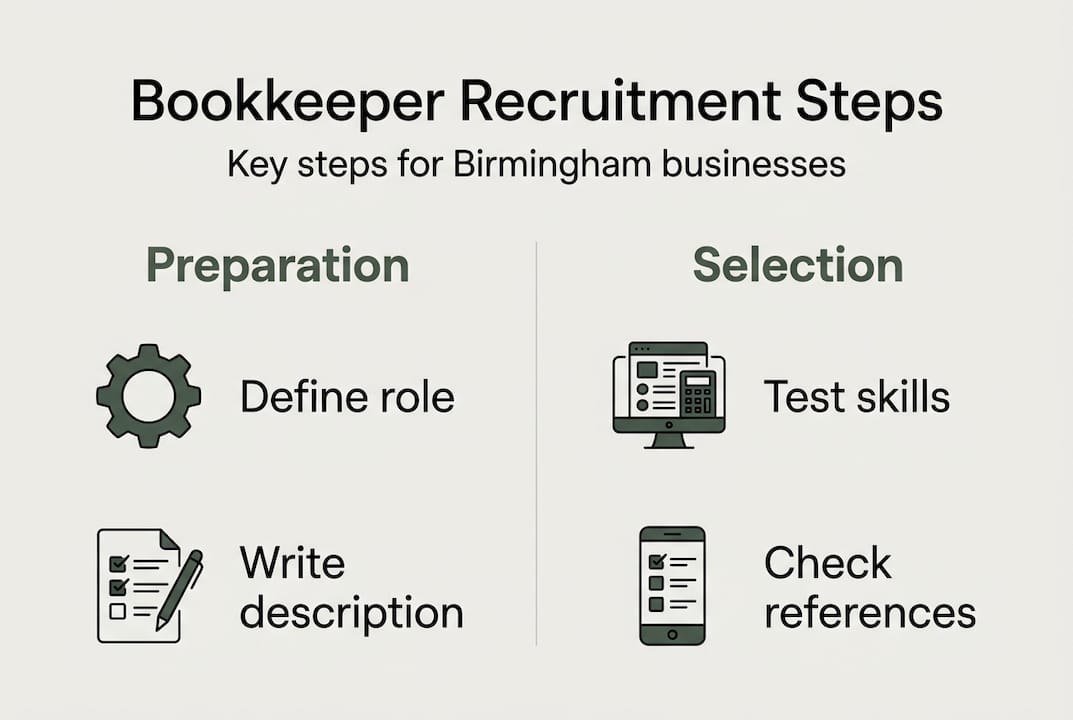
Step-by-step skills assessment structure:
| Stage | Activity | What it reveals |
|---|---|---|
| 1. Technical test | Reconcile a sample bank statement | Accuracy and software confidence |
| 2. Scenario exercise | Identify an error in a set of accounts | Attention to detail and problem-solving |
| 3. Software task | Process a batch of invoices in Xero | Practical tool proficiency |
| 4. Structured interview | Competency-based questions | Communication and judgement |
Recommended interview question categories:
- Technical knowledge: Ask candidates to explain how they would handle a VAT discrepancy or a payroll error.
- Problem-solving: Present a realistic scenario where figures do not balance and ask how they would investigate.
- Communication: Ask how they would explain a financial issue to a non-finance director.
- Attention to detail: Use a short written exercise with deliberate errors to see if they spot them.
For a full list of effective interview questions tailored to bookkeeper roles, you can find structured examples that cover all these categories.
Avoid common hiring mistakes
Even experienced hiring managers make avoidable errors when recruiting bookkeepers. Before you make a final offer, consider these practical pitfalls that regularly trip up Birmingham businesses.
Focusing beyond CVs to practical abilities is a principle that applies equally to avoiding the mistakes below.
Top hiring mistakes and how to counter them:
- Hiring on cost alone. The cheapest candidate is rarely the best value. A bookkeeper who makes errors costs far more in corrections and penalties than a slightly higher salary would.
- Overlooking cultural fit. A technically brilliant bookkeeper who cannot communicate with your team or adapt to your working style will struggle. Assess fit during the interview, not after the offer.
- Skipping reference checks. References for permanent hires are not a formality. They are your last line of defence against a costly mistake. Always speak to a previous line manager, not just HR.
- Confusing the role with an accountant. Understanding the difference between bookkeepers and accountants prevents you from setting unrealistic expectations or hiring the wrong level of professional entirely.
- Rushing the process. Urgency leads to shortcuts. A two-week structured process is far better than a rushed hire you spend six months managing out.
Pro Tip: Always conduct reference checks by phone rather than email. A conversation reveals hesitations and nuances that a written reference never will.
Verify and onboard your bookkeeper effectively
Making an offer is not the finish line. The first three months of employment are where most bookkeeper hires either succeed or begin to unravel. A structured onboarding process that includes early practical reviews is what separates a good hire from a great one.
Set clear expectations from day one. Your new bookkeeper should know exactly what they are responsible for, who they report to, and what success looks like at the 30, 60, and 90-day marks.
Onboarding essentials for a new bookkeeper:
- Full access and training on your accounting software (Xero, Sage, or QuickBooks)
- A walkthrough of your chart of accounts and reporting structure
- Introduction to your payroll schedule and VAT filing calendar
- Clear guidance on data security and financial controls
- A named point of contact for questions during the settling-in period
At the three-month mark, run a structured review. Check the accuracy of their work, ask for their feedback on processes, and assess whether they are meeting the goals you set at the start. For businesses that want additional support during this period, specialised finance onboarding support can help bridge any gaps.
Get expert support to recruit the best bookkeepers
Recruiting a bookkeeper is a process that rewards preparation and penalises shortcuts. If you have followed this guide, you are already ahead of most businesses in Birmingham. But if you want certainty alongside efficiency, working with a specialist recruiter removes the guesswork entirely.
At Ibaco Recruitment, we connect Birmingham businesses with thoroughly vetted, qualified bookkeepers and accountants for permanent roles. Our bookkeeper recruitment services draw on deep local knowledge of the West Midlands talent market, and we typically place candidates within two weeks. There are no upfront fees, and every candidate we present has been assessed against your specific requirements. Whether you need a bookkeeper with Xero expertise or someone who can manage payroll for a growing team, we also help businesses hire accountants in Birmingham when the role demands a broader skill set. Get in touch to tell us what you need.
Frequently asked questions
How much do bookkeepers in Birmingham typically earn?
Bookkeepers in Birmingham generally earn between £28,000 and £40,000 per year, which aligns with UK benchmarks, and annual wage growth of 4 to 5 per cent is expected.
What are the most important skills for a bookkeeper?
Accuracy, proficiency with current accounting software, and a solid grasp of compliance are the most critical skills, alongside the ability to communicate financial information clearly. A structured hiring process that includes skills tests will confirm these abilities before you hire.
How can I objectively assess a bookkeeper's skills before hiring?
Use structured skills tests and competency-based interviews that mirror real business tasks, such as reconciling a sample bank statement or identifying errors in a set of accounts.
What is the main difference between a bookkeeper and an accountant?
Bookkeepers manage daily financial transactions and record-keeping, while accountants handle broader financial reporting, tax compliance, and strategic analysis. The distinction between the two roles matters when defining what your business actually needs.