

TL;DR:
- Most Birmingham SMBs face urgent accounting talent shortages that stall growth.
- Building an active, segmented talent pool speeds up hiring and improves candidate quality.
- Combining apprenticeships, outsourcing, and upskilling offers a cost-effective strategy to address skills gaps.
Accounting talent shortages are not a distant concern for Birmingham's small and medium-sized businesses. They are happening right now, quietly stalling growth plans and forcing finance directors to make do with under-resourced teams. 94% of SMBs report recruitment issues actively stalling growth across the UK, and Birmingham is no exception. Yet most businesses keep responding the same way: posting a job ad, waiting, and hoping. There is a smarter, more proactive approach that forward-thinking HR managers are already using. This article explains what an accounting talent pool is, why it matters specifically for Birmingham businesses, and exactly how to build one that works.
Table of Contents
- What is an accounting talent pool?
- Why Birmingham SMBs face a talent crisis
- Building and maintaining your accounting talent pool
- Advanced strategies: segmentation, upskilling, and hybrid approaches
- What most SMBs miss about accounting talent pools
- Find your next qualified accountant in Birmingham
- Frequently asked questions
Key Takeaways
| Point | Details |
|---|---|
| Talent pools explained | An accounting talent pool is a curated database of qualified, pre-vetted professionals maintained for future hires. |
| Regional challenges | Birmingham SMBs face pronounced skill shortages: most report stalled growth and low applicant numbers. |
| Effective build strategies | Segmenting your pool by skills and nurturing candidates regularly ensures readiness and reduces time-to-hire. |
| Advanced tactics | Leveraging apprenticeships, outsourcing, and upskilling opportunities helps bridge gaps and attract talent. |
| Practical next steps | Finance directors can apply talent pool principles and connect with local specialist recruiters for immediate access. |
What is an accounting talent pool?
An accounting talent pool is not a spreadsheet of CVs gathering dust in a shared drive. It is a living, actively managed database of pre-vetted candidates, organised by skills, qualifications, and readiness to move. As talent pool research confirms, an accounting talent pool is a curated database of pre-vetted, qualified candidates for accounting roles, maintained proactively rather than reactively.
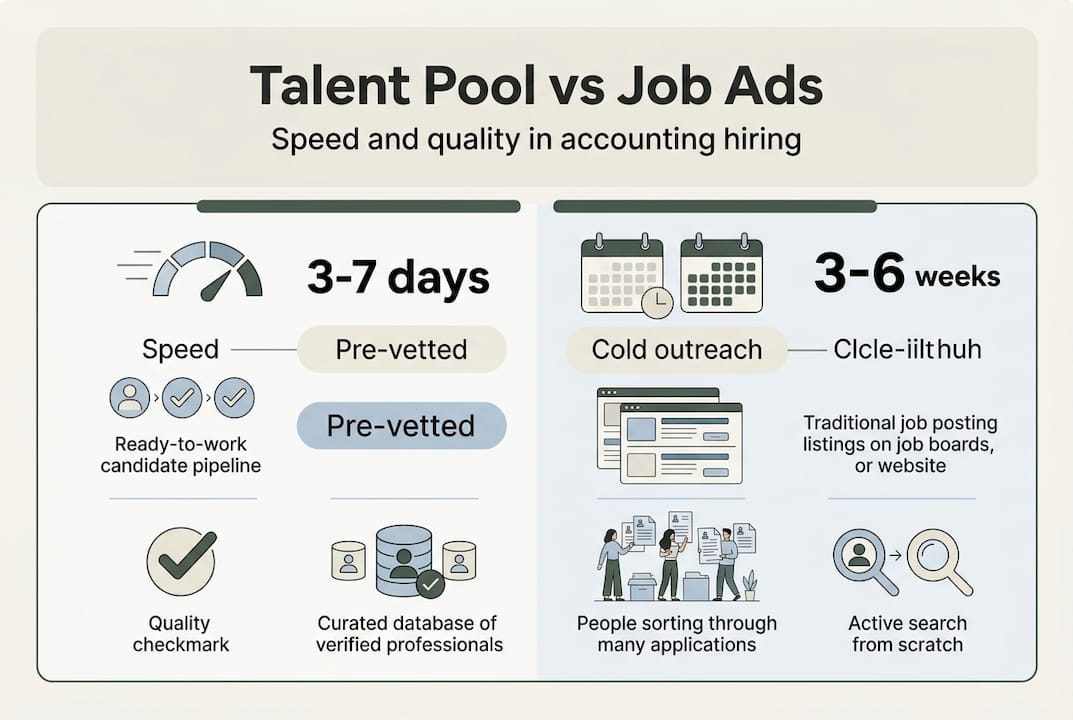
The critical distinction here is timing. Traditional recruitment starts when a vacancy opens. You write a job ad, post it, wait two to six weeks for applications, sift through unsuitable candidates, and finally make an offer, often to someone who is already fielding three other offers. A talent pool flips this entirely. You are already in conversation with qualified people before the vacancy exists.
For Birmingham SMBs, the roles worth including in a talent pool span a wide range. Think bookkeepers, AAT-qualified accounts assistants, part-qualified ACCA or CIMA candidates, management accountants, and finance managers. Each of these roles has a different hiring timeline and a different candidate profile, which is why segmentation matters so much.
Consider the contrast between the two approaches:
| Criteria | Talent pool | Reactive job ads |
|---|---|---|
| Speed to first interview | 3 to 7 days | 3 to 6 weeks |
| Candidate quality | Pre-vetted, engaged | Unknown, unscreened |
| Candidate engagement | Ongoing relationship | Cold, transactional |
| Cost per hire | Lower over time | Higher per vacancy |
| Risk of drop-off | Lower | Higher |
The numbers tell a stark story. Time-to-hire for SMBs averages 45 days, compared to just 27 days at larger firms that invest in proactive talent pipelines. That 18-day gap is not just an inconvenience. It represents weeks of missed invoicing, delayed month-end closes, and pressure on your existing team.
The roles you should prioritise in your pool include:
- Bookkeepers with Xero, Sage, or QuickBooks experience
- AAT-qualified accounts assistants at Level 3 or 4
- Part-qualified ACCA or CIMA candidates seeking their first commercial role
- Payroll specialists familiar with UK PAYE and auto-enrolment
- Finance managers with SMB experience in the West Midlands
If you want to understand how the Birmingham accountant recruitment process works in practice, the regional context adds another layer of urgency.
Why Birmingham SMBs face a talent crisis
Birmingham is the UK's second city, but when it comes to accounting talent, it competes with London on salary expectations while offering far fewer candidates per role. The regional picture is genuinely difficult. Only 2 to 3 applicants apply per accounting role in regional cities like Birmingham, compared to far higher ratios in London. That is a razor-thin margin when you need someone with specific software skills or a particular qualification level.

The consequences are measurable. 94% of SMBs report recruitment issues stalling growth, and 74% say they are unable to take on additional clients because their finance function simply cannot scale. For a Birmingham business trying to grow, that is a direct brake on revenue.
The skills gap compounds the problem. Finance directors are increasingly asking for candidates who understand data analytics and can work alongside AI-driven reporting tools. Yet 88 to 90% of firms say their current staff need upskilling in these areas. The traditional accounting qualification, while still essential, is no longer sufficient on its own.
Retention adds another layer of difficulty. A significant proportion of newly qualified accountants leave their employer within 12 months of completing their qualification. Only around 20% remain with the firm that supported their training beyond the post-qualification period. Birmingham SMBs that invest in training often find themselves inadvertently building talent pipelines for larger competitors.
Here is a snapshot of the regional data:
| Metric | Birmingham/Midlands | National average |
|---|---|---|
| Applicants per accounting role | 2 to 3 | 4 to 6 |
| Average accountant salary | £29,567 | £33,200 |
| Average time-to-hire (SMBs) | 45 days | 38 days |
| Firms reporting skills gaps | 88 to 90% | 85% |
Understanding the Birmingham accounting qualifications landscape helps explain why certain candidates are harder to find. AAT Level 4 completions in the Midlands have not kept pace with demand, and many graduates are drawn to graduate schemes at larger firms or relocate to Manchester and London.
If you are currently advertising roles without a structured pipeline behind them, the bookkeeper hiring guide offers a practical starting point for understanding what qualified candidates actually expect from Birmingham employers.
Building and maintaining your accounting talent pool
Knowing why the problem exists is one thing. Building a system that solves it is another. The good news is that constructing an effective accounting talent pool does not require a large HR team or an enterprise-level budget. It requires consistency and a clear process.
Segmenting by skills is the foundation. Group candidates by qualification level, software proficiency, and the type of role they are suited for. A bookkeeper comfortable with Xero and bank reconciliation is a very different hire to a part-qualified ACCA candidate looking for a management accounts role. Mixing them into one undifferentiated list wastes everyone's time.
Here is a practical sequence for building your pool:
- Define your segments by role type, qualification, and software skills
- Source candidates through local universities, AAT college partnerships, LinkedIn, employee referrals, and apprenticeship programmes
- Screen and vet each candidate with a structured skills assessment and reference check
- Enter them into an ATS or CRM with tags for availability, qualification status, and last contact date
- Nurture the relationship with quarterly check-ins, relevant industry updates, or invitations to local networking events
- Refresh the pool every six months, removing candidates who have moved on and adding new ones
The most effective sourcing channels for Birmingham accounting talent include:
- Local further education colleges offering AAT programmes
- LinkedIn outreach targeting Midlands-based part-qualified candidates
- Employee referral schemes with a small incentive for successful hires
- Apprenticeship providers partnered with West Midlands businesses
- Accounting-specific job boards and professional networks
Pro Tip: Candidates who hear from you regularly, even just a brief update every quarter, are far more likely to say yes when a role opens. Sporadic outreach feels transactional. Consistent engagement builds genuine interest.
The most common pitfall is building the pool once and then ignoring it. Candidate circumstances change constantly. Someone who was not ready to move six months ago may be actively looking today. Your accountant hiring methods should include a calendar reminder to review and refresh your pool at regular intervals.
Advanced strategies: segmentation, upskilling, and hybrid approaches
Once your talent pool is functioning, there are several advanced strategies that can significantly improve both the quality and the speed of your hires.
Segmenting by career stage is one of the most underused tactics. Career changers, people moving into accounting from adjacent fields such as administration or retail management, represent a meaningful slice of the candidate market. Over 20% of AAT starters come from non-finance backgrounds. They often bring strong commercial awareness and a genuine hunger to prove themselves, qualities that are harder to find in candidates who have followed a linear path.
Hybrid approaches are increasingly common among Birmingham SMBs. 61 to 67% of firms now use outsourcing or offshoring as a pressure valve when their internal team is stretched. Meanwhile, 70% of employers use apprenticeships as part of their talent strategy, and 88 to 90% cite upskilling as an urgent priority. These approaches work best in combination, not as standalone fixes.
Which strategies suit which firm sizes:
- Micro businesses (1 to 9 staff): Focus on bookkeeping apprenticeships and part-time qualified hires
- Small businesses (10 to 49 staff): Blend apprenticeships with one or two outsourced functions such as payroll
- Medium businesses (50 to 249 staff): Invest in a structured talent pool with ATS support and dedicated upskilling budgets
For finance directors specifically, prioritising data analytics and AI literacy in your talent pool criteria will future-proof your team. Candidates who can interpret dashboards in Power BI or automate reconciliation tasks in Excel are becoming the baseline expectation, not a premium skill.
Pro Tip: Apprenticeships funded through the Apprenticeship Levy can dramatically reduce your cost-per-hire. If your payroll exceeds £3 million, you are already paying into the Levy. Using it for accounting apprentices is one of the most cost-effective recruitment decisions a Birmingham SMB can make.
Explore the full range of accounting recruitment services available to Birmingham businesses if you want to understand how these hybrid strategies can be implemented with specialist support.
What most SMBs miss about accounting talent pools
Here is the uncomfortable truth: most Birmingham SMBs treat talent pools as a recruitment tactic rather than a business asset. They build a list, forget about it, and then wonder why candidates are cold when they finally make contact.
The conventional wisdom says that adding more candidates to your pool solves the problem. It does not. The quality of your engagement matters far more than the size of your database. A pool of 20 warm, well-nurtured candidates will outperform a list of 200 people who last heard from you 18 months ago.
Career changers are one of the most overlooked segments. They are often more committed, more adaptable, and more grateful for the opportunity than candidates who have been in accounting their entire career. Birmingham businesses that actively seek them out, rather than filtering them out, consistently report stronger retention.
Another counterintuitive insight: upskilling your existing team is often faster and more reliable than hiring from outside. If you have a bookkeeper who is ready to step into a management accounts role with six months of targeted training, that is a hire you have already made. Leveraging career changers and highlighting quality of life can also attract more recruits who might otherwise default to London opportunities.
Birmingham has a genuine lifestyle advantage over London. Shorter commutes, lower housing costs, and a strong local community are real selling points that many SMBs fail to mention in their recruitment conversations. If you are competing on salary alone, you will lose. If you compete on the full picture, you have a much stronger case. Understanding SMB hiring qualifications helps you frame these conversations more effectively with candidates who are weighing up their options.
Find your next qualified accountant in Birmingham
Building a talent pool takes time and consistency, but you do not have to start from scratch on your own. At Ibaco Recruitment, we work exclusively with Birmingham and West Midlands businesses to connect them with thoroughly vetted, permanent accounting professionals.
Whether you need a bookkeeper with Xero experience or a part-qualified ACCA candidate ready to step into a management accounts role, our team already maintains an active pool of finance professionals across the region. There are no upfront fees, and most placements complete within two weeks. If you are ready to move from reactive hiring to a proactive strategy, hire accountants through Ibaco and experience the difference that local expertise makes. You can also explore our broader finance recruitment Birmingham services to find the right fit for your business.
Frequently asked questions
How does an accounting talent pool differ from traditional job postings?
Talent pools provide pre-vetted, segmented candidates who are already engaged with your business, enabling significantly faster and higher-quality hires compared to posting a vacancy and waiting for applications to arrive.
What skills are most needed in Birmingham accounting hires in 2026?
Finance directors report urgent demand for data analytics and AI literacy alongside core AAT and ACA standards, with 88 to 90% of firms saying their teams need training in these emerging areas.
How long does it take to fill an accounting role through an SMB talent pool?
SMBs with active talent pools can reduce average time-to-hire from 45 days to under 30 by maintaining warm candidate relationships and conducting upfront vetting before vacancies open.
Are apprenticeships and outsourcing viable for accounting talent shortages?
Absolutely. Birmingham SMBs increasingly combine both approaches, with 61 to 67% choosing hybrid outsourcing arrangements and 70% using apprenticeships as part of their permanent talent strategy.
What is the average salary for an accountant in Birmingham in 2026?
The Midlands average salary for accountants sits at £29,567, which is notably lower than the national average and creates both a cost advantage and a competitive challenge when attracting candidates who compare offers from London firms.