

TL;DR:
- Over 84% of UK SMEs experience payroll errors, risking fines and staff dissatisfaction.
- Payroll in the UK involves calculating pay, deducting taxes, reporting to HMRC, and issuing payslips.
- Using professional support or hybrid payroll solutions enhances accuracy and ensures compliance.
Over 84% of UK SMEs experience payroll errors, and 40% have faced fines as a direct result. That figure tends to surprise business owners who consider payroll a routine admin task. The reality is that payroll processing in the UK is a layered, deadline-driven obligation that touches tax law, employment rights, and HMRC reporting all at once. Get it wrong and you risk financial penalties, staff dissatisfaction, and unnecessary stress. This guide walks you through what payroll processing actually involves, the standard monthly cycle, your options for managing it, and the compliance mistakes that catch SMEs out most often.
Table of Contents
- What payroll processing really means for UK businesses
- Step-by-step UK payroll cycle: from registration to payslips
- Processes, tools and costs: choosing how to run your payroll
- Compliance pitfalls and how to stay on HMRC's good side
- Our advice: what SMEs get wrong about payroll (and how to get it right))
- Next steps: get expert payroll and finance staffing support
- Frequently asked questions
Key Takeaways
| Point | Details |
|---|---|
| Payroll errors are common | Most UK SMEs face payroll mistakes and fines, so understanding the process is critical. |
| Follow the seven-step cycle | Completing all required payroll tasks each month ensures timely, compliant payments. |
| Choose the right method | Manual, software, or outsourced payroll options vary in cost, risk, and control. |
| Stay compliant to avoid penalties | Automate, audit, and stay updated to minimise fines and HMRC trouble. |
What payroll processing really means for UK businesses
Most business owners think of payroll as simply transferring wages into employee bank accounts. In practice, it is far more involved than that. Payroll processing is the systematic process of calculating pay, deducting income tax and National Insurance, reporting to HMRC, and paying employees on time, primarily through the PAYE (Pay As You Earn) system. Every step must be accurate, timely, and properly recorded.
Here is what payroll processing actually covers for a typical UK employer:
- Calculating gross pay, including overtime, bonuses, and statutory payments such as Statutory Sick Pay (SSP) or Statutory Maternity Pay (SMP)
- Applying the correct tax codes and National Insurance categories for each employee
- Deducting student loan repayments, pension contributions, and any salary sacrifice arrangements
- Submitting Real Time Information (RTI) reports to HMRC on or before each payday
- Issuing payslips to employees and maintaining accurate records
- Handling year-end reporting, including P60s for all employees and P11Ds for benefits in kind
The HMRC PAYE guide sets out every employer obligation in detail, and the rules change annually. Tax thresholds, National Insurance rates, and pension auto-enrolment thresholds all shift, meaning your payroll process must be reviewed and updated at the start of each tax year.
"Accurate payroll is not just about paying people correctly. It is a compliance function that protects your business from penalties and builds trust with your workforce."
One of the most persistent misconceptions is that payroll only matters when something goes wrong. In truth, consistent payroll accuracy improves staffing efficiency and ensures accounting compliance, reducing the risk of costly penalties and employee disputes. Staff who are paid incorrectly, even once, lose confidence quickly. Rebuilding that trust takes far longer than preventing the error in the first place.
If you are hiring or reviewing your finance team, understanding the essential accounting skills required for payroll management will help you assess whether your current setup is fit for purpose. Many SMEs discover gaps only when a problem surfaces.
Step-by-step UK payroll cycle: from registration to payslips
Now that we know what payroll processing means, let us break down exactly how the typical payroll month unfolds. The standard UK payroll cycle for SMBs follows seven core steps, each with its own deadline and documentation requirement.
- Register as an employer with HMRC before your first payday, obtaining your PAYE reference number
- Collect employee information, including P45s from new starters, National Insurance numbers, and tax codes
- Calculate gross and net pay for each employee, accounting for all deductions and statutory payments
- Submit the Full Payment Submission (FPS) to HMRC on or before each payday via RTI
- Pay employees on the agreed date, ensuring bank transfers are initiated in time
- Issue payslips to every employee, showing gross pay, deductions, and net pay clearly
- Complete year-end reporting, including P60s by 31 May and any P11Ds by 6 July
Deadlines are non-negotiable. The FPS must reach HMRC on or before payday. PAYE and National Insurance payments are due by the 22nd of the following month if paying electronically. Missing these dates triggers automatic penalties.
| Payroll stage | Document required | Deadline |
|---|---|---|
| New employee starts | P45 or starter checklist | Before first payday |
| Each pay period | Full Payment Submission (FPS) | On or before payday |
| Monthly PAYE payment | PAYE/NI payment to HMRC | 22nd of following month |
| Year-end employee summary | P60 issued to employee | By 31 May |
| Benefits reporting | P11D submitted to HMRC | By 6 July |
Understanding PAYE and NI basics is essential before you attempt to run payroll independently. Many SMEs underestimate how quickly the paperwork accumulates, particularly once you have more than five employees.
When you are building a finance team capable of managing this cycle, screening payroll staff qualifications carefully will save you significant time and risk later.
Processes, tools and costs: choosing how to run your payroll
Understanding the steps is one thing. Deciding how to handle payroll is another. Here is how your options stack up for a typical UK SME.
Four main methodologies exist for SMBs: HMRC's free Basic PAYE Tools (suitable for fewer than 10 employees), commercial payroll software, outsourcing to an accountant or payroll bureau, and a hybrid approach combining software with professional oversight.
| Method | Approximate monthly cost | Best suited to | Key risk |
|---|---|---|---|
| HMRC Basic PAYE Tools | Free | Under 10 employees | Manual entry errors |
| Commercial software (e.g. Sage, Xero) | £10 to £50 per month | 5 to 50 employees | Requires trained user |
| Accountant or payroll bureau | £50 to £200+ per month | Growing SMEs | Cost, less direct control |
| Hybrid (software plus review) | £30 to £150 per month | 10 to 100 employees | Coordination needed |
For very small businesses, HMRC's free tool is a practical starting point. However, as your headcount grows, the manual effort required increases significantly. Research from SMB payroll guidance confirms that errors multiply with manual processes, particularly when staff changes, bonuses, or statutory payments are involved.

Commercial software such as Xero, Sage, or QuickBooks automates much of the calculation and RTI submission process, reducing the margin for human error. These platforms also update automatically when tax rates change, which is a genuine time-saver at the start of each new tax year.
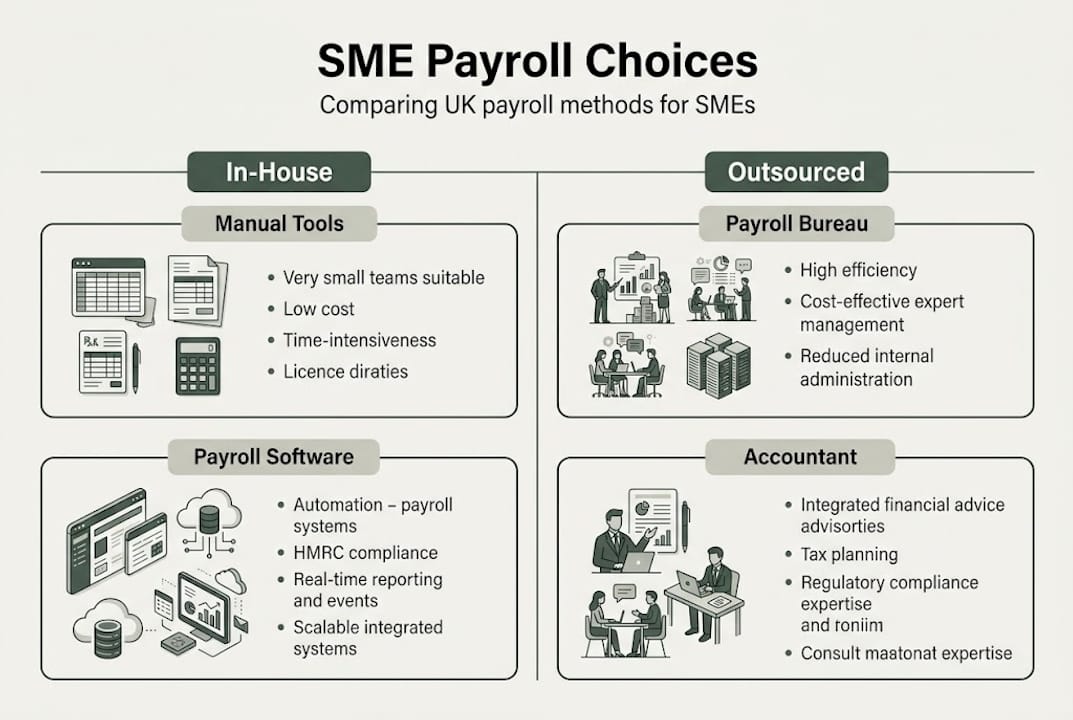
Outsourcing payroll entirely gives you expert accuracy and frees up internal resource, but it does reduce your direct visibility over the numbers. Many growing businesses find the hybrid model most effective: software handles the mechanics, while a qualified professional reviews submissions before they go to HMRC.
Pro Tip: If you are spending more than four hours per month on payroll administration, the cost of commercial software or part-time specialist support will almost certainly pay for itself in time saved and errors avoided.
For broader financial management context, reviewing bookkeeping best practices alongside your payroll approach ensures your records remain consistent and audit-ready.
Compliance pitfalls and how to stay on HMRC's good side
Even with the best intentions, mistakes can happen. Here is what to watch for and practical strategies to keep your payroll accurate.
The most common payroll errors in UK SMEs include:
- Using the wrong tax code for an employee, often after a job change or HMRC update
- Missing RTI submission deadlines, even by a single day
- Failing to apply the correct National Insurance category, particularly for directors
- Not updating payroll for mid-year changes to tax thresholds or minimum wage rates
- Overlooking statutory payment obligations such as SSP or SMP
The consequences go beyond fines. 84% of SMEs have experienced payroll errors, 40% have been fined, and manual payroll costs businesses more than four hours per month on average. Errors also damage staff trust and can trigger HMRC investigations that consume significant management time.
"The businesses that manage payroll well are not necessarily the ones with the most sophisticated software. They are the ones with clear processes and someone accountable for checking the output."
Automation helps, but it is not a complete solution on its own. PAYE deadline details are updated by HMRC each tax year, and software must be configured correctly to reflect those changes.
Pro Tip: Schedule a payroll audit at the start of each new tax year. Check that all tax codes are current, that auto-enrolment contributions meet the minimum threshold, and that any new starters or leavers have been processed correctly. A two-person review process, where one person runs payroll and another checks it before submission, catches the majority of errors before they reach HMRC.
Understanding the role of bookkeepers in maintaining payroll records is equally important. A skilled bookkeeper ensures that payroll data feeds accurately into your management accounts, giving you a clear picture of your true staffing costs at all times.
Our advice: what SMEs get wrong about payroll (and how to get it right)
We have worked with enough Birmingham and West Midlands businesses to notice a pattern. The business owners who struggle most with payroll are not the ones who lack effort. They are the ones who treat payroll as a control issue rather than a systems issue.
DIY payroll feels reassuring because you can see every number. But that sense of control is often an illusion. When the person running payroll is also managing operations, chasing invoices, and handling HR, the margin for error is significant. The risk is not always visible until HMRC sends a notice.
The hybrid approach, software that automates the mechanics combined with a qualified professional who reviews submissions, is underused by SMEs at the growth stage. It is more cost-effective than full outsourcing and far more reliable than manual processing alone. What most guides miss is that the annual update process matters as much as the monthly cycle. Tax code changes, new minimum wage rates, and pension threshold adjustments all require deliberate action, not just software updates.
Building financial staffing retention strategies around your payroll function ensures continuity. When the person who understands your payroll setup leaves, the risk to your compliance increases immediately.
Next steps: get expert payroll and finance staffing support
For SMEs ready to take payroll accuracy and compliance even further, here is how to access trusted professional support.
Getting payroll right consistently requires more than good intentions. It requires the right people in the right roles.

At Ibaco Recruitment, we specialise in connecting Birmingham and West Midlands businesses with thoroughly vetted finance professionals who understand UK payroll, PAYE compliance, and accounting standards from day one. Whether you need a permanent bookkeeper who can own your payroll process or an experienced accountant to review and strengthen your existing setup, we can match you with qualified candidates, often within two weeks. There are no upfront fees and no guesswork. Explore our accounting recruitment services or visit our recruitment for employers page to get started today.
Frequently asked questions
How is payroll different from bookkeeping for a UK SME?
Payroll processing focuses specifically on calculating and distributing wages, whereas bookkeeping covers all financial transactions, with payroll being just one element within the broader records.
What are the penalties for late RTI payroll submission?
Late RTI filing triggers automatic penalties starting at £100 or more per missed period, with amounts increasing for repeated failures throughout the tax year.
Is payroll software mandatory for UK small businesses?
Payroll software is not legally required, but HMRC-recognised software is strongly recommended for accuracy, RTI compliance, and keeping pace with annual tax changes as your business grows.
How long must payroll records be kept for HMRC?
UK employers must retain payroll records for a minimum of three years from the end of the tax year they relate to.