

TL;DR:
- ACCA guarantees ethical conduct, technical competence, and ongoing professional development for professionals.
- Earning ACCA involves passing multiple rigorous exams, ethics modules, and gaining practical experience over three years.
- For UK SMEs, ACCA professionals offer broad expertise in compliance, tax efficiency, and strategic business support.
The letters ACCA on an accountant's CV often seem impressive, but many UK business owners are unsure what they actually guarantee. You might recognise the title, yet struggle to explain what it means in practical terms for your business. That gap in understanding can lead to poor hiring decisions, missed compliance opportunities, and underutilised talent. This guide cuts through the confusion. We will explain exactly what ACCA certification means, how it is earned, how it compares to other qualifications, and why it matters specifically for small and medium-sized businesses across the UK. With over 250,000 members worldwide, ACCA is far more than a set of letters.
Table of Contents
- What does ACCA certification mean?
- How is ACCA certification earned?
- ACCA vs other accounting qualifications
- Why UK SMEs prefer ACCA certified professionals
- The real value of ACCA for SMEs: What many overlook
- Find the right ACCA accountant for your business
- Frequently asked questions
Key Takeaways
| Point | Details |
|---|---|
| Global recognition | ACCA is a respected qualification trusted by businesses and regulators worldwide. |
| Rigorous qualification | ACCA professionals complete tough exams and strict practical experience before certification. |
| Compliance and performance | Hiring ACCA certified accountants helps SMEs meet UK legal obligations and boost commercial outcomes. |
| ACCA vs ACA/CIMA | ACCA offers broader business versatility, while ACA and CIMA have more specialised UK focuses. |
| Strategic business asset | Certified accountants bring not just compliance but ethical leadership and strategic business value. |
What does ACCA certification mean?
ACCA stands for the Association of Chartered Certified Accountants, a global professional body founded in 1904, with over 250,000 members across 180 countries. It is one of the most widely recognised accountancy qualifications in the world, and in the UK it carries a protected title. That means only individuals who have met strict requirements can legally use the designation "ACCA" after their name.
For businesses, this protection matters enormously. When you hire someone with ACCA status, you are not simply trusting a qualification printed on a certificate. You are engaging a professional who is regulated, insured, and bound by a code of ethics enforced by an independent body. If they fall short, there are formal mechanisms to hold them accountable.
Understanding accounting qualifications explained in full context helps, but here is what ACCA membership specifically guarantees:
- Ethical conduct: Members must adhere to ACCA's strict code of ethics, covering integrity, objectivity, and professional behaviour.
- Technical competency: Members have passed rigorous exams covering financial reporting, taxation, audit, and strategic management.
- Continuing professional development: ACCA members must complete annual CPD to maintain their status and stay current with regulation changes.
- Regulated practice: Any ACCA member offering public practice services must hold a practising certificate, ensuring consumer protection.
- Accountability: Members are subject to disciplinary procedures if they breach professional standards.
"ACCA membership is not a one-time achievement. It is an ongoing commitment to professional standards that businesses can rely on year after year."
For a UK SME owner or finance director, this structure offers genuine reassurance. You are not guessing at competence. You are hiring someone whose knowledge and conduct are continuously monitored by a respected global institution.
How is ACCA certification earned?
Now that you understand what ACCA status represents, it is worth knowing precisely how someone earns it. The process is demanding by design, and that rigour is exactly what makes the qualification valuable to employers.
The ACCA Qualification requires up to 13 exams, an ethics and professional skills module, and three years of relevant practical experience. These three components must all be completed before full membership is awarded.
Here is how the qualification breaks down step by step:
- Applied Knowledge exams (3 papers): Cover business and technology, management accounting, and financial accounting. These build foundational understanding.
- Applied Skills exams (6 papers): Progress into corporate and business law, performance management, taxation, financial reporting, audit and assurance, and financial management.
- Strategic Professional exams (4 papers, 2 compulsory and 2 optional): These are the most advanced papers. No exemptions are permitted at this level, ensuring every ACCA member has demonstrated strategic competence personally.
- Ethics and Professional Skills module: A practical online module reinforcing ethical judgement and professional conduct in real-world scenarios.
- Practical Experience Requirement (PER): A minimum of three years working in a relevant finance role, with nine performance objectives signed off by a workplace mentor.
| Component | Papers or requirements | Exemptions available? |
|---|---|---|
| Applied Knowledge | 3 exams | Yes, for eligible graduates |
| Applied Skills | 6 exams | Yes, for eligible graduates |
| Strategic Professional | 4 exams | No |
| Ethics module | 1 module | No |
| Practical experience | 3 years, 9 objectives | No |
Pro Tip: When reviewing CVs, ask candidates to specify which ACCA exams they have passed and whether they hold full membership or are still studying. Part-qualified candidates are valuable, but only fully qualified members carry the complete guarantee.
The no-exemption rule at Strategic Professional level is particularly significant. It means every ACCA member has personally demonstrated competence in areas like strategic business leadership and advanced financial reporting. You can screen accounting qualifications more confidently knowing this safeguard exists.
ACCA vs other accounting qualifications
With the ACCA path clear, it helps to understand how it compares with the other qualifications you will encounter during hiring. The two most common alternatives are the ICAEW ACA and the CIMA qualification.
ACCA offers broader global flexibility, whereas ICAEW is more audit-focused and CIMA is geared toward management accountants working inside businesses. Each qualification reflects a different career path and skill set.
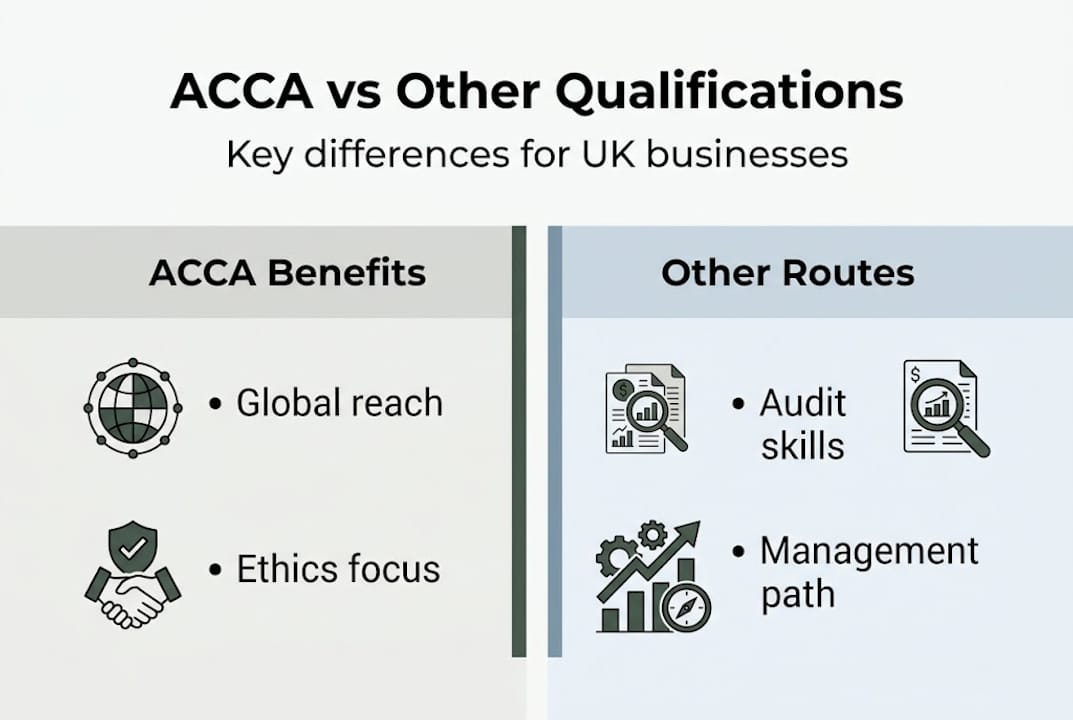
| Qualification | Primary focus | Best use case for SMEs | Global recognition |
|---|---|---|---|
| ACCA | Broad finance, tax, audit, reporting | General accounting, compliance, advisory | Very high, 180 countries |
| ICAEW ACA | Audit and practice | External audit, regulated practice | Strong, primarily UK and Commonwealth |
| CIMA | Management accounting | Internal finance, cost control, strategy | Strong in corporate environments |
For most UK SMEs, ACCA is the most practical choice when hiring a general accountant or finance manager. The breadth of the qualification means an ACCA professional can handle tax compliance, financial reporting, management accounts, and strategic planning without you needing to hire multiple specialists.
ICAEW ACA holders are excellent if your primary need is external audit or regulated practice work. However, the qualification is more narrowly focused and typically commands a higher salary premium. CIMA is ideal if you need someone embedded in operations, focused on cost management and internal decision-making, rather than statutory compliance.
When choosing between these accounting qualification comparisons, consider these factors:
- Compliance needs: ACCA covers HMRC, VAT, and Companies House requirements thoroughly.
- Growth stage: Early-stage SMEs benefit most from ACCA's breadth; larger firms may need CIMA for internal reporting.
- Budget: ACCA professionals are widely available across salary ranges, making them accessible for growing businesses.
- International activity: If you trade globally, ACCA's 180-country recognition adds practical value.
Why UK SMEs prefer ACCA certified professionals
Having compared ACCA with other qualifications, it is time to focus on the practical advantages it delivers for businesses like yours. The benefits go well beyond having a credentialled name on the payroll.

ACCA members are trained to support compliance with HMRC, Companies House, and Making Tax Digital, and studies link certified accountants to an 11.5% revenue uplift for the businesses they serve. That is not a marginal improvement. For a business turning over £500,000, that figure represents a meaningful financial gain.
ACCA also works closely with the Financial Reporting Council to improve audit and reporting standards for smaller businesses, meaning the profession is continuously evolving to serve SME needs specifically.
Here is what ACCA certified professionals typically bring to a UK SME:
- Tax efficiency: Identifying legitimate reliefs and structuring finances to reduce your tax liability legally.
- MTD compliance: Ensuring your digital record-keeping meets HMRC's Making Tax Digital requirements, avoiding penalties.
- Cash flow management: Spotting patterns early and advising on working capital before problems escalate.
- Financial reporting: Producing accurate statutory accounts that satisfy Companies House filing requirements.
- Strategic input: Advising on pricing, investment, and growth decisions backed by solid financial analysis.
Pro Tip: Before hiring, ask candidates for a specific example of how they improved compliance or reduced costs for a previous employer. ACCA professionals should be able to articulate tangible outcomes, not just list responsibilities.
The way accountants add value to a business is often underestimated until something goes wrong. Having ACCA-qualified support means you are far less likely to face HMRC penalties, missed deadlines, or avoidable financial errors. Use a thorough accounting skills checklist to match the right candidate to your specific needs.
The real value of ACCA for SMEs: What many overlook
Here is something most hiring guides will not tell you. Many SMEs hire an ACCA professional and then promptly underutilise them. They assign routine bookkeeping tasks, never ask for strategic input, and wonder why their finances feel static. The qualification signals far more capability than most business owners actually draw on.
There is also a trap worth naming. Some hiring managers fixate on the letters themselves, treating ACCA as a proxy for competence without assessing whether the individual actually fits the business context. A brilliant technical accountant may struggle in a fast-moving SME environment if they lack commercial awareness or communication skills.
The real advantage of hiring accredited accountants for SMEs is not just compliance. It is the ethical and strategic training embedded in the ACCA syllabus that equips these professionals to challenge assumptions, flag risks early, and contribute to business decisions beyond the numbers. That hidden asset is worth actively unlocking. Involve your ACCA accountant in quarterly planning, pricing reviews, and growth conversations. The qualification was designed for exactly that kind of contribution.
Find the right ACCA accountant for your business
Understanding ACCA is one thing. Finding the right person who holds the qualification and fits your business is another challenge entirely.

At Ibaco Recruitment, we specialise in connecting Birmingham and West Midlands businesses with thoroughly vetted, ACCA-qualified finance professionals for permanent roles. Every candidate we put forward has been assessed not just on their qualification, but on their practical experience and business fit. Whether you are ready to find ACCA talent or want to explore how we match candidates to your specific needs, we make the process straightforward. Visit Ibaco to submit your hiring request, and we will typically have matched candidates ready within two weeks, with no upfront fees. You can also browse our full range of employer solutions to see how we support businesses at every stage of growth.
Frequently asked questions
What is the difference between ACCA and Chartered Accountant (ACA) status?
ACCA offers global flexibility and a broad finance focus, while ACA is more audit and practice-centred, particularly within the UK market.
How long does it take to qualify as an ACCA?
The ACCA Qualification takes a minimum of three years of practical experience, plus completion of up to 13 exams and an ethics module.
Are UK businesses required to hire ACCA certified accountants?
It is not a legal requirement, but ACCA professionals provide compliance support and measurable financial benefits that make them a strong choice for growing SMEs.
Do ACCA exams have exemptions for graduates?
Graduates may claim exemptions for lower-level ACCA exams depending on their degree subject, but the final Strategic Professional papers cannot be exempted under any circumstances.