

TL;DR:
- ACCA is a highly respected international accounting qualification with broad technical and ethical training.
- ACCA pass rates reflect the qualification's rigor, with lower rates at advanced levels indicating complex judgment skills.
- Birmingham's growing financial sector values ACCA for its international scope, IFRS expertise, and future skills focus.
Not all accountancy qualifications are equal, and if you're hiring finance professionals in Birmingham, that distinction matters far more than you might think. The ACCA, short for the Association of Chartered Certified Accountants, is one of the most respected and widely recognised accounting credentials in the world. Yet many HR managers and business owners treat it as simply another line on a CV, interchangeable with AAT, ACA, or CIMA. This guide cuts through that confusion by explaining exactly what ACCA certification is, how it works, what the exam data tells you about candidate quality, and how Birmingham's finance market makes it particularly valuable for your next hire.
Table of Contents
- What is ACCA certification?
- How the ACCA qualification works: Structure and requirements
- Exams, pass rates, and what they mean for employers
- Why Birmingham's market demands ACCA-qualified professionals
- What's changing for ACCA in 2027 and why it matters for future-proofing
- What most guides miss: Getting the best from ACCA-qualified hires
- Need help hiring ACCA-qualified experts for your Birmingham team?
- Frequently asked questions
Key Takeaways
| Point | Details |
|---|---|
| Global recognition | ACCA certification signals technical and ethical competence valued worldwide. |
| Flexible qualification routes | Exemptions and multiple entry points make ACCA accessible for diverse hires. |
| Rigorous exam standards | Varied pass rates mean ACCA graduates bring proven knowledge and persistence. |
| Demand in Birmingham | Local data shows high demand and salary premiums for ACCA-certified staff. |
| Future-ready curriculum | 2027 updates ensure ACCA candidates stay relevant with digital and ethical skills. |
What is ACCA certification?
ACCA stands for the Association of Chartered Certified Accountants, a global professional body founded in 1904. Unlike some qualifications that are largely domestic, ACCA was built with international scope at its core. It trains accountants in International Financial Reporting Standards (IFRS), which are the accounting rules used by most listed companies, multinational organisations, and a growing number of UK SMEs operating across borders.
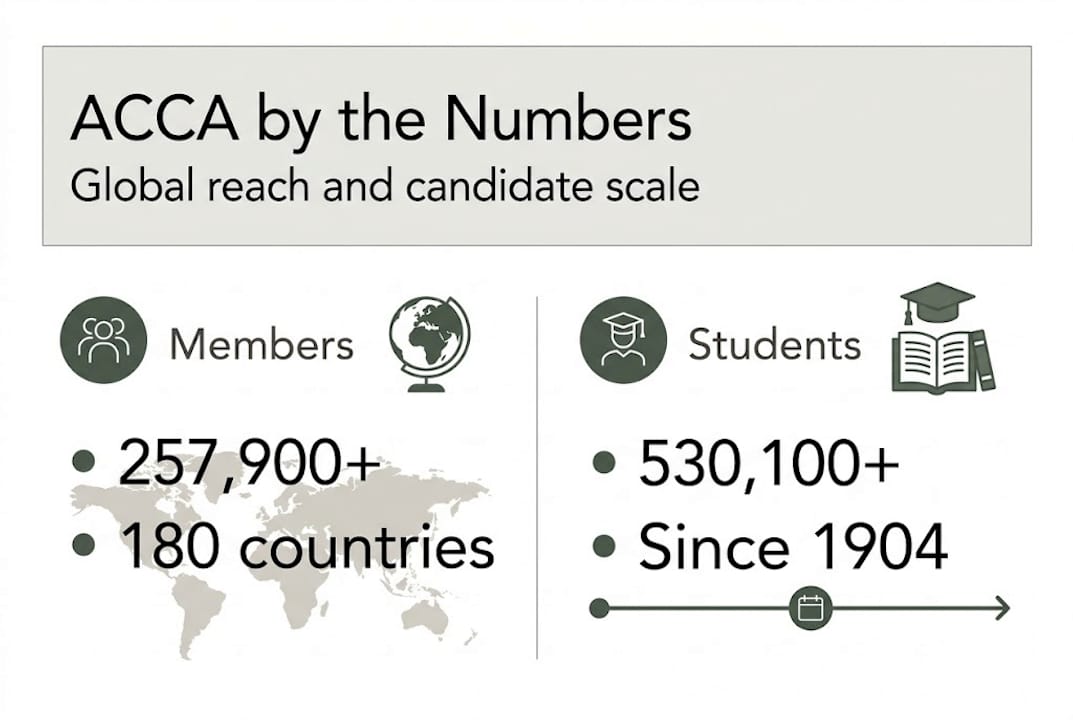
The scale is significant. Over 257,900 members and 530,100 students in 180 countries hold or are pursuing ACCA, making it one of the largest accountancy bodies on the planet. For Birmingham businesses that trade internationally, or that deal with overseas clients and investors, hiring someone trained in IFRS is a practical advantage, not merely a prestige point.
So how does ACCA compare to its peers? ACA (offered by ICAEW) is often seen as the gold standard for audit and practice roles within UK firms. CIMA focuses heavily on management accounting and business strategy. The American CPA is US-specific and less relevant to UK compliance. ACCA sits uniquely in between: it covers both financial and management accounting, audit, taxation, and ethics, giving candidates broad commercial awareness alongside technical rigour.
Here is why HR managers consistently value ACCA-certified candidates:
- Broad technical coverage across financial reporting, audit, tax, and management accounting
- IFRS fluency, critical for businesses with international dealings
- Ethical training embedded throughout the qualification
- Flexibility, as ACCA-qualified accountants can work across practice, commerce, and industry
- Global portability, reassuring for businesses seeking long-term, adaptable employees
For further context on how ACCA sits within the wider landscape, the UK accounting qualifications explained guide is worth reviewing alongside this article.
How the ACCA qualification works: Structure and requirements
Earning an ACCA qualification is no small undertaking, and understanding the structure helps you assess candidates more accurately during shortlisting.
The qualification is organised across three levels. The up to 13 exams required span Applied Knowledge, Applied Skills, and Strategic Professional, alongside a mandatory Ethics and Professional Skills module and three years of relevant practical work experience.
| Level | Exams | Typical duration | Common exemptions |
|---|---|---|---|
| Applied Knowledge | 3 | 6–12 months | Available for degree holders |
| Applied Skills | 6 | 12–18 months | Available with relevant qualifications |
| Strategic Professional | 4 | 12–18 months | None |
Candidates with prior qualifications or relevant degrees can access up to 9 exemptions covering the Applied Knowledge and Applied Skills levels. Crucially, no exemptions exist for the Strategic Professional level, so every fully qualified ACCA member has passed those advanced papers, regardless of their background.
The steps to ACCA membership work broadly as follows:
- Register with ACCA and confirm eligibility
- Claim applicable exemptions based on prior qualifications
- Sit and pass Applied Knowledge exams
- Complete Applied Skills exams
- Finish the Ethics and Professional Skills module
- Sit and pass all four Strategic Professional exams
- Log and verify three years of relevant practical experience
- Apply for full ACCA membership
For businesses hiring junior or part-qualified candidates, it is worth checking the accounting qualifications for SMEs breakdown to understand where a candidate sits in their journey. Being aware of the accounting compliance checklist for UK SMEs can also help frame what skills your business actually needs.
Pro Tip: Ask candidates whether their undergraduate degree granted exemptions. A finance or accounting degree could cut their exam load significantly, meaning they qualified faster and may be more recently tested on advanced topics.
Exams, pass rates, and what they mean for employers
Pass rates tell you something important: ACCA is genuinely hard to complete, and the difficulty scales up sharply at higher levels.

ACCA publishes its results data publicly, and the December 2025 figures show Applied Knowledge averaging 73%, Applied Skills at 50%, and Strategic Professional at approximately 45%, across over 120,000 students sitting that session. At the top of the difficulty curve, the Advanced Audit and Assurance paper carries a pass rate of around 38%, while the Business and Technology paper at Knowledge level sits around 87%.
| Qualification | Knowledge level pass rate | Professional level pass rate |
|---|---|---|
| ACCA | ~73% | ~45% |
| CIMA | ~65% | ~50% |
| ACA | ~80% | ~55% |
What does this tell you as an employer? A fully qualified ACCA member has demonstrated persistence, intellectual rigour, and the ability to handle complex, written, scenario-based assessments. The lower pass rates at Strategic Professional are not accidental. Those papers test judgement, not just technical recall, which is precisely what senior finance roles demand.
For employers, the practical implication is role fit. Candidates strong in finance recruitment trends confirm that ACCA-qualified professionals cluster naturally in external reporting, audit support, financial analysis, and compliance roles, where their IFRS training and ethical grounding add tangible value.
Pro Tip: When reviewing CVs, note the dates of recent exam passes. A candidate who sat Strategic Professional papers within the last two years is likely more current on evolving reporting standards than one who qualified a decade ago without continuing development.
Why Birmingham's market demands ACCA-qualified professionals
Birmingham is not just the UK's second city by population. It is a growing financial services hub, home to significant operations from major banks, professional services firms, and a thriving SME sector that increasingly requires sophisticated financial oversight.
The numbers reflect real demand. Median ACCA salaries in Birmingham and the West Midlands range from £31,000 to £65,000, with 49 active job adverts citing ACCA at any given time. That breadth of salary range reflects how ACCA-qualified professionals appear at every level, from part-qualified management accountants to senior finance directors.
"Birmingham's finance market is active, and ACCA remains one of the most frequently requested qualifications across sectors ranging from professional services to manufacturing and retail."
The sectors actively seeking ACCA-qualified candidates in Birmingham include:
- Audit and assurance within mid-tier and Big Four satellite offices
- Commerce and industry including manufacturing, retail, and logistics
- SMEs requiring versatile accountants who can handle reporting and tax
- Corporate finance teams needing IFRS-literate analysis and reporting staff
- Financial services firms requiring regulatory and compliance-aware professionals
The accountancy firms' role in the UK is expanding, and Birmingham sits at the centre of that regional growth. When shortlisting ACCA candidates, prioritise those with sector-specific experience in your industry. A manufacturing firm and a financial services company may both want ACCA on the CV, but the day-to-day demands are vastly different. Explore accounting roles in Birmingham 2026 to match qualifications to specific role types, and review the accountant recruitment process to structure your hiring approach.
What's changing for ACCA in 2027 and why it matters for future-proofing
ACCA is not standing still. From 2027, the qualification will undergo a significant redesign. The new curriculum will introduce employability modules covering artificial intelligence, ethics, and sustainability, alongside more interactive and scenario-based learning formats. Current students will be supported through the transition.
This matters for your hiring decisions right now. Candidates qualifying under the current framework have deep technical grounding. Those who qualify under the 2027 structure will arrive with additional fluency in AI-assisted financial analysis, environmental reporting, and evolving ethical frameworks. Neither cohort is superior, but they offer different strengths.
The top skill shifts for future ACCA graduates include:
- AI literacy, including using data analytics tools in financial modelling and audit
- Sustainability reporting, covering ESG metrics and environmental disclosures
- Advanced ethics, going beyond existing codes to address emerging dilemmas in technology and global finance
- Integrated thinking, connecting financial and non-financial performance for stakeholders
- Adaptive communication, presenting complex financial information to non-finance audiences
For Birmingham HR managers building teams beyond the next two or three years, these skill shifts are worth factoring into your candidate profiles now. Reviewing the UK accounting qualifications explained resource will help you map current and future candidates onto the roles you are building towards.
What most guides miss: Getting the best from ACCA-qualified hires
Here is a view you will not find in most recruitment guides: having ACCA on a CV does not automatically tell you whether someone will perform well in your business. The qualification confirms rigour and technical competence. It does not guarantee sector fit, communication style, or the ability to work within your culture.
In our experience working with Birmingham businesses, the hires that underperform are rarely technically unqualified. They are people whose knowledge was never properly connected to the business context. An ACCA-qualified candidate who studied complex IFRS consolidations may struggle in a hands-on SME environment where speed, pragmatism, and cross-functional collaboration matter more than textbook precision.
The best interview approach we have seen works like this: present candidates with a real financial scenario from your business, strip out sensitive figures, and ask them to walk you through their thought process out loud. That exercise reveals far more than asking them to recite what their exams covered.
Cultural fit and genuine enthusiasm for your sector matter enormously. Candidates who are still actively pursuing CPD, engaging with ACCA's continuing education requirements, and staying current on Birmingham finance recruitment insights tend to be the ones who grow into long-term assets. The badge matters. The person behind it matters more.
Need help hiring ACCA-qualified experts for your Birmingham team?
Recruiting for ACCA roles involves more than matching a qualification to a job title. It means understanding candidate pathways, exam histories, practical experience quality, and how all of that maps to your specific business needs.

At Ibaco Recruitment, we specialise in connecting Birmingham businesses with thoroughly vetted, ACCA-qualified finance professionals for permanent roles. Our bookkeeper and accountant recruitment services are built around the local market, with no upfront fees and placements typically completed within two weeks. If you are ready to find the right person, explore our pool of ACCA-qualified jobseekers and let us handle the matching.
Frequently asked questions
How long does it take to complete the ACCA qualification?
Completion typically takes 3 to 4 years, covering all exams, the mandatory ethics module, and three years of relevant practical experience.
Can ACCA exemptions speed up the qualification?
Yes. Prior degrees and certain qualifications can grant up to 9 exemptions for Applied Knowledge and Applied Skills papers, meaningfully reducing the overall exam load.
Are ACCA exams difficult?
Difficulty varies significantly by level. Knowledge exams average 73% pass rates, while Strategic Professional papers average closer to 45%, reflecting the depth of judgement required.
Is ACCA certification valued more than CIMA or ACA in Birmingham?
ACCA is particularly valued for its global versatility and IFRS focus, but the best choice depends on your specific role requirements and whether the position leans towards management, audit, or financial reporting.
What's new in ACCA from 2027?
From 2027, ACCA will introduce new modules covering AI, ethics, and sustainability, preparing future graduates for the evolving demands of the finance profession.