

Growing a Birmingham business means facing tax deadlines, payroll questions, and ever-changing compliance rules that can quickly become overwhelming. You need more than basic bookkeeping—you need expert support from a local accountant who understands both national regulations and the unique challenges in Birmingham. With professionally qualified accountants offering tailored financial management, compliance advice, and day-to-day support, you can focus on your business while staying confident that everything from pay slips to tax planning is handled by someone invested in your success.
Table of Contents
- What Local Accountants Offer Businesses
- UK Accounting Qualifications and Skills
- Compliance with Local and National Regulations
- Benefits Over Outsourced or Remote Staff
- Common Pitfalls When Hiring Accountants
Key Takeaways
| Point | Details |
|---|---|
| Comprehensive Financial Services | Local accountants in Birmingham provide essential services beyond tax filing, including bookkeeping, payroll management, and VAT compliance to ensure financial accuracy and regulatory adherence. |
| Strategic Business Insights | They offer management accounting and forecasting services that help businesses understand profitability and plan for future growth, enabling informed decision-making. |
| Qualified Expertise | Hiring accountants with recognised qualifications (AAT, ACCA, ICAEW, or CIMA) ensures competent handling of financial matters and adherence to ethical standards, ultimately protecting your business interests. |
| Accessibility and Local Knowledge | Local accountants facilitate direct communication and understand the unique challenges of Birmingham businesses, providing tailored advice and responsive support that enhances business operations. |
What Local Accountants Offer Businesses
Local accountants go far beyond filing tax returns once a year. They become financial partners who help your business run smoothly while keeping you compliant with regulations.
Here's what you can expect from a qualified local accountant in Birmingham:
Core Financial Services
Your accountant handles bookkeeping and accounts preparation, ensuring your financial records are accurate and up to date. This means day-to-day transaction recording, reconciliation of bank accounts, and preparation of financial statements that banks and creditors trust.
Payroll management takes the complexity out of employee payments. They calculate salaries, handle PAYE deductions, manage pension contributions, and submit records to HMRC on your behalf.
VAT compliance keeps you on the right side of tax authorities. If your turnover exceeds the threshold, local accountants ensure you're meeting Making Tax Digital requirements and submitting returns accurately.
Tax and Compliance Support
Accountants specialise in multiple tax areas:
- Corporation tax for limited companies
- Personal income tax planning for directors and sole traders
- Capital gains tax advice on asset sales
- Business income tax optimisation
- Inheritance tax planning for complex family situations
They help you understand compliance with Making Tax Digital regulations, ensuring your records meet HMRC standards without penalties.
Strategic Financial Advice
Beyond compliance, local accountants offer genuine business insight. Management accounting helps you understand profitability by department or product. Budgeting and forecasting allows you to plan cash flow, identify seasonal trends, and anticipate financial challenges.
They advise on choosing the right accounting methods for your business structure and provide guidance that helps you focus on growth rather than financial administration.
Additional Specialist Services
Many local accountants also offer:
- Internal audit and financial reviews
- Company secretarial support
- Financial advice for mortgage purposes (banks often require accountant-prepared accounts)
- Essential financial advice and compliance support tailored to business needs
Local accountants work within strict ethical and practice standards, which means you're getting qualified advice you can rely on.
They understand local Birmingham businesses, regional economic trends, and the specific challenges small to medium-sized companies face. This isn't generic advice—it's tailored to your situation.
Pro tip: When engaging a local accountant, ask specifically which accounting software they use (Xero, Sage, or QuickBooks) and whether they charge fixed fees or hourly rates for different services—this clarity upfront prevents billing surprises later.
Here is a summary of how local accountants support Birmingham businesses:
| Area of Support | Practical Examples | Main Business Benefit |
|---|---|---|
| Bookkeeping & Records | Daily transaction logging, reconciliation | Reliable financial data |
| Payroll Services | PAYE, auto-enrolment, HMRC submissions | Stress-free employee payments |
| VAT Compliance | Digital VAT returns, software advice | Avoidance of HMRC penalties |
| Tax Planning & Advice | Corporation, income, and capital gains tax | Tax efficiency and savings |
| Strategic Decision Support | Budgeting, forecasting, management accounts | Informed growth planning |
| Regulatory Compliance | Deadlines, Making Tax Digital implementation | Smooth audits and inspections |
UK Accounting Qualifications and Skills
Not all accountants are equal. The ones you hire in Birmingham should hold recognised professional qualifications that prove their competency and commitment to ethical standards.
The UK accountancy profession is built on credentials from established professional bodies. These qualifications aren't handed out lightly—they require rigorous training, practical experience, and assessment.
Major UK Accounting Qualifications
When hiring a local accountant, look for these recognised credentials:
- AAT (Association of Accounting Technicians) – Entry-level through advanced bookkeeping and accounting qualifications
- ACCA (Association of Chartered Certified Accountants) – Comprehensive accounting and tax expertise
- ICAEW (Institute of Chartered Accountants in England and Wales) – The gold standard Chartered Accountant qualification
- CIMA (Chartered Institute of Management Accountants) – Specialises in management accounting and financial strategy
Each qualification demands different levels of experience and study. A professional accountant holding AAT, ICAEW, ACCA, or CIMA credentials proves they've met strict competency standards in bookkeeping, taxation, financial accounting, and advisory services.
The following table clarifies the main UK accountancy qualifications and what they indicate:
| Qualification | Typical Focus Area | Relevant Skills for Businesses |
|---|---|---|
| AAT | Bookkeeping and accounts | Day-to-day accounts, compliance |
| ACCA | Broad financial expertise | Taxation, reporting, advisory |
| ICAEW | Chartered accountancy | Advanced analysis, audit, strategy |
| CIMA | Management accounting | Finance leadership, strategic planning |
What These Qualifications Mean for Your Business
Qualified accountants undergo rigorous assessments in multiple areas. They're trained in taxation expertise, financial reporting standards, auditing principles, and advisory services that directly benefit your business.

These professionals understand Making Tax Digital compliance, corporation tax planning, payroll regulations, and VAT requirements. More importantly, they stay updated as rules change throughout the year.
Ethical and Technical Standards
UK qualified accountants uphold strict ethical and technical standards set by their professional bodies. This means you're getting advice you can trust, backed by regulation and professional oversight.
If something goes wrong, you have recourse through their professional body. Qualified accountants carry professional indemnity insurance and are accountable for their work.
Hiring a qualified accountant isn't just about compliance—it's about having someone who can advise on tax planning, statutory compliance, and financial strategy with proven expertise.
Small to medium-sized businesses benefit most from accountants with tax and advisory experience. They understand challenges specific to growing companies and can offer practical solutions, not just bookkeeping.
Look beyond the qualification itself. Ask about their experience in your industry, the software they use, and whether they've worked with businesses similar to yours in Birmingham.
Pro tip: When interviewing accountants, ask to see proof of their professional qualification and confirm their membership is current—this takes 30 seconds and guarantees you're getting genuine expertise.
Compliance with Local and National Regulations
Regulatory requirements change constantly. HMRC updates rules, Making Tax Digital evolves, and penalties for non-compliance grow steeper each year. A local accountant keeps you ahead of these changes and protects your business from costly mistakes.
Tax Adviser Registration and HMRC Interaction
Qualified accountants handle direct communication with HMRC on your behalf. They submit your tax returns, claims, and supporting documents—ensuring everything meets current standards and deadlines.
Some accountants are registered tax advisers with HMRC. This registration matters because it grants them official authority to represent you and access HMRC systems directly. Tax adviser registration with HMRC requires meeting strict standards that protect your interests.
Key Compliance Areas Your Accountant Manages
Local accountants ensure you meet obligations across multiple areas:
- VAT compliance – Correct registration, timely returns, and accurate records
- PAYE administration – Accurate payroll withholding and monthly submission to HMRC
- Corporation tax – Proper calculation and filing for limited companies
- Business income tax – Accurate self-assessment for sole traders and partnerships
- Accounts filing – Timely submission to Companies House (for limited companies)
Each area has specific deadlines and penalties for lateness. Missing a VAT return deadline costs £200 per month. Late accounts filing attracts escalating fines. Your accountant ensures these never happen.
Making Tax Digital Compliance
Accountants guide businesses through Making Tax Digital requirements, including maintaining digital records and submitting returns electronically. They advise on choosing the right accounting software and ensure your records meet HMRC standards.
They also help you understand which exemptions apply to your business and when the rules change.
Financial Record Keeping Standards
Proper record keeping isn't just good practice—it's a legal requirement. Accountants ensure your bookkeeping meets standards for accuracy, completeness, and audit trail.
This protects you in two ways. First, if HMRC ever investigates, your records will withstand scrutiny. Second, accurate records help you make better business decisions.
Local accountants reduce your regulatory risk by staying current with changes and ensuring timely, accurate submissions—avoiding penalties that can reach thousands of pounds.
They understand local Birmingham business needs and national requirements, creating a compliance strategy tailored to your situation.
Pro tip: Set up automatic monthly accounting reviews with your accountant rather than dealing with everything at year-end—this catches compliance issues early when they're cheaper to fix.
Benefits Over Outsourced or Remote Staff
There's a fundamental difference between a remote accountant you email questions to and a local accountant who understands your business inside and out. When something urgent happens, you need someone who can respond immediately—not wait for a timezone to align.
Direct Communication and Accessibility
Local accountants offer face-to-face meetings when you need them. You can walk into their office with a query and leave with answers the same day. No email chains. No scheduling video calls across time zones.
This accessibility matters when emergencies occur. A supplier dispute affects your cash flow. HMRC sends a letter with questions. You need immediate advice. Remote accountants often can't deliver that speed.
Local accountants provide direct communication and faster, more responsive service compared to outsourced alternatives, building relationships based on regular in-person contact.
Understanding Your Local Market
Birmingham's business environment is distinct. Economic conditions, industry concentrations, and regional regulations differ from other areas. A local accountant understands these nuances.
They know which sectors dominate in the city, what challenges manufacturers face versus service businesses, and how local property values affect valuations. This context shapes better advice.
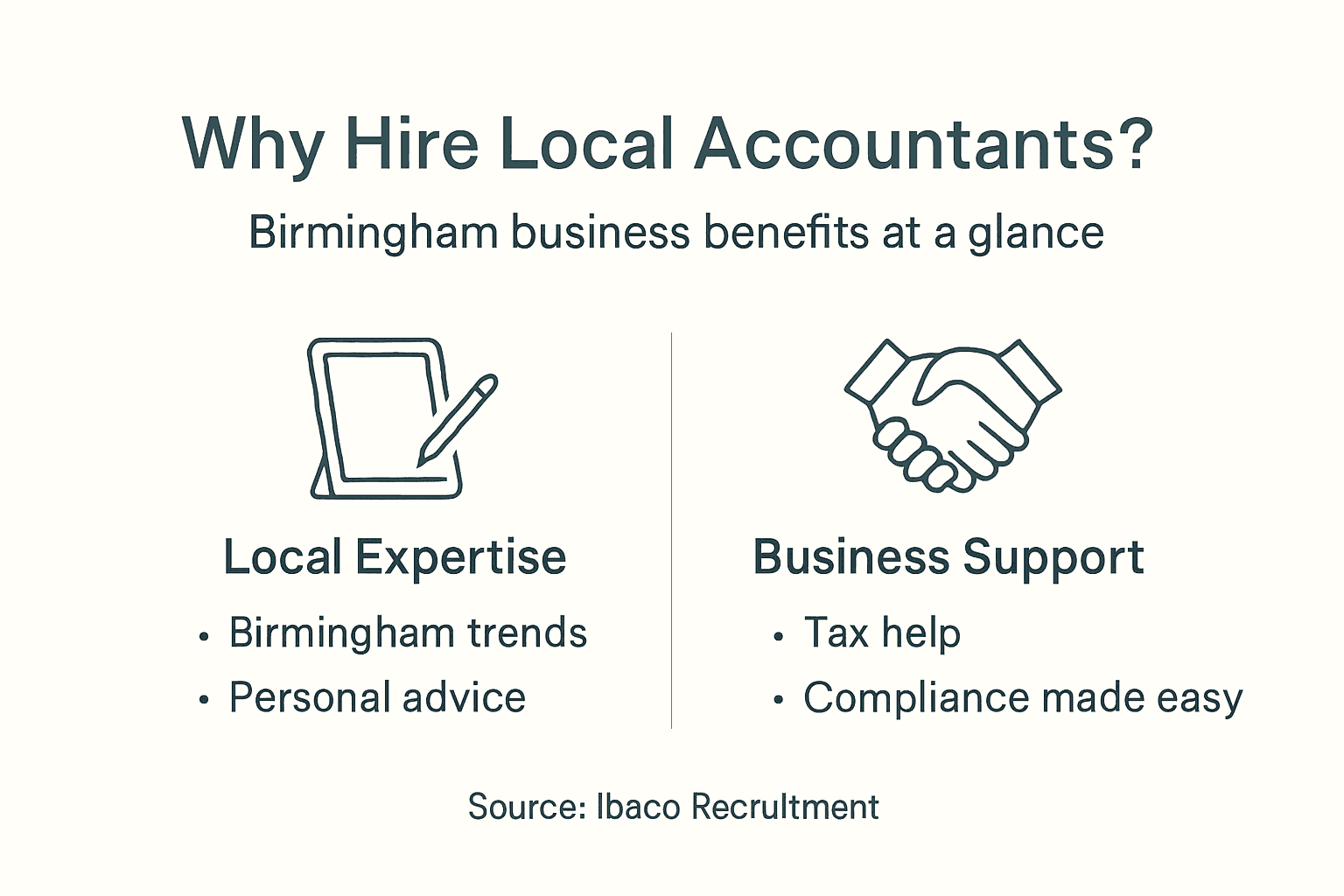
Outsourced accountants work with generic templates. Local ones tailor recommendations to your actual situation.
Building Genuine Relationships
Personalised service builds trust. When your accountant knows your business, your staff, and your aspirations, they become genuine advisors—not transaction processors.
This matters for long-term planning. Tax strategy evolves with your business. An accountant who understands your five-year plan can structure decisions accordingly.
Remote relationships stay transactional. Local relationships become partnerships.
Responsiveness to Urgent Matters
When you need something urgently, delays cost money. A local accountant can prioritise your request and deliver fast.
Compare these scenarios:
- Local accountant: "I'll review this today and ring you this afternoon."
- Outsourced firm: "We'll add this to the queue. You should hear back within 5 business days."
One costs you nothing extra. The other costs you time and opportunity.
Local accountants deliver superior responsiveness because they're embedded in your community, available for urgent meetings, and invested in your success—something remote arrangements simply cannot replicate.
They understand regional business practices and can explain decisions in the context you care about. Your business isn't a case number; it's a relationship.
Pro tip: When meeting with a local accountant candidate, ask specifically about their average response time for urgent queries and whether they offer evening or early morning appointments—this reveals their commitment to accessibility.
Common Pitfalls When Hiring Accountants
Hiring the wrong accountant costs far more than you'd expect. Bad advice cascades through your finances. Missed deadlines trigger penalties. And you waste time managing someone who isn't delivering.
Avoid these common mistakes from the start.
Not Verifying Qualifications and Memberships
This is the biggest mistake. You assume someone is qualified because they call themselves an accountant. They're not.
Always verify credentials with professional bodies like AAT, ACCA, ICAEW, or CIMA. Check their membership status on the body's website. Ask for proof. It takes minutes and prevents hiring unqualified staff.
Unqualified accountants miss tax-saving opportunities, misinterpret regulations, and expose you to HMRC penalties. Verifying professional qualifications and ethical standards protects your business from inexperienced practitioners.
Ignoring Industry and Software Experience
Different industries have unique accounting challenges. Manufacturing differs vastly from retail or professional services. An accountant unfamiliar with your sector gives generic advice.
Also verify accounting software knowledge. If they've never used Xero or Sage and you rely on those tools, they'll struggle. This creates bottlenecks immediately.
Ask specific questions: "Have you worked with manufacturing businesses?" and "Which accounting software do you specialise in?"
Unclear Fee Structures
You agree to hire someone without discussing costs. Months later, you're shocked by bills. This happens constantly.
Clear fee discussions prevent conflict:
- Fixed monthly retainer or hourly rate?
- What's included in the base fee?
- Which services cost extra?
- When are you invoiced?
Get everything in writing. A one-page service agreement costs nothing and saves arguments later.
Overlooking Making Tax Digital Knowledge
You need accountants with up-to-date knowledge on digital accounting and Making Tax Digital regulations. If they don't understand MTD requirements, they can't help you comply.
Ask directly: "How do you help clients meet Making Tax Digital obligations?" Their answer reveals their knowledge level.
Underestimating Communication and Responsiveness
You hire someone who disappears when you need them. Emails go unanswered for weeks. Calls aren't returned.
Establish communication expectations upfront. How quickly do they respond to queries? Are they available for urgent meetings? Do they proactively contact you with updates?
Poor communication kills even technically competent accountants. Always assess responsiveness and communication style before hiring—mismatches become painful very quickly.
Test this during your initial meetings. Do they listen? Do they ask questions about your business? Or do they rush through conversations?
Failing to Check References
Ask for client references and actually contact them. Ask specifically about responsiveness, quality of advice, and whether they'd hire the accountant again.
References reveal what you won't discover in interviews.
Pro tip: Create a hiring checklist with non-negotiable items: verified qualifications, industry experience, your accounting software knowledge, fixed fee quote, and three reference checks—follow this and you'll avoid 90% of hiring mistakes.
Find Trusted Local Accountants for Your Birmingham Business Today
Hiring a local accountant who understands Birmingham’s unique market and UK accounting standards is critical to avoid costly compliance errors and gain personalised financial insight. If you are struggling with finding qualified professionals familiar with AAT, ACCA, or CIMA qualifications and software like Xero or Sage, Ibaco Recruitment offers a solution designed specifically for Birmingham-based small to medium businesses. Their thorough vetting process means you connect with skilled candidates who are ready to support your business’s tax planning, payroll management, and Making Tax Digital compliance from day one.
Don’t let your accounting needs slow your growth. Visit Ibaco Recruitment now to submit your hiring request and access a pool of vetted local finance talent. Experience quick placements often within two weeks and enjoy clear, transparent recruitment with no upfront fees. Secure your trusted finance professional today and ensure your business thrives with expert local accounting support.
Frequently Asked Questions
What services do local accountants provide for businesses?
Local accountants offer a range of services including bookkeeping, payroll management, VAT compliance, tax planning, and strategic financial advice. They ensure your financial records are accurate, help you plan for taxes, and support compliance with regulations.
How can a local accountant help with Making Tax Digital compliance?
Local accountants assist with Making Tax Digital by advising on the right accounting software, maintaining accurate digital records, and ensuring timely submission of VAT and tax returns according to HMRC standards.
Why is it important to verify the qualifications of an accountant?
Verifying qualifications ensures that the accountant is competent and has the necessary expertise to provide reliable financial advice. Qualified accountants are more likely to keep up-to-date with regulatory changes and can provide accurate, compliant services.
What considerations should I make when selecting an accountant for my business?
When selecting an accountant, consider their qualifications, industry experience, familiarity with accounting software, clear fee structures, communication style, and responsiveness. Asking for references can also help gauge their reliability and service quality.
Recommended
- Why Hire a Local Birmingham Accountant? Key Benefits
- Hire Accountants in Birmingham (2026 Guide) | IBACO Recruitment Experts
- Hire Accountants in Birmingham (2026 Guide) | IBACO Recruitment Experts
- Bookkeeper & Accountant Recruitment Insights | IBACO Recruitment
- United Kingdom Tax Calculator 2026 — Net Salary After Tax | ShouldIMove