

Many believe years of experience alone make an expert bookkeeper, but without formal UK qualifications, costly compliance issues often follow. Understanding the difference between genuine qualifications and mere experience is essential for Birmingham and West Midlands businesses seeking reliable bookkeeping support. This guide clarifies what truly defines a qualified bookkeeper, from recognised certifications like AAT and ACCA to practical software proficiency and ethical standards that protect your business.
Table of Contents
- Introduction to bookkeeping qualifications in the UK
- Understanding UK accounting standards and regulatory compliance
- Essential software proficiency for qualified bookkeepers
- Common misconceptions about bookkeeping qualifications
- Practical hiring framework for West Midlands businesses
- Ethical and professional standards in UK bookkeeping
- Summary and next steps for hiring qualified bookkeepers
- Find qualified bookkeepers with Ibaco recruitment
- Frequently asked questions
Key takeaways
| Point | Details |
|---|---|
| Formal qualifications matter | AAT, ACCA, and CIMA certifications demonstrate standardised UK accounting knowledge and ethical training essential for compliance. |
| Software proficiency is critical | Competence with Xero, Sage, and QuickBooks reduces errors and shortens onboarding periods significantly. |
| Ethical compliance protects businesses | GDPR adherence and confidentiality safeguards prevent legal penalties and protect sensitive financial data. |
| Experience alone isn't enough | Misconceptions about qualifications versus experience lead to recruitment errors and compliance risks. |
| Structured vetting speeds hiring | Practical frameworks including certificate verification and skill testing ensure better candidate evaluation. |
Introduction to bookkeeping qualifications in the UK
Formal bookkeeping qualifications provide the foundation for accurate financial management in UK businesses. These certifications ensure bookkeepers understand both technical accounting principles and the ethical standards required by law.
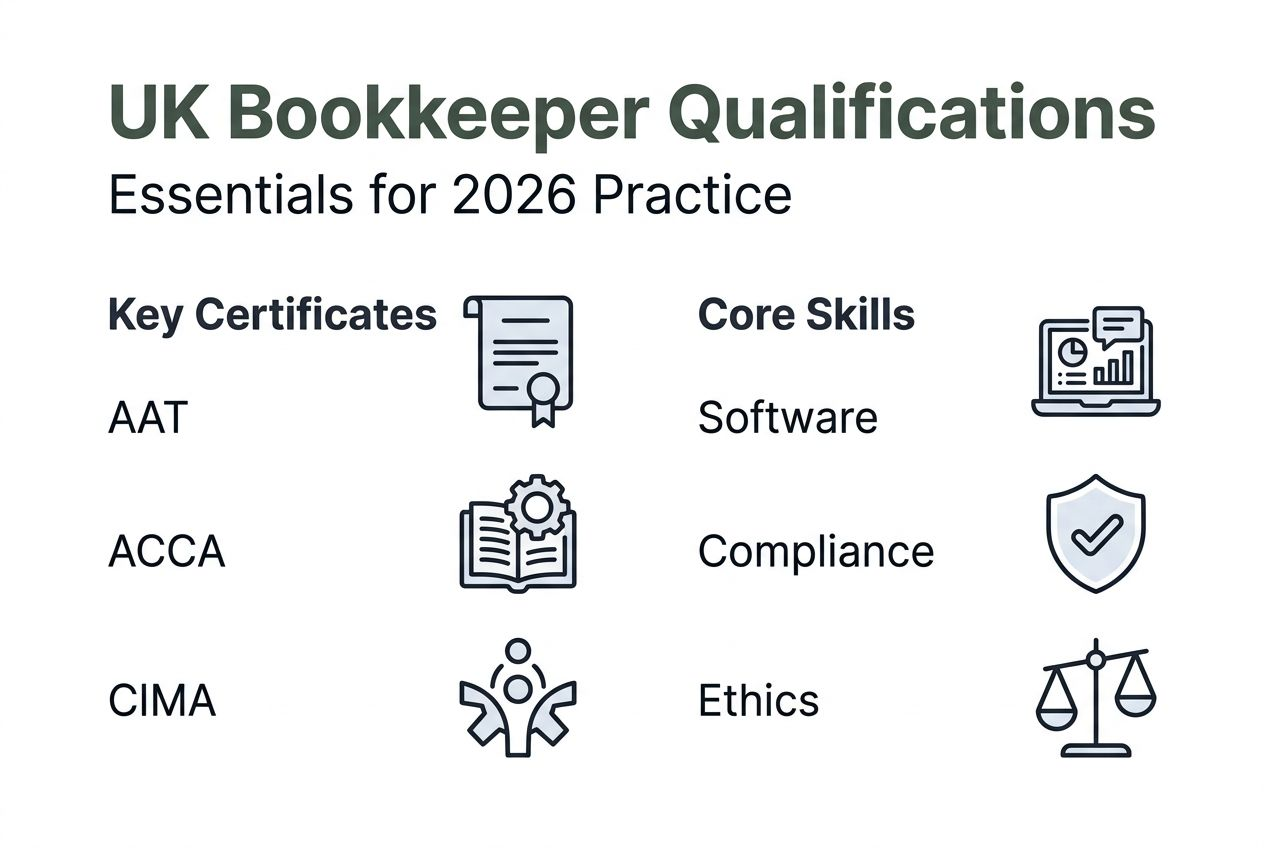
The Association of Accounting Technicians (AAT) offers practical training focused on bookkeeping fundamentals, VAT returns, and payroll management. Most entry and mid-level bookkeepers in the West Midlands hold AAT qualifications, making it the most recognised credential for day-to-day financial tasks.
ACCA (Association of Chartered Certified Accountants) covers broader accounting topics including auditing, taxation, and financial reporting. Whilst typically associated with accountants, many senior bookkeepers pursue ACCA to expand their expertise and career prospects.
CIMA qualification is valued for its comprehensive training in management accounting and financial analysis. CIMA-qualified professionals bring strategic financial insight increasingly valuable to growing businesses needing both compliance and planning support.
Qualification comparison:
| Qualification | Primary focus | Typical role level | Recognition scope |
|---|---|---|---|
| AAT | Practical bookkeeping, VAT, payroll | Entry to mid-level | UK-wide, essential baseline |
| ACCA | Accounting, auditing, taxation | Mid to senior level | International, comprehensive |
| CIMA | Management accounting, analysis | Senior bookkeeping to finance management | UK and global, strategic |
When you hire a bookkeeper in Birmingham, these qualifications directly correlate with salary expectations and compliance reliability. AAT-qualified candidates typically command £22,000 to £28,000 annually, whilst ACCA or CIMA credentials push salaries toward £32,000 or higher.
Pro Tip: Always verify qualifications through official registers before finalising job offers. AAT maintains a searchable member directory, and ACCA offers online verification tools that confirm active membership status within minutes.
Qualifications also determine how quickly bookkeepers adapt to regulatory changes. Certified professionals receive ongoing updates about UK GAAP modifications and tax law amendments, ensuring your business remains compliant without constant supervision.
Understanding UK accounting standards and regulatory compliance
UK Generally Accepted Accounting Practice (UK GAAP) provides the framework all qualified bookkeepers must follow. These standards ensure financial statements accurately reflect business performance and comply with legal requirements.

Formal UK bookkeeping qualifications ensure standardised knowledge of accounting rules and ethical standards necessary for compliance. Without this foundation, bookkeepers may inadvertently misclassify transactions or overlook critical reporting obligations.
GDPR compliance is non-negotiable in modern bookkeeping. Bookkeepers handle sensitive financial data including employee salaries, supplier payment details, and client transaction histories. A single data breach can result in fines up to £17.5 million or 4% of global turnover, whichever is higher.
Key compliance responsibilities include:
- Maintaining accurate audit trails for all financial transactions
- Implementing secure data storage systems with encryption and access controls
- Understanding VAT regulations and filing accurate quarterly returns
- Recognising when to escalate complex tax scenarios to qualified accountants
- Protecting client confidentiality through proper information handling protocols
Confidentiality obligations extend beyond data protection laws. Professional bookkeepers sign non-disclosure agreements and understand the severe reputational damage that follows breaches of trust. Your financial information remains strictly confidential when handled by properly qualified professionals.
Legal risks multiply quickly with unqualified bookkeepers. Incorrect VAT submissions trigger HMRC investigations, whilst poor record-keeping complicates tax audits and creates unnecessary business disruption. Qualified bookkeepers recognise warning signs early and maintain documentation standards that satisfy regulatory scrutiny.
"Professional qualifications embed the ethical framework and technical knowledge that protects businesses from costly compliance failures and reputational harm."
For bookkeeper recruitment insights, understanding these standards helps you ask informed interview questions that separate genuinely qualified candidates from those with surface-level knowledge.
Essential software proficiency for qualified bookkeepers
Software competence transforms bookkeeping efficiency and accuracy. In 2026, approximately 83% of UK SMBs rely on cloud-based accounting platforms like Xero, Sage, or QuickBooks to manage their finances.
Proficiency with these tools dramatically reduces onboarding periods. A bookkeeper experienced with your chosen software becomes productive within days rather than weeks, immediately adding value to your finance operations.
Software comparison for West Midlands businesses:
| Platform | Best suited for | Key features | Learning curve |
|---|---|---|---|
| Xero | SMBs, growing businesses | Real-time reporting, bank reconciliation, multi-currency | Moderate |
| Sage | Established businesses, manufacturing | Inventory management, payroll integration, compliance tools | Moderate to steep |
| QuickBooks | Small businesses, freelancers | Simple invoicing, expense tracking, mobile access | Low to moderate |
Software skills directly impact error rates. Manual data entry mistakes decrease by up to 60% when bookkeepers properly utilise automated bank feeds and reconciliation features. These tools also flag unusual transactions, helping prevent fraud and catch errors before they compound.
When you hire a bookkeeper in Birmingham, testing software proficiency during interviews provides clear evidence of practical capability. Simple tasks like reconciling a sample bank statement or generating a profit and loss report reveal genuine competence quickly.
Pro Tip: Request candidates complete a timed practical test using your actual accounting software during the interview process. This 30-minute exercise reveals far more about real-world capability than theoretical questions ever could.
Cloud-based platforms also enable remote collaboration, increasingly important for flexible working arrangements. Qualified bookkeepers comfortable with these tools maintain productivity whether working on-site or remotely, providing business continuity during disruptions.
Regular software updates mean continuous learning is essential. Qualified bookkeepers stay current with new features and compliance changes, ensuring your business benefits from the latest automation and reporting capabilities without additional training costs.
Common misconceptions about bookkeeping qualifications
Several myths persist about what makes a bookkeeper truly qualified, leading businesses to make expensive hiring mistakes.
Myth one: Experience alone equals qualification. Whilst experience provides valuable context, it doesn't guarantee knowledge of current UK accounting standards or ethical obligations. Formal qualification increases compliance accuracy by an estimated 30% according to industry surveys, demonstrating the tangible value of structured training.
Myth two: International qualifications match UK standards. Accounting practices vary significantly between countries. Only UK-recognised qualifications like AAT, ACCA, and CIMA fully prepare bookkeepers for British tax regulations, VAT requirements, and HMRC reporting obligations. International credentials may indicate general competence but require supplementary UK-specific training.
Myth three: Software skills are secondary to accounting knowledge. Modern bookkeeping is inseparable from technology. Poor software proficiency increases error rates, slows financial reporting, and limits the strategic insights available from your financial data. Both theoretical knowledge and practical digital skills are equally essential.
Key misconception consequences:
- Hiring based on experience alone risks compliance failures and costly HMRC penalties
- Accepting non-UK qualifications without verification creates gaps in regulatory knowledge
- Overlooking software competence extends onboarding periods and reduces productivity
- Assuming all bookkeepers understand GDPR leads to potential data breaches
Industry data consistently shows formally qualified bookkeepers identify and prevent errors earlier than unqualified counterparts. This proactive approach saves businesses thousands in corrected filings, penalty avoidance, and efficient financial management.
"The difference between a qualified and unqualified bookkeeper becomes painfully clear during HMRC audits, when proper documentation and justified accounting treatments protect businesses from penalties and extended investigations."
For bookkeeper hiring insights, understanding these misconceptions helps you develop interview questions that test real knowledge rather than accepting impressive-sounding claims at face value.
Verifying qualifications takes minimal effort but prevents maximum problems. Always request original certificates and confirm active membership status through professional body websites before making job offers.
Practical hiring framework for West Midlands businesses
A structured approach to hiring qualified bookkeepers saves time and improves candidate quality significantly. Follow these steps to identify genuinely qualified professionals efficiently.
Step-by-step qualification verification:
- Request original AAT, ACCA, or CIMA certificates during initial screening
- Verify active membership through official professional body registers online
- Confirm continuing professional development (CPD) records showing ongoing training
- Check professional indemnity insurance coverage appropriate to the role scope
Testing UK GAAP understanding:
Scenario-based questions reveal practical knowledge better than theoretical discussions. Ask candidates to explain how they would handle specific situations like capitalising assets, recognising revenue, or classifying expenses. Strong candidates provide clear rationales referencing relevant accounting standards.
Software proficiency assessment:
Practical tests deliver objective capability evidence. Provide sample data and ask candidates to complete common tasks like bank reconciliation, invoice processing, or generating financial reports. Time limits reveal efficiency alongside accuracy.
GDPR and ethical awareness evaluation:
Ask candidates to describe their data protection protocols and how they handle confidential information. Strong answers reference specific GDPR principles, encryption methods, and access control practices rather than vague assurances about being careful.
Realistic recruitment timelines:
- General recruitment approaches: 6 to 8 weeks average time to hire
- Specialist finance recruitment agencies: 2 to 3 weeks typical placement period
- Internal promotion or referral: 3 to 4 weeks including verification and transition
When you hire a bookkeeper in Birmingham through accounting recruitment services Birmingham, these timelines often compress further because pre-vetted candidates already meet baseline qualification requirements.
Pro Tip: Most businesses overlook ethics vetting, assuming qualifications guarantee integrity. Always include scenario questions about handling conflicts of interest, pressure to manipulate figures, or discovering errors in previous work. How candidates respond reveals character as much as competence.
Essential interview questions:
- Describe your process for month-end reconciliation and how you ensure accuracy
- Explain how you stay current with UK tax regulation changes
- Walk through your data backup and security procedures
- Share an example of catching a significant error and how you resolved it
- Describe your experience with our specific accounting software platform
These questions probe practical knowledge whilst revealing problem-solving approaches and attention to detail. Strong candidates provide specific examples rather than generic best practice statements.
Ethical and professional standards in UK bookkeeping
Ethical obligations form the foundation of professional bookkeeping practice. These standards protect businesses, maintain public trust, and ensure financial information integrity.
GDPR compliance is legally required and fundamental to client relationships. Bookkeepers must implement robust data protection measures including encrypted storage, secure transmission protocols, and strict access controls. Breaches carry severe penalties and destroy the trust essential to effective financial management.
Confidentiality extends beyond legal requirements. Professional bookkeepers maintain discretion about business performance, employee compensation, and strategic financial decisions. This trust enables honest conversations about financial challenges and opportunities without fear of information leaks.
Core ethical responsibilities:
- Maintaining objectivity when reporting financial performance, even under pressure
- Refusing to manipulate figures or misrepresent business financial health
- Reporting suspected fraud or material misstatements to appropriate authorities
- Avoiding conflicts of interest that compromise professional judgment
- Continuing professional development to maintain technical competence
Ethical standards and data protection are fundamental to qualified bookkeepers' role in UK businesses. These principles separate true professionals from individuals merely performing technical tasks.
Breaches of ethical standards carry serious consequences. Professional bodies can revoke membership, ending careers built over years. Legal penalties for GDPR violations or fraud participation include substantial fines and potential imprisonment. Reputational damage affects both the bookkeeper and their employer.
"Professional ethics aren't abstract ideals but practical safeguards that protect your business from fraud, ensure regulatory compliance, and maintain the stakeholder trust essential for long-term success."
Including ethics assessment in your hiring process demonstrates commitment to professional standards. Ask candidates about difficult situations they've navigated, like pressure to delay recording expenses or requests to obscure financial weaknesses. Their responses reveal values and decision-making frameworks.
For ongoing professional bookkeeping standards guidance, professional bodies offer resources and training that reinforce ethical practice throughout careers. Supporting your bookkeeper's professional development strengthens your business's ethical foundation.
Regular ethics training refreshes awareness and addresses new challenges like cybersecurity threats and remote working confidentiality issues. Investing in this development pays dividends through enhanced compliance and reduced risk exposure.
Summary and next steps for hiring qualified bookkeepers
Qualified bookkeepers combine formal credentials, practical software expertise, regulatory knowledge, and ethical standards to deliver reliable financial management. This comprehensive skill set protects your business whilst enabling informed decision-making.
AAT, ACCA, and CIMA qualifications provide standardised training in UK GAAP, VAT regulations, and professional ethics. Software proficiency with Xero, Sage, or QuickBooks ensures efficient, accurate bookkeeping with minimal supervision. GDPR compliance and confidentiality safeguards protect sensitive business information from breaches and misuse.
Specialist local recruitment agencies reduce hiring time substantially whilst improving candidate quality. Their pre-vetting processes verify qualifications, test practical skills, and assess ethical awareness before candidates reach your interview stage.
Final hiring checklist:
- Verify AAT, ACCA, or CIMA certification through official registers
- Test software proficiency with practical tasks using your accounting platform
- Assess UK GAAP knowledge through scenario-based questions
- Evaluate GDPR awareness and ethical decision-making frameworks
- Confirm professional indemnity insurance and CPD records
- Check references specifically addressing accuracy, reliability, and confidentiality
Implementing this structured approach transforms recruitment from a time-consuming uncertainty into a confident, efficient process. Each verification step eliminates risk whilst building assurance that your chosen candidate truly meets professional standards.
Begin your next hiring process with confidence by leveraging local expertise and available resources. Finance recruitment trends Birmingham insights help you stay current with market conditions, salary expectations, and candidate availability in the West Midlands.
Qualified bookkeepers are investments in business stability and growth. Their expertise prevents costly errors, maintains compliance, and provides the accurate financial intelligence essential for strategic planning. Taking time to verify qualifications thoroughly pays dividends through years of reliable service.
Find qualified bookkeepers with Ibaco recruitment
After understanding what makes a bookkeeper truly qualified, the next step is finding candidates who meet these exacting standards efficiently. This is where specialist recruitment expertise proves invaluable.
Ibaco specialises in placing qualified bookkeeping and accounting professionals throughout the West Midlands. Our deep understanding of finance recruitment trends Birmingham ensures we match businesses with candidates who hold genuine UK qualifications, demonstrate software proficiency, and uphold professional ethical standards.
Using specialist accounting recruitment agency Birmingham services can reduce sourcing time by up to two-thirds compared to general recruitment approaches. We verify qualifications through official registers, test practical skills with real-world scenarios, and assess GDPR awareness before candidates reach your interview stage.
When you hire accountants in Birmingham through Ibaco, you benefit from pre-vetted professionals who understand local market dynamics and possess the technical competence your business requires. Our streamlined process typically delivers qualified candidates within two weeks, letting you fill critical finance roles quickly without compromising on quality.
Frequently asked questions
What makes a bookkeeper truly qualified in the UK?
A truly qualified bookkeeper combines formal certification (AAT, ACCA, or CIMA) with practical software proficiency and ethical awareness. These elements together ensure compliance with UK accounting standards, efficient financial management, and protection of sensitive business data through proper GDPR practices.
How can I verify a candidate's bookkeeping qualifications?
Check official registers maintained by AAT, ACCA, or CIMA to confirm active membership status. Request original certificates during interviews and verify continuing professional development records. Most professional bodies offer online verification tools that provide instant confirmation of credential validity and membership standing.
Which financial software skills are essential for bookkeepers in the West Midlands?
Proficiency with Xero, Sage, and QuickBooks is essential due to widespread adoption across UK SMBs. These platforms enable efficient bank reconciliation, accurate reporting, and real-time financial visibility. Testing practical competence during hire a bookkeeper in Birmingham interviews reveals genuine capability quickly.
Why are ethical standards and GDPR compliance crucial for bookkeepers?
Bookkeepers handle sensitive financial information including salaries, supplier details, and strategic business data. GDPR compliance prevents costly data breaches and legal penalties, whilst ethical standards ensure accurate financial reporting free from manipulation. These protections maintain stakeholder trust and business reputation whilst satisfying regulatory requirements.