

Specialised finance recruitment agencies can reduce hiring time to under two weeks, transforming how West Midlands SMEs secure qualified bookkeepers and accountants. Finance recruitment focuses exclusively on matching permanent finance professionals with businesses needing expertise in UK accounting standards, qualifications like AAT, ACCA, and CIMA, and software proficiency in platforms such as Xero, Sage, and QuickBooks. For small to medium-sized enterprises facing compliance pressures and operational demands, this targeted approach delivers vetted candidates faster and more reliably than general recruitment channels.
Table of Contents
- Introduction To Finance Recruitment
- Key Qualifications And Standards In Uk Finance Recruitment
- The Role Of Local Market Expertise In West Midlands Finance Hiring
- Technical Skills And Software Proficiencies Required
- Common Misconceptions About Finance Recruitment
- Finance Recruitment Process And Efficiency Gains
- Why Choose A Specialised Finance Recruitment Agency?
- Practical Steps For Successful Finance Recruitment In The West Midlands
- Why Choose Ibaco For Your Finance Recruitment Needs?
Key takeaways
| Point | Details |
|---|---|
| Specialised recruitment reduces hiring time | Finance recruitment agencies typically fill vacancies in under two weeks, cutting delays significantly. |
| UK qualifications ensure compliance | AAT, ACCA, and CIMA certifications guarantee candidates understand legal and financial regulations. |
| Local expertise improves retention | West Midlands market knowledge enhances candidate fit, boosting retention by approximately 25%. |
| Technical skills drive efficiency | Proficiency in Xero, Sage, and QuickBooks optimises daily finance operations and reporting accuracy. |
| Tailored matching beats generic posting | Specialised agencies deliver three times more suitable candidates than online job boards alone. |
Introduction to finance recruitment
Finance recruitment is a specialised hiring process designed to connect businesses with qualified finance professionals, primarily accountants and bookkeepers, for permanent roles. Unlike general recruitment, it focuses exclusively on candidates who possess UK-specific certifications, technical software skills, and industry knowledge essential for compliance and operational accuracy. For SMEs in the West Midlands, this approach addresses critical challenges that generic hiring methods often miss.
Small to medium-sized businesses face unique pressures. Prolonged vacancies in finance roles create compliance risks, disrupt cash flow management, and strain existing teams. Generic job postings attract unqualified applicants, wasting time and resources. Specialised finance recruitment Birmingham agencies solve these problems by pre-vetting candidates against strict criteria, ensuring only qualified professionals reach the interview stage.
Typical permanent roles include:
- Management accountants overseeing financial planning and analysis
- Financial controllers responsible for reporting and compliance
- Bookkeepers managing daily transactions and reconciliations
- Payroll specialists handling employee compensation and tax submissions
- Credit controllers monitoring receivables and cash flow
Specialised agencies understand the West Midlands business landscape, matching candidates who fit both technical requirements and organisational culture. They verify qualifications, assess software competencies, and confirm familiarity with local economic conditions. This rigour eliminates mismatches and accelerates placement, addressing the vacancy duration problem that undermines SME growth.
Key qualifications and standards in UK finance recruitment
UK accounting qualifications form the backbone of reliable finance recruitment, ensuring candidates meet legal and professional standards. Three certifications dominate the landscape: AAT (Association of Accounting Technicians), ACCA (Association of Chartered Certified Accountants), and CIMA (Chartered Institute of Management Accountants). Each qualification represents specific competencies and career pathways, making them essential filters during candidate selection.
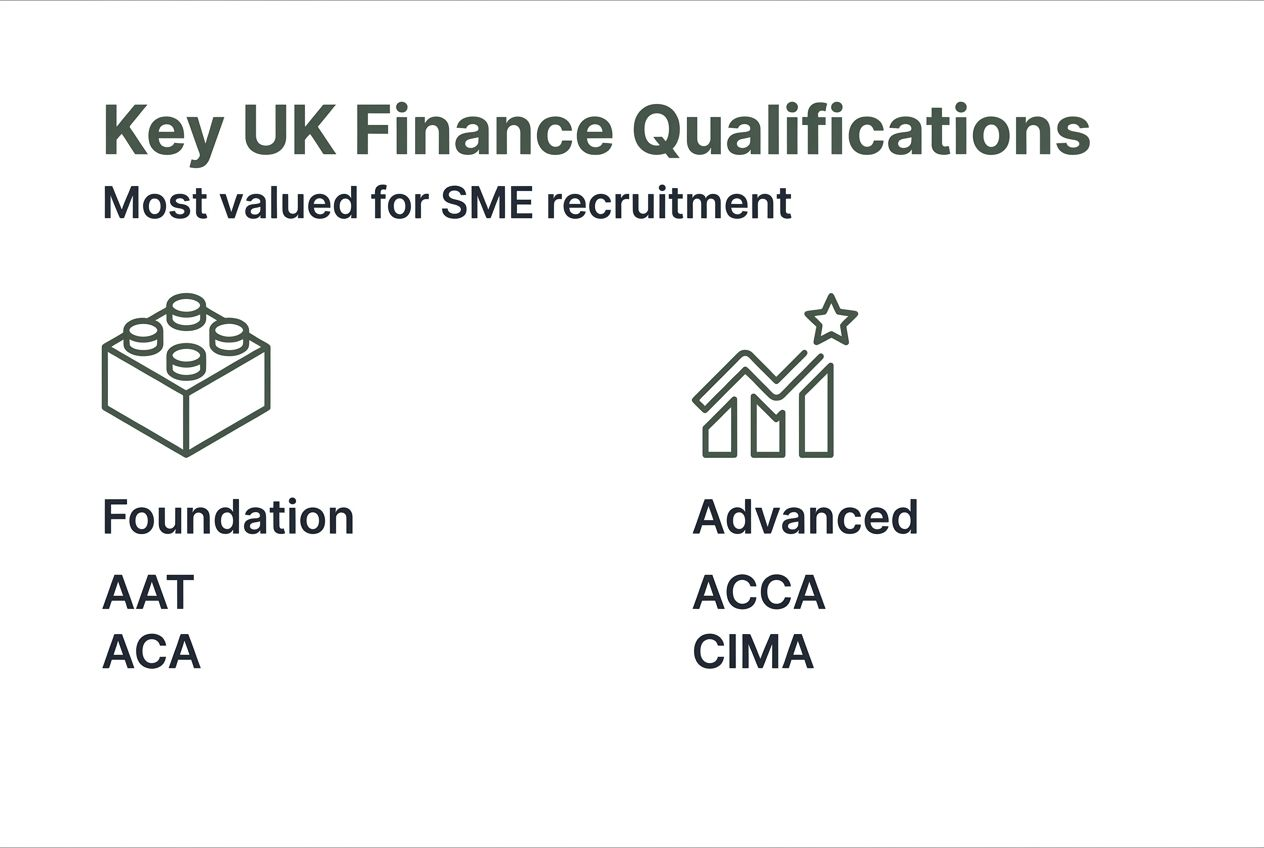
AAT provides foundational bookkeeping and accounting skills, ideal for transactional roles and junior positions. ACCA offers broader financial expertise, covering audit, taxation, and strategic management, suitable for senior accountants and financial controllers. CIMA specialises in management accounting, focusing on business strategy and performance management, perfect for roles requiring analytical insight. AAT, ACCA and CIMA qualifications ensure candidates understand UK GAAP, tax regulations, and compliance frameworks.
For SMEs, insisting on verified certifications reduces compliance risks and improves financial accuracy. Qualified professionals understand HMRC requirements, statutory reporting deadlines, and audit trails, preventing costly errors. They apply consistent methodologies, maintain proper documentation, and adapt to regulatory changes, safeguarding business operations.
| Qualification | Focus Area | Typical Roles |
|---|---|---|
| AAT | Bookkeeping and transactional accounting | Bookkeepers, accounts assistants |
| ACCA | Financial reporting, audit, taxation | Accountants, financial controllers |
| CIMA | Management accounting, strategic planning | Management accountants, finance managers |
Pro Tip: Always verify certifications directly with professional bodies using candidate membership numbers. This simple step confirms active status and ensures qualifications remain current and valid.
Qualifications also impact candidate reliability. Certified professionals adhere to ethical codes, undergo continuous professional development, and maintain accountability through regulatory oversight. This commitment translates to higher work quality, better decision-making, and reduced turnover, delivering long-term value for SMEs.
The role of local market expertise in West Midlands finance hiring
The West Midlands presents a distinctive business environment characterised by diverse manufacturing, professional services, and retail sectors. SMEs operating in this region face specific economic conditions, regulatory nuances, and competitive pressures that demand finance professionals familiar with local market dynamics. Recruiters and candidates with West Midlands expertise deliver measurable advantages in retention, cultural fit, and operational effectiveness.

Local knowledge encompasses understanding regional salary benchmarks, sector-specific compliance requirements, and business networking ecosystems. Finance professionals familiar with West Midlands industries integrate faster, communicate effectively with local suppliers and clients, and anticipate challenges unique to the area. This familiarity reduces onboarding time and accelerates productivity, critical factors for resource-constrained SMEs.
Research shows employing candidates with local market knowledge improves retention rates by approximately 25%. Higher retention lowers recruitment costs, preserves institutional knowledge, and maintains team stability. Candidates who understand Birmingham's economic landscape and business culture align better with organisational values, fostering cohesive teams and reducing hiring errors.
Key benefits include:
- Faster integration into existing finance teams and processes
- Better alignment with regional compliance and tax considerations
- Stronger professional networks supporting business development
- Enhanced understanding of local supplier and customer relationships
- Reduced cultural mismatches and communication barriers
Local expertise delivers 25% higher retention, cutting long-term recruitment costs and preserving team stability.
Specialised recruiters leverage their West Midlands connections to identify candidates embedded in the regional business community. They assess not just technical skills but also cultural alignment, ensuring placements succeed beyond the initial hiring phase. This holistic approach transforms recruitment from a transactional process into a strategic partnership.
Technical skills and software proficiencies required
Modern finance roles demand proficiency in specialised software platforms that automate transactions, streamline reporting, and ensure regulatory compliance. For West Midlands SMEs, candidates skilled in Xero, Sage, and QuickBooks bring immediate operational value, reducing manual errors and accelerating financial cycles. Software competency is no longer optional; it's a fundamental requirement for effective finance recruitment.
Xero excels in cloud-based accounting, offering real-time visibility and integration with banking systems. Sage provides robust solutions for payroll, invoicing, and inventory management, popular among established SMEs. QuickBooks delivers user-friendly interfaces ideal for smaller businesses managing straightforward accounting needs. Proficiency in finance software like Xero, Sage and QuickBooks is crucial for SME finance operation efficiency, enabling professionals to produce accurate reports, manage cash flow, and meet HMRC deadlines.
Technical skills extend beyond software. Candidates must demonstrate competencies in:
- Advanced Excel for data analysis, pivots, and financial modelling
- HMRC Making Tax Digital (MTD) compliance and submission protocols
- Bank reconciliation processes ensuring transaction accuracy
- Financial reporting under UK GAAP and FRS 102 standards
- Payroll processing including PAYE, National Insurance, and pension contributions
Assessing software skills during interviews reveals practical capability. Ask candidates to describe specific workflows, troubleshoot common issues, or explain recent software updates. This approach separates candidates with genuine expertise from those claiming superficial familiarity.
Pro Tip: Request candidates to complete a practical software task during the interview process, such as reconciling a sample bank statement or generating a management report. This reveals real competency and problem-solving ability under realistic conditions.
Continuous learning matters too. Finance software evolves rapidly with regulatory changes and feature updates. Candidates committed to professional development stay current, adapting to new tools and maintaining competitive advantages. This mindset ensures long-term value for SMEs investing in permanent finance staff.
Common misconceptions about finance recruitment
Many SMEs approach finance recruitment with assumptions that undermine success, extending vacancies and increasing compliance risks. Correcting these misconceptions enables more effective hiring strategies and better candidate outcomes. Understanding what doesn't work is as valuable as knowing best practices.
Myth one: all finance professionals are interchangeable. Reality reveals significant differences in qualifications, specialisations, and experience levels. A bookkeeper handles transactions; a management accountant drives strategic decisions. Confusing these roles leads to mismatched expectations and poor performance. Specialised recruitment clarifies distinctions, matching specific needs with appropriate expertise.
Myth two: posting on general job boards suffices. Generic platforms attract unqualified applicants lacking UK certifications or sector knowledge. Sorting through unsuitable candidates wastes time and delays hiring. Specialised recruitment agencies provide three times more suitable candidate matches than online job postings alone, delivering pre-vetted professionals who meet exact criteria.
Myth three: local and sector expertise isn't crucial. SMEs often assume any qualified accountant fits any business. Reality shows candidates unfamiliar with regional markets, industry-specific regulations, or local business culture struggle to integrate. This mismatch increases turnover and reduces effectiveness, negating initial hiring efforts.
Common misconceptions include:
- Believing lower salaries attract equally qualified candidates
- Assuming internal referrals eliminate the need for professional recruitment
- Thinking recruitment agencies charge prohibitive fees for SMEs
- Expecting immediate candidate availability without lead time
- Underestimating the value of cultural fit and soft skills
These assumptions create prolonged vacancies, forcing existing staff to shoulder additional workloads. Compliance risks escalate when unqualified individuals manage financial reporting. Specialised agencies eliminate these pitfalls by applying rigorous standards, verifying credentials, and ensuring candidates meet both technical and cultural requirements.
Finance recruitment process and efficiency gains
Specialised finance recruitment follows a streamlined workflow designed to minimise SME administrative burden whilst maximising candidate quality. Understanding this process clarifies how agencies deliver faster placements and better matches than traditional hiring methods. Efficiency gains translate directly to cost savings and operational continuity.
The process unfolds in three main steps:
- Submit detailed hiring request specifying qualifications, software skills, salary range, and cultural preferences. Clear specifications enable precise candidate matching.
- Agency conducts comprehensive vetting including qualification verification, reference checks, technical assessments, and cultural fit evaluation. Only candidates meeting all criteria proceed.
- Shortlisted candidates participate in focused interviews, followed by offer negotiation and onboarding support to ensure smooth integration.
Using specialised finance recruitment typically fills vacancies in under two weeks, dramatically faster than general methods requiring four to eight weeks. This speed reduces lost productivity, maintains financial reporting continuity, and prevents compliance lapses. For SMEs, faster hiring means lower costs and reduced stress on existing teams.
| Metric | Specialised Finance Agency | General Recruitment Agency |
|---|---|---|
| Average time to hire | Under 14 days | 4-8 weeks |
| Candidate qualification rate | 85-90% meet all criteria | 40-50% meet basic criteria |
| First-year retention | 80-85% | 60-65% |
| Administrative burden on SME | Low - agency handles vetting | High - SME screens candidates |
Pro Tip: Prepare detailed job specifications before contacting agencies, including must-have qualifications, preferred software experience, salary budget, and team culture descriptors. Clear requirements accelerate matching and improve candidate quality from the first shortlist.
Efficiency extends beyond speed. Specialised agencies handle time-consuming tasks like advertising, screening, and initial interviews, freeing SME resources for core operations. They manage salary negotiations, coordinate interview schedules, and facilitate smooth onboarding. Understanding how long to hire accountant Birmingham reveals why this partnership model delivers superior outcomes for busy SME leaders.
Why choose a specialised finance recruitment agency?
Specialised finance recruitment agencies outperform generalist firms through focused expertise, rigorous vetting processes, and deep market knowledge tailored to SME needs. Their exclusive focus on finance roles creates efficiencies and quality standards unattainable by agencies spreading resources across multiple sectors. For West Midlands SMEs, this specialisation translates to measurable advantages.
Quality stems from systematic vetting. Specialised finance recruiters provide higher quality, vetted candidates with faster placement times, applying strict criteria to every candidate. They verify UK qualifications through professional bodies, assess technical competencies via practical tests, and confirm cultural fit through behavioural interviews. This thoroughness eliminates unsuitable applicants before they reach SME interview stages.
Faster placements reduce vacancy costs and operational disruptions. Specialised agencies maintain active candidate pools, relationship networks with qualified professionals, and streamlined processes enabling rapid matching. They understand urgency, prioritising SME hiring needs and delivering shortlists within days rather than weeks.
Tailored matching addresses SME-specific requirements. Agencies consider company size, growth stage, industry sector, and team dynamics when selecting candidates. They recognise that a corporate accountant may struggle in an SME environment requiring versatility and hands-on engagement. This nuanced understanding produces better long-term fits.
Key advantages include:
- Reduced administrative burden freeing SME resources for core operations
- Access to passive candidates not visible on job boards
- Expert salary benchmarking ensuring competitive yet sustainable offers
- Ongoing support through probation periods and beyond
- Market insights informing hiring strategies and workforce planning
| Feature | Specialised Finance Agency | Generalist Recruitment Agency |
|---|---|---|
| Finance qualification verification | Standard practice | Often overlooked |
| Software skills assessment | Practical testing | Self-reported only |
| West Midlands market knowledge | Deep local expertise | Limited regional insight |
| Candidate pool quality | Pre-vetted finance professionals | Mixed quality across sectors |
| Placement speed | Under 14 days typically | 4-8 weeks average |
Research from recruitment expertise insights confirms specialised agencies deliver superior candidate quality through focused processes and sector knowledge. Their commitment to finance roles creates competitive advantages benefiting both candidates and employers.
Practical steps for successful finance recruitment in the West Midlands
Navigating finance recruitment effectively requires strategic preparation and clear communication with specialised agencies. SMEs following structured steps maximise success rates, reduce hiring time, and secure candidates who deliver immediate value. These practical actions consolidate previous insights into actionable guidance.
- Submit comprehensive hiring requests detailing required UK qualifications (AAT, ACCA, CIMA), essential software proficiencies (Xero, Sage, QuickBooks), salary range, and West Midlands location preferences. Include cultural descriptors like team size, management style, and growth ambitions to enable precise matching.
- Understand agency vetting processes and actively participate in candidate evaluation. Review qualification certificates, assess software demonstration results, and evaluate references. Ask agencies to explain their assessment criteria and scoring methods.
- Conduct focused interviews emphasising technical competency and local market fit. Use scenario-based questions revealing problem-solving approaches, software application skills, and familiarity with regional business conditions. Explore candidates' understanding of West Midlands economic landscape and professional networks.
- Implement best practices for smooth onboarding including clear role expectations, comprehensive system access, mentor assignment, and regular check-ins during probation. Early integration support maximises retention and accelerates productivity.
Pro Tip: Maintain transparent, regular communication with your recruitment agency throughout the process. Share feedback promptly after interviews, clarify evolving requirements, and discuss market conditions. This partnership approach refines candidate matching and improves outcomes.
Successful onboarding extends beyond administrative tasks. Introduce new finance staff to key stakeholders, explain reporting relationships, and clarify decision-making authority. Provide comprehensive software training even for experienced users, ensuring familiarity with your specific configurations and workflows. Resources like step by step financial consultation demonstrate structured approaches applicable to onboarding processes.
Consider requesting personalised financial advice on optimising your finance team structure as your business grows. Specialised agencies often provide workforce planning guidance, helping SMEs anticipate future hiring needs and build scalable finance functions.
Why choose Ibaco for your finance recruitment needs?
Finding qualified finance professionals shouldn't drain your resources or extend for months. Ibaco specialises exclusively in finance recruitment Birmingham, connecting West Midlands SMEs with vetted accountants and bookkeepers who understand UK accounting standards and regional business dynamics. Our deep expertise in AAT, ACCA, and CIMA qualifications, combined with proven knowledge of Xero, Sage, and QuickBooks, ensures candidates meet your exact technical and cultural requirements.
We typically fill vacancies in under two weeks through rigorous candidate vetting and local market expertise. Our accounting recruitment agency Birmingham process handles everything from initial sourcing to onboarding support, reducing your administrative burden whilst delivering permanent finance staff ready to contribute immediately. Explore our comprehensive bookkeeper and accountant recruitment services designed specifically for SMEs seeking reliable, qualified finance professionals who drive compliance and operational excellence.
FAQ
What is finance recruitment?
Finance recruitment is the specialised hiring process focused on finding qualified finance professionals such as accountants and bookkeepers for permanent roles. It emphasises candidates meeting UK accounting standards, possessing relevant certifications like AAT, ACCA, or CIMA, and demonstrating proficiency in finance software. This targeted approach ensures SMEs secure professionals who deliver compliance, accuracy, and operational efficiency from day one.
Why is UK accounting qualification important in finance recruitment?
UK accounting qualifications ensure candidates understand legal frameworks, tax regulations, and financial reporting standards specific to British businesses. Certifications like AAT, ACCA, and CIMA demonstrate verified competency, reducing risks of errors and compliance failures. Qualified professionals maintain ethical standards, undergo continuous development, and apply consistent methodologies, protecting SME financial integrity and operational continuity.
How does local West Midlands market knowledge benefit SME finance recruitment?
Local market knowledge improves candidate alignment with regional business culture, economic conditions, and compliance requirements specific to the West Midlands. Professionals familiar with Birmingham's business landscape integrate faster, communicate effectively with local stakeholders, and anticipate sector-specific challenges. This familiarity boosts retention rates by approximately 25%, reducing long-term recruitment costs and preserving team stability for growing SMEs.
What typical timeframe can SMEs expect when using specialised finance recruitment?
Specialised finance recruitment agencies typically fill vacancies in under two weeks, significantly faster than general recruitment methods requiring four to eight weeks. This speed results from pre-vetted candidate pools, focused expertise, and streamlined processes designed specifically for finance roles. Faster placements reduce productivity losses, maintain financial reporting continuity, and prevent compliance risks associated with prolonged vacancies.
What mistakes should SMEs avoid during finance recruitment?
Avoid relying solely on generic job boards, which attract unqualified candidates lacking UK certifications and sector knowledge. Don't overlook the importance of verified qualifications, local market fit, and software proficiencies essential for effective finance roles. Resist assuming all finance professionals are interchangeable; specialisations matter significantly. Engage specialised agencies offering rigorous vetting, market expertise, and tailored matching to secure qualified candidates efficiently and reliably.