

Many finance managers underestimate the strategic value bookkeepers bring to accounting firms. Yet 70% of advanced bookkeepers provide value-added financial insights beyond routine data entry. For West Midlands SMBs, bookkeepers serve as operational linchpins, ensuring accurate data flows that power decision-making. This guide explores the expanded roles bookkeepers play in modern finance management, helping you maximize their impact while connecting with skilled bookkeepers and accountants in Birmingham.
Table of Contents
- Introduction: The Integral Role of Bookkeepers in Accounting Firms
- Core Functions and Responsibilities of Bookkeepers
- Difference Between Bookkeepers and Accountants
- Operational Impact of Bookkeepers on SMB Financial Management
- Common Misconceptions About Bookkeepers
- Framework to Evaluate Bookkeeping Hiring Needs for SMBs
- Leveraging Specialist Recruitment for Efficient Bookkeeper Hiring in the West Midlands
- Optimize Your Finance Team with Ibaco Recruitment
Key Takeaways
| Point | Details |
|---|---|
| Error Reduction | Bookkeepers reduce financial errors by up to 80%, improving audit smoothness. |
| Core Functions | They perform transactional tasks and reconciliations using specialized software like Xero and Sage. |
| Role Distinction | Bookkeepers and accountants have complementary but distinct responsibilities. |
| Strategic Value | Common misconceptions undervalue bookkeepers' advisory capabilities and insights. |
| Hiring Efficiency | Specialist recruitment improves hiring quality and operational fit quickly. |
Introduction: The Integral Role of Bookkeepers in Accounting Firms
Bookkeeping forms the foundation of sound financial management. It involves systematically recording, organizing, and maintaining financial transactions to create accurate ledgers. Within accounting firms serving West Midlands SMBs, bookkeepers ensure every transaction is captured correctly, providing the raw data accountants need for analysis and reporting.
The bookkeeper's role extends far beyond simple data entry. Advanced bookkeepers add strategic financial insights by spotting anomalies, identifying cash flow trends, and flagging issues before they escalate. For SMBs, this proactive approach prevents costly mistakes and supports better operational decisions.
Accounting firms position bookkeepers as the first line of defense in financial accuracy. They handle daily transaction processing, maintain subsidiary ledgers, and ensure compliance with UK accounting standards. This frees accountants to focus on higher-level analysis, tax strategy, and advisory services.
For West Midlands businesses, bookkeepers provide crucial support by:
- Maintaining real-time financial visibility through accurate record keeping
- Ensuring compliance with VAT regulations and UK GAAP requirements
- Supporting cash flow management through timely reconciliations
- Reducing administrative burden on finance directors and managers
When you hire a bookkeeper in Birmingham, you gain a partner who understands local business dynamics and regulatory nuances. The right bookkeeper becomes integral to your finance team's success, not just a back-office function.
Core Functions and Responsibilities of Bookkeepers
Bookkeepers perform essential daily tasks that maintain financial integrity. Their work ensures your business has accurate, up-to-date records for decision-making and compliance.
Recording financial transactions forms the core responsibility. Bookkeepers capture every sale, purchase, receipt, and payment in your accounting system. They code transactions to appropriate accounts, attach supporting documentation, and maintain detailed audit trails. This meticulous work creates the foundation for reliable financial statements.
Bank and account reconciliations happen regularly to verify accuracy. Bookkeepers match bank statements against recorded transactions, identifying discrepancies immediately. They reconcile credit card accounts, payroll liabilities, and vendor statements. Professional bookkeepers reduce financial errors by up to 80%, improving audit smoothness and financial confidence.
Compliance support ensures timely, precise record keeping. Bookkeepers maintain documentation for VAT returns, payroll submissions, and year-end reporting. They track deadlines, organize supporting records, and prepare files for accountant review. This proactive approach prevents penalties and reduces stress during audit periods.
Software proficiency distinguishes modern bookkeepers. They use tools like Xero, Sage, and QuickBooks daily to:
- Automate transaction imports and categorization
- Generate real-time financial reports for management review
- Track invoices and manage accounts receivable efficiently
- Integrate banking feeds for seamless reconciliation
Quality bookkeeper and accountant recruitment services verify these software skills during vetting. When evaluating bookkeepers, confirm they have hands-on experience with your specific accounting platform. Understanding the bookkeeper vs accountant distinction helps you set appropriate expectations for daily tasks versus strategic analysis.
Difference Between Bookkeepers and Accountants
Confusion between bookkeeper and accountant roles creates inefficiencies in finance teams. While both handle financial data, their scope and expertise differ significantly.
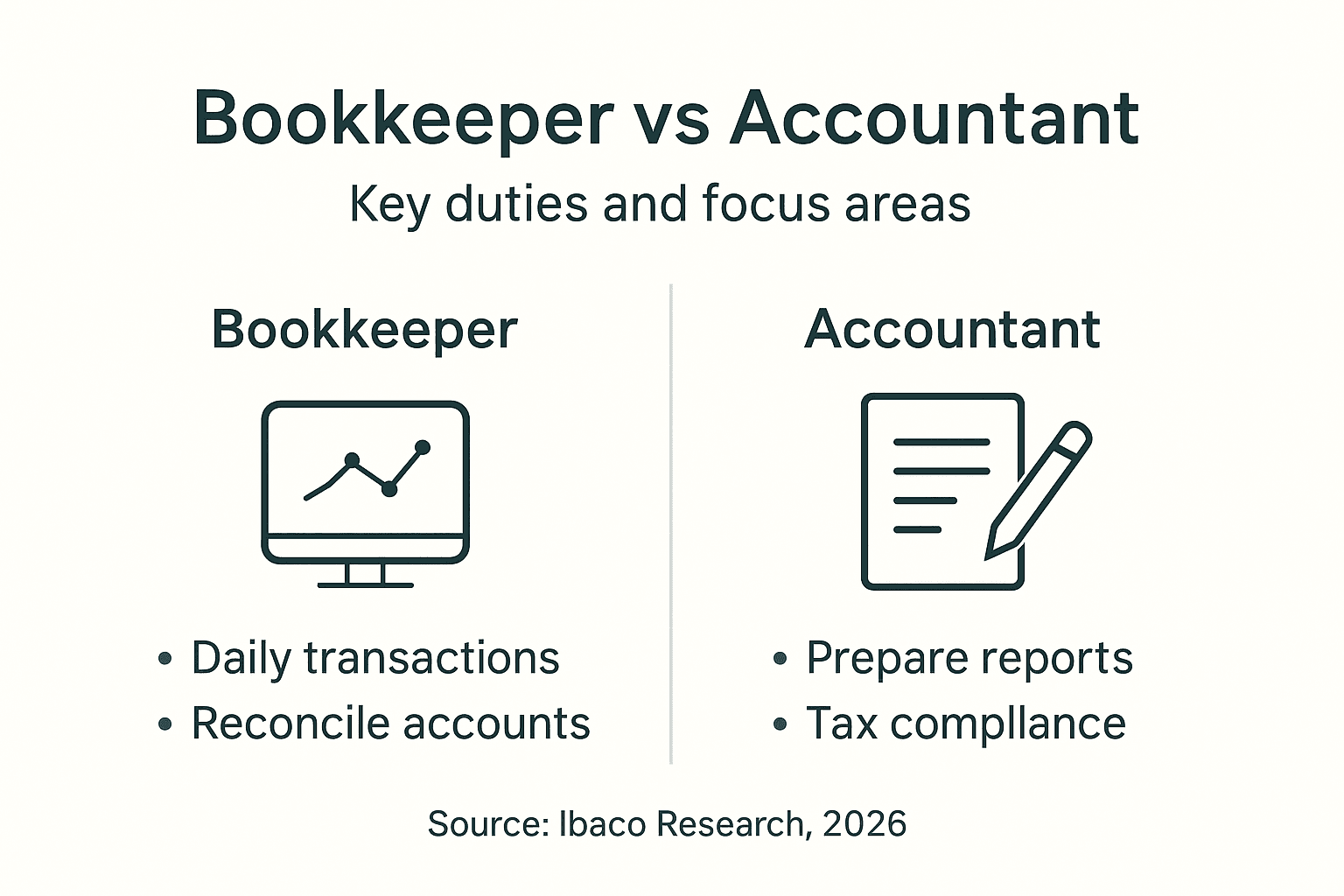
Bookkeepers focus on transactional data processing. They record daily transactions, maintain ledgers, and ensure accurate data entry. Their work provides the foundation accountants need for analysis. Bookkeepers typically hold AAT qualifications and specialize in operational accuracy rather than strategic interpretation.
Accountants manage financial analysis, reporting, and compliance. They prepare financial statements, conduct tax planning, and provide advisory services. Accountants handle higher-level financial reporting and compliance that requires professional qualifications like ACCA or CIMA. They interpret data to guide business strategy and ensure regulatory adherence.
| Aspect | Bookkeeper | Accountant |
|---|---|---|
| Primary Focus | Transaction recording | Financial analysis |
| Typical Tasks | Data entry, reconciliations | Tax planning, audits |
| Qualifications | AAT, software certifications | ACCA, CIMA, ACA |
| Decision Support | Operational accuracy | Strategic guidance |
| Software Use | Daily transaction processing | Analysis and reporting tools |
The roles complement each other powerfully. Bookkeepers create clean, accurate data that accountants transform into actionable insights. When both work together effectively, your finance function operates smoothly from transaction capture through strategic planning.
Proper collaboration improves outcomes:
- Bookkeepers flag unusual transactions for accountant review
- Accountants rely on accurate bookkeeping for timely reporting
- Clear role boundaries prevent duplication and gaps
- Regular communication ensures data quality and compliance
Pro Tip: Define clear handoff points between bookkeepers and accountants. Specify when bookkeepers should escalate issues and what analysis accountants expect from transaction data. This clarity prevents confusion and maximizes efficiency.
Understanding this distinction helps when you hire qualified accountants or bookkeepers. Review the detailed bookkeeper vs accountant guide to align hiring decisions with your specific needs.
Operational Impact of Bookkeepers on SMB Financial Management
Bookkeepers deliver tangible benefits that directly improve SMB financial health. Their contributions extend beyond accurate records to measurable operational advantages.
Reduced errors enhance financial statement reliability. Bookkeepers' work reduces financial errors by up to 80%, improving audit readiness and stakeholder confidence. Fewer mistakes mean less time correcting entries and more time analyzing performance. Clean books support faster decision-making and reduce year-end surprises.

Compliance with UK accounting standards protects from penalties. Bookkeepers maintain proper documentation for VAT returns, ensure correct coding for expense categories, and track statutory deadlines. This diligence prevents costly fines and reduces compliance risk. For West Midlands SMBs, local bookkeepers understand regional business practices and regulatory nuances.
Increased cash flow visibility supports operational decisions. Daily transaction recording provides real-time insights into:
- Outstanding receivables requiring follow-up
- Upcoming payment obligations and timing
- Cash position trends affecting liquidity planning
- Expense patterns revealing cost control opportunities
Streamlined processes lead to faster reporting and audits. Well-maintained books accelerate month-end close, enabling quicker management reviews. When audit time arrives, organized records reduce accountant hours and associated costs. Finance directors spend less time hunting documentation and more time on strategic initiatives.
Pro Tip: Schedule weekly bookkeeper reviews rather than monthly. This frequent touchpoint catches errors early, maintains data freshness, and prevents backlog accumulation that slows reporting.
When you find expert bookkeepers, prioritize candidates demonstrating these operational strengths. The bookkeeper impact on SMBs multiplies when you match skills to your specific operational needs and reporting requirements.
Common Misconceptions About Bookkeepers
Several persistent myths undervalue bookkeepers and prevent SMBs from maximizing their contributions. Correcting these misconceptions helps finance managers appreciate broader bookkeeper capabilities.
-
Myth: Bookkeepers only do basic data entry. Reality: Experienced bookkeepers offer strategic advisory insights beyond data entry. They analyze patterns, spot anomalies, and flag issues requiring management attention. Advanced bookkeepers contribute to cash flow forecasting, budget variance analysis, and process improvement recommendations.
-
Myth: No qualifications are needed for bookkeeping. Reality: UK accounting standards and software proficiency require proper training. Professional bookkeepers typically hold AAT qualifications and maintain continuing education. They understand double-entry principles, VAT regulations, and compliance requirements that untrained staff miss. Software certifications in Xero, Sage, or QuickBooks demonstrate technical competence essential for modern bookkeeping.
-
Myth: Bookkeepers and accountants are interchangeable. Reality: Roles differ but complement each other strategically. Bookkeepers excel at transactional accuracy and daily operations. Accountants provide analytical expertise and strategic guidance. Treating them as substitutes creates gaps in either operational execution or strategic planning. Proper staffing includes both roles working collaboratively.
-
Myth: Bookkeeping software eliminates the need for skilled bookkeepers. Reality: Technology automates tasks but cannot replace judgment. Bookkeepers interpret automated feeds, catch system errors, and make coding decisions software cannot handle. They customize chart of accounts, set up workflows, and ensure integrations function correctly. Software amplifies skilled bookkeepers' productivity rather than replacing them.
-
Myth: Any admin staff can handle bookkeeping duties. Reality: Financial accuracy requires specialized knowledge and attention. Assigning bookkeeping to untrained staff increases error rates, compliance risks, and correction costs. Professional bookkeepers bring expertise that protects financial integrity and supports reliable reporting.
Understanding these realities helps you clear bookkeeping misconceptions that might limit your finance team's effectiveness. When hiring, prioritize qualified candidates over cost savings from undertrained staff.
Framework to Evaluate Bookkeeping Hiring Needs for SMBs
Assessing bookkeeping requirements systematically ensures you hire the right resources at the right level. This four-factor framework guides evidence-based hiring decisions.
-
Assess transaction volume and complexity. Count monthly transactions across all accounts. High-volume businesses with multiple revenue streams need full-time bookkeepers. Lower volume operations might succeed with part-time support. Consider complexity factors like multi-currency transactions, inventory tracking, or project-based accounting that demand specialized skills.
-
Evaluate required bookkeeping software compatibility. Identify your accounting platform and integration needs. If you use Xero, ensure candidates demonstrate Xero proficiency. Complex integrations with CRM systems, e-commerce platforms, or inventory management tools require advanced technical skills. Match candidate capabilities to your technology stack.
-
Consider compliance risk related to industry regulations. Industries with strict regulatory requirements need bookkeepers experienced in relevant compliance. Construction firms require CIS scheme knowledge. Charities need fund accounting expertise. VAT-registered businesses demand strong VAT return experience. Higher compliance stakes justify more experienced, qualified bookkeepers.
-
Define expectations for advisory input. Determine whether you need basic transaction processing or strategic insights. Some SMBs want bookkeepers who proactively flag trends and suggest improvements. Others prefer strict operational focus with accountants handling analysis. Clear expectations help you target appropriate experience levels.
| Factor | Basic Need | Advanced Need |
|---|---|---|
| Transaction Volume | Under 200/month | Over 500/month |
| Software | Single platform | Multiple integrations |
| Compliance | Standard VAT | Industry-specific regulations |
| Advisory Role | Transaction focus | Strategic insights |
Pro Tip: Start by auditing six months of financial activity. Count transactions, note complexity spikes, and identify recurring challenges. This data-driven approach reveals actual needs rather than assumptions.
This framework guides discussions when you hire a bookkeeper in Birmingham. Clear requirements help recruitment specialists match candidates precisely to your operational needs and growth plans.
Leveraging Specialist Recruitment for Efficient Bookkeeper Hiring in the West Midlands
Specialist recruitment agencies streamline bookkeeper hiring by providing vetted candidates who match your specific requirements. For West Midlands SMBs, local recruitment expertise delivers faster, better-quality placements.
Specialist recruitment ensures candidates possess required qualifications and software skills. Agencies verify AAT certifications, confirm software proficiency through testing, and validate references before presenting candidates. This vetting eliminates unqualified applicants and saves your team interview time. You meet only candidates genuinely capable of performing required tasks.
Recruitment agencies save time by presenting vetted matches faster. Over 60% of West Midlands SMBs report faster decision-making after hiring vetted bookkeepers via recruitment specialists. Instead of sorting hundreds of applications, you review pre-screened profiles aligned to your needs. Typical placement times drop from months to weeks, reducing operational strain during vacancy periods.
Proper hiring reduces risk of errors and improves operational fit. Mismatched bookkeepers create costly mistakes, compliance issues, and team friction. Specialists assess cultural fit alongside technical skills, ensuring candidates align with your business style and reporting expectations. Better matches lead to longer tenure and higher productivity.
Local West Midlands agencies improve understanding of SMB market needs:
- Knowledge of regional salary expectations prevents offer rejections
- Familiarity with local business practices ensures realistic candidate expectations
- Understanding of Birmingham's finance talent pool speeds candidate identification
- Connections to qualified candidates seeking opportunities in your area
Specialist agencies handle negotiation, reference checks, and offer management professionally. They guide salary discussions, coordinate interview scheduling, and facilitate smooth onboarding transitions. This support reduces administrative burden on your HR team.
When selecting recruitment partners, prioritize those specializing exclusively in finance roles. General agencies lack the technical knowledge to assess bookkeeping competencies accurately. Finance recruitment in Birmingham specialists understand qualification nuances and software requirements critical for successful placements. Their bookkeeper recruitment services deliver candidates who contribute immediately rather than requiring extensive training.
Optimize Your Finance Team with Ibaco Recruitment
Finding the right bookkeeper transforms your finance operations from reactive to strategic. West Midlands SMBs need partners who understand local market dynamics and deliver qualified candidates quickly.

Ibaco Recruitment specializes in connecting Birmingham businesses with vetted finance professionals. Our focus on bookkeepers and accountants means we deeply understand the qualifications, software skills, and industry experience your team needs. We verify AAT credentials, test Xero and Sage proficiency, and assess candidates' cultural fit before introduction.
Our streamlined process delivers results within two weeks typically. Submit your hiring requirements, review matched candidate profiles, and conduct interviews with pre-vetted professionals ready to contribute immediately. No upfront fees mean you invest only when we successfully place the right bookkeeper.
Local expertise matters. We understand West Midlands business challenges, salary expectations, and regulatory requirements specific to Birmingham SMBs. Our candidates know the regional market and bring relevant experience serving similar businesses.
Ready to strengthen your finance team? Explore our finance recruitment in Birmingham services, review our comprehensive bookkeeper recruitment services, or start your search to hire a bookkeeper in Birmingham today. Let us connect you with qualified professionals who elevate your financial operations.
FAQ
What qualifications should I look for in a bookkeeper?
Prioritize AAT qualifications and proven proficiency in software like Xero, Sage, or QuickBooks. Experience with UK SMB financial compliance ensures candidates understand VAT regulations and statutory reporting requirements. When you hire qualified bookkeepers in Birmingham, verify they hold current certifications and maintain continuing professional development.
How do bookkeepers contribute beyond routine data entry?
Advanced bookkeepers analyze cash flows, flag discrepancies, and support strategic decision-making. They identify expense trends, spot invoice anomalies, and provide insights that improve financial oversight. Understanding bookkeeper advisory roles helps you leverage their full capabilities beyond simple data entry tasks.
When should an SMB use a recruitment agency for hiring bookkeepers?
Use agencies when needing vetted, qualified candidates quickly without internal recruitment capacity. Specialists help avoid mistakes like hiring under-skilled bookkeepers lacking software proficiency. 60% of West Midlands SMBs reported faster decision-making after hiring vetted bookkeepers via specialists, reducing vacancy periods and operational disruption. Consider hiring bookkeepers via recruitment agencies when quality and speed matter more than managing recruitment internally.
What software skills are essential for bookkeepers today?
Proficiency with Xero, Sage, and QuickBooks is essential for accurate bookkeeping and system integration. Familiarity with UK-specific financial compliance software features ensures proper VAT handling and statutory reporting. Evaluate candidates' bookkeeper software skills through practical testing rather than relying solely on resume claims to verify genuine competence.