

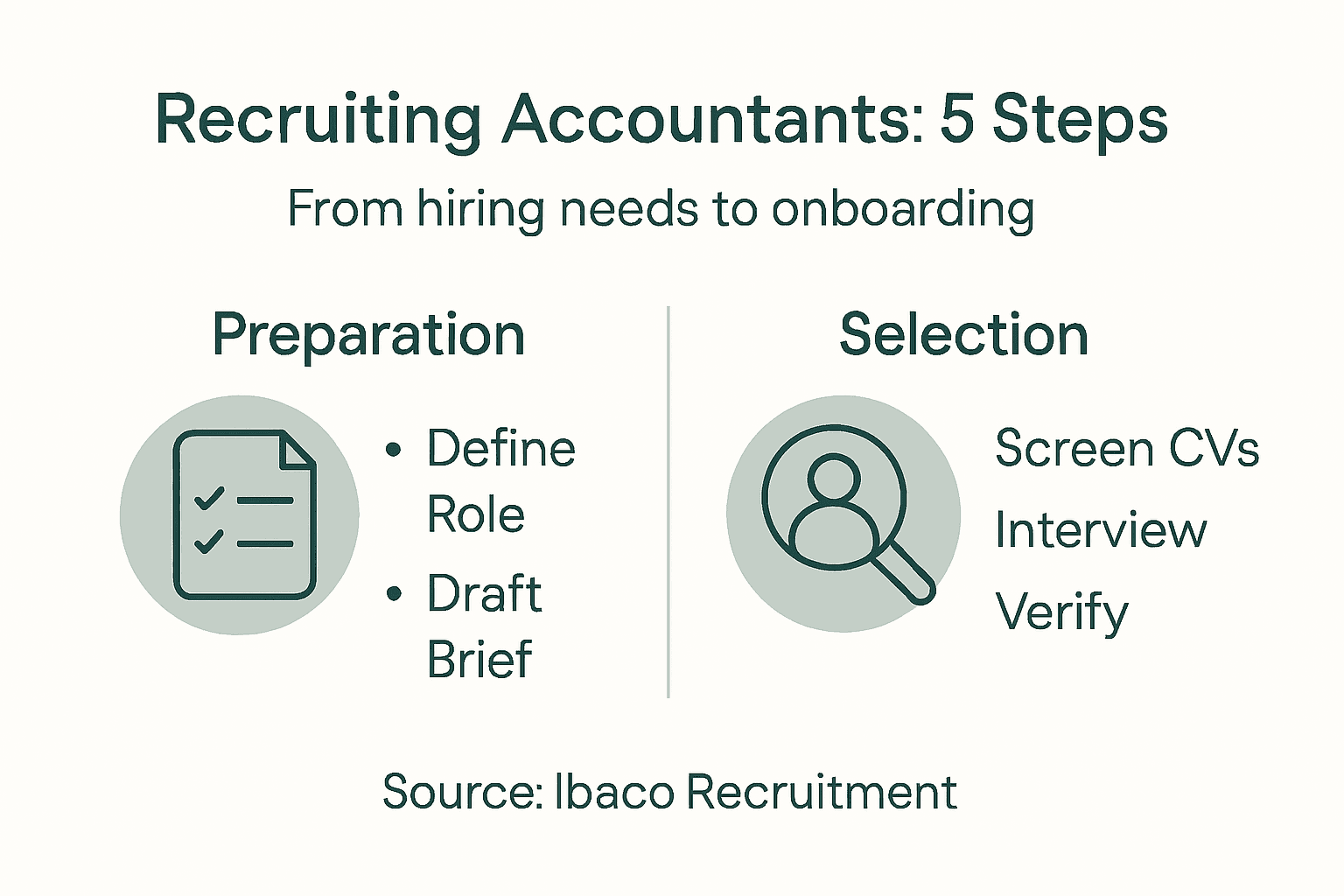
Recruiting the right accountant or bookkeeper can feel like a high-stakes puzzle for any Birmingham business leader. Too many applicants lack the specific skills or mindset your company needs. Clear, detailed planning is the foundation of efficient hiring and a stronger finance team. This article shares expert steps for defining your requirements, crafting targeted job briefs, and selecting the right professionals who add real value to your business.
Table of Contents
- Step 1: Identify your accountant requirements
- Step 2: Draft an attractive job brief and criteria
- Step 3: Screen and shortlist qualified candidates
- Step 4: Conduct effective interviews and testing
- Step 5: Finalise selection and secure your hire
Quick Summary
| Key Point | Explanation |
|---|---|
| 1. Clearly define accountant needs | Identify specific accounting tasks, business size, and required skills before beginning the hiring process for accurate candidate matching. |
| 2. Craft an engaging job brief | Use a clear job title and specific responsibilities to attract qualified candidates while highlighting your company's culture and values. |
| 3. Implement a structured screening process | Create a checklist based on must-have criteria to efficiently filter applicants, ensuring focus on essential qualifications and skills. |
| 4. Conduct consistent interviews | Use standard questions for all candidates to fairly assess their fit, technical ability, and cultural compatibility within your team. |
| 5. Move swiftly after selection | Verify references, negotiate terms, and send a formal offer quickly to secure your chosen candidate before they accept other offers. |
Step 1: Identify your accountant requirements
Before you start searching for candidates, you need a clear picture of what your business actually needs. Posting a vague job description wastes everyone's time. Taking 30 minutes to define your requirements now saves hours of interviewing wrong candidates later.
Start by mapping out your current accounting workload. What financial tasks consume the most time in your business right now? Are you drowning in invoicing? Struggling with payroll? Need someone to handle tax compliance? The answers determine which accounting role fits best.
Consider your business size and complexity. A sole trader managing straightforward sales might need a part-time bookkeeper. A growth-stage company with multiple revenue streams, employees, and regulatory obligations requires a more senior accountant with broader skills. Match the role to your actual operational demands, not to what sounds impressive.
Define the specific skills and software experience you need:
To help match accountant roles to business needs, consider this comparison:
| Business Size & Type | Recommended Role | Typical Tasks | Benefit to Company |
|---|---|---|---|
| Sole trader, small business | Part-time bookkeeper | Basic invoicing, expenses | Cost-effective compliance |
| Medium, growing SME | Qualified accountant | Payroll, reporting, VAT | More financial insight |
| Multi-site or complex firm | Senior accountant | Budgeting, audits, analysis | Strategic financial input |
- Accounting software familiarity: Xero, Sage, QuickBooks, or other platforms your business uses
- Compliance knowledge: VAT, PAYE, payroll, corporation tax depending on your industry
- Sector experience: Hospitality, manufacturing, professional services, and other sectors have different accounting priorities
- Technical competencies: Financial reporting, cash flow forecasting, audit support, or cost analysis
Think about qualifications and certifications too. Accountants typically hold qualifications like AAT, ACCA, or CIMA certifications, which signal training in UK accounting standards and professional practice. Do you need someone already qualified, or are you willing to train someone with foundational skills?
Your team's personality and working style matter as well. Will this person work remotely, in-office, or hybrid? Do they need to integrate with existing staff? Are they supporting a finance director or working independently? Clarity on these points attracts the right fit.
Define your exact requirements before searching. Vague job descriptions attract unsuitable candidates and waste recruitment time.
Once you know your staffing gap, you'll recognise the right candidate when you find them. Clarity here prevents misalignment during interviews and shortens your hiring timeline.
Professional tip: Document your requirements in writing, including must-have skills, nice-to-have experience, and any red flags (like missing software knowledge if you use specialist tools). This reference document keeps your hiring focused and helps compare candidates fairly.
Step 2: Draft an attractive job brief and criteria
A strong job brief attracts qualified candidates and sets clear expectations from day one. Your advert is your first impression—make it count. A well-written brief cuts through the noise and reaches the right people.
Start with a compelling job title that reflects the actual role. "Senior Accountant" tells candidates more than "Accounts Person." Be specific about seniority level and specialisation if relevant. This filters applications early, saving you time reviewing unsuitable profiles.
Next, write a brief overview of the role in plain language. Explain what success looks like in this position. Why does this role matter to your business? A finance director at a growth-stage manufacturing firm needs a different skill set than one managing a professional services practice. Make this distinction clear.
Outline the key responsibilities using clear and specific job descriptions. Avoid vague phrases like "handles accounting duties." Instead, be precise:
- Prepare monthly management accounts and financial reports
- Process invoices, expenses, and payroll
- Manage VAT returns and tax compliance
- Reconcile bank accounts and balance sheet items
- Support budgeting and cash flow forecasting
Separate must-have qualifications from nice-to-have ones. Must-haves are non-negotiable: perhaps AAT qualification, Xero experience, and five years' accounting background. Nice-to-haves include industry expertise, advanced Excel skills, or knowledge of specific compliance requirements. This distinction attracts candidates confident they meet your core needs.
Be transparent about working arrangements, salary range if possible, and reporting structure. Remote flexibility, office location, and whether they work under a finance director or independently all matter to candidates. Honesty here prevents mismatches and speeds hiring.
Include a sentence about your company culture and why someone should care about joining you. Birmingham businesses have personality—show it. Are you supporting local growth? Offering stability? Investing in training?
A specific, honest job brief attracts genuinely qualified candidates and reduces time spent interviewing wrong fits.
Proofread everything carefully. Typos signal carelessness. Use consistent formatting. Make the brief scannable with short paragraphs and bullet points.
Professional tip: Ask your current finance team or a trusted colleague to review your brief before posting. They spot gaps you might miss and can suggest refinements that attract better-quality applicants.
Step 3: Screen and shortlist qualified candidates
You've posted your job brief and applications are flooding in. Now comes the critical task of separating genuine contenders from unsuitable applicants. Smart screening saves weeks of interview time and identifies your strongest candidates early.
Start by creating a screening checklist based on your must-have requirements. Does the candidate hold the required qualification? Have they worked with your accounting software? Do they have the minimum years of experience you specified? Score each application against these non-negotiable criteria first.
Many candidates will fall away at this stage, and that's intentional. You're filtering for basic fit, not personality or potential yet. This initial pass is mechanical and quick—five minutes per application at most.
Next, review the CVs of candidates who passed the screening checklist. Look for patterns that suggest genuine accounting competence.
- Progression and stability: Have they progressed within accounting roles or jumped around frequently?
- Relevant experience: Do their previous employers and industries match your needs?
- Gaps and discrepancies: Unexplained employment gaps or conflicting dates raise red flags
- Software and skills listed: Do they specifically mention the tools you use daily?
Using documented and equitable evaluation methods ensures fair assessment across all applicants. Create a simple scoring sheet so every candidate is judged against the same criteria. This protects against unconscious bias and gives you a clear audit trail of your decisions.
Read cover letters carefully but briefly. A strong cover letter shows genuine interest in your business, not just generic enthusiasm. Can they explain why they want this role in your organisation, or does it read like a template?
Narrow your applications down to five to eight strong candidates for interview. Quality over quantity matters here. A shortlist this size is manageable whilst still giving you genuine choice.
Document your screening decisions. This transparency protects your hiring process and helps you defend selections if questioned.
Before moving forward, double-check references are listed and contact information is complete. You'll need these details shortly.
Professional tip: Create a simple spreadsheet listing candidates, their scores against your criteria, and your shortlist decision. This becomes invaluable if you need to revisit decisions later and demonstrates rigorous, fair recruitment practice.
Step 4: Conduct effective interviews and testing
Interviews reveal whether candidates can actually do the job and fit your team's culture. A poorly run interview wastes everyone's time. A structured approach identifies the strongest candidate and protects your hiring from bias.

Prepare a consistent set of questions for all candidates. Ask every accountant the same core questions in the same order. This ensures fair comparison and gives you reliable data about each person's competencies.
Use behavioural and situational questioning techniques to assess real capability. Instead of "Do you have strong attention to detail?" ask "Tell me about a time you caught a significant error in financial records. What was the error, how did you find it, and what did you do?" Real examples reveal genuine competence.
Structure your interview around key areas relevant to the role:
- Technical knowledge: Can they explain accounting concepts, VAT processes, or software workflows?
- Problem-solving: How do they approach unfamiliar accounting challenges?
- Communication: Can they explain complex financial information clearly?
- Reliability: Do their employment history and references suggest dependability?
- Cultural fit: Will they work well with your existing team?
Take detailed notes during each interview. Record specific answers, not impressions. "Strong communication" is vague. "Explained a complex payroll issue in three clear sentences" is concrete and comparable.
Consider a practical accounting test for technical roles. Give candidates a small accounting task relevant to your business—reconciling a small account, spotting errors in basic records, or working with your software for 15 minutes. This reveals actual capability beyond interview polish.
Allow time for candidates to ask questions. Their questions tell you what matters to them and whether they've researched your business.
Structured interviews with consistent questions, detailed notes, and practical testing produce fairer hiring decisions and stronger candidates.
Score each candidate against the same rubric immediately after their interview, while details are fresh. This creates an objective comparison when you're deciding between finalists.
Professional tip: Involve a colleague in interviews as a second assessor. Their perspective catches blind spots you might miss, and shared decision-making strengthens confidence in your final choice.
Step 5: Finalise selection and secure your hire
You've found your ideal candidate. Now comes the final stretch: verifying their background, negotiating terms, and getting them through the door. Move quickly at this stage—top candidates receive multiple offers.
Contact your chosen candidate's references immediately. Speak directly with their previous managers or colleagues, not just HR departments. Ask specific questions about their accounting ability, reliability, and how they work under pressure. Listen for what they don't say as much as what they do.
Check that all their qualifications are genuine. Request copies of their AAT, ACCA, or relevant certificates. Verify their professional body membership if claimed. This takes minutes and protects your business from hiring fraud.
Following reference and background verification procedures ensures you're hiring safely and compliantly. Document everything you check and keep records. This protects you legally and demonstrates due diligence.
Prepare a formal offer letter that includes:
- Job title and reporting line
- Salary and payment frequency
- Holiday entitlement and other benefits
- Start date and notice requirements
- Any probation period terms
- Key working conditions (office location, flexibility, hours)
Be specific about everything. Vague offers create misunderstandings later. Include a deadline for their response—typically five working days—to maintain momentum.
Discuss salary and benefits honestly. If you've advertised a range, stay within it. If the candidate negotiates, be prepared to discuss what's flexible and what isn't. Fair compensation shows respect and increases the chance they'll accept.
Once they've accepted, send a written confirmation and agree a start date. Ask for any documentation you still need—proof of right to work, disclosure checks if required, or professional indemnity insurance.
Moving quickly from interview to offer prevents excellent candidates from accepting elsewhere and demonstrates your professionalism.
Begin planning their onboarding immediately. Have their desk ready, software access arranged, and key contacts identified. Strong first impressions matter enormously and reduce early-stage turnover.
Professional tip: Keep unsuccessful candidates warm by sending them a brief, courteous rejection note explaining you've chosen another candidate. Thank them for their time and indicate you'll keep their details on file. They may prove valuable for future roles or refer others to you.
Here's a summary of key stages in the accountant hiring process:
| Stage | Main Focus | Typical Activities | Success Measure |
|---|---|---|---|
| Define requirements | Identify business/accounting needs | Map tasks, specify skills needed | Clear job profile |
| Attract candidates | Write targeted job brief | Detail responsibilities, culture | Quality applications |
| Screen applicants | Filter for essential criteria | Score applications, shortlist | Strong candidate pool |
| Interview & test | Assess fit and ability | Structured interviews, task tests | Objective evidence |
| Offer & onboard | Secure preferred candidate | Verify references, formal letter | Smooth start, retention |
Find the Perfect Accountant for Your Birmingham Business with Ibaco Recruitment
Recruiting the right accountant can feel overwhelming when faced with vague job descriptions and a flood of unsuitable candidates. This article highlights the need to define clear accounting requirements, screen for essential qualifications such as AAT, ACCA, or CIMA, and ensure familiarity with crucial software like Xero or Sage. If you want to avoid wasting valuable time and secure a finance professional who truly fits your business demands Ibaco Recruitment specialises in connecting Birmingham-based businesses with thoroughly vetted and qualified accountants and bookkeepers who meet these precise criteria.
Take control of your recruitment process today by partnering with a local expert that understands the unique challenges of the Birmingham and West Midlands market. With no upfront fees and a commitment to quality and transparency Ibaco Recruitment offers a streamlined experience from submitting your hiring request to onboarding top talent often within two weeks. Start your journey to a reliable permanent accountant now by visiting Ibaco Recruitment to submit your requirements, review vetted candidate matches, and schedule interviews with confidence.
Frequently Asked Questions
What are the key requirements to consider when recruiting accountants for my Birmingham business?
Before you start recruiting, clearly define your business's accounting needs. Map out tasks such as invoicing or payroll, and identify the skills and software experience required, such as familiarity with specific accounting platforms.
How can I create an attractive job brief for an accountant position?
Craft a compelling job brief by using a specific job title and clearly outlining the role's responsibilities and must-have qualifications. Make your language clear and engaging to attract suitable candidates more effectively.
What should I include in the interview process for prospective accountants?
During interviews, focus on structured questions that assess each candidate's technical knowledge, problem-solving ability, and cultural fit. Use behavioural questions to extract real examples of their past experience to gauge their suitability for your business needs.
How can I efficiently screen candidates for an accountant role?
Develop a screening checklist that includes essential qualifications and experience, such as specific software knowledge and years of experience. This allows you to quickly assess applications and shortlist candidates who meet your specific requirements.
What steps should I take after selecting a candidate for an accountant role?
Once you've selected a candidate, contact their references and verify their qualifications. Prepare a formal offer letter detailing job title, salary, and working conditions to ensure clarity and prevent misunderstandings.
How can I ensure a successful recruitment process for accountants?
Document your requirements, screening decisions, and interview notes throughout the recruitment process. This practice helps you stay organised, reduces bias, and supports informed decision-making, ultimately leading to a stronger hire.
Recommended
- Hire Accountants in Birmingham (2026 Guide) | IBACO Recruitment Experts
- Accounting Recruitment Agencies in Birmingham (2026) | IBACO Recruitment
- Finance Recruitment Trends in Birmingham (2026) | IBACO Recruitment
- Hire a Bookkeeper in Birmingham (2026 Guide) | IBACO Recruitment
- Role of Accountants for SMEs – Ensuring Growth and Compliance