

Hiring permanent finance staff for your Birmingham business can feel challenging when accounting CVs all look impressive but qualifications vary widely. The gap between an entry-level AAT certificate and a full chartered accountant status can mean the difference between efficient bookkeeping and strategic business advice. Identifying the right mix of credentials, experience, and active accreditation with UK professional bodies will help you select candidates whose skills truly meet your needs. For lasting success, focus on matching qualifications to your business goals.
Table of Contents
- Step 1: Identify Essential Accounting Qualifications
- Step 2: Review Relevant Work Experience and Software Skills
- Step 3: Evaluate Accreditation and Compliance with UK Standards
- Step 4: Verify Qualifications and References Before Hiring
Quick Summary
| Key Insight | Explanation |
|---|---|
| 1. Understand Qualification Levels | Distinguish between entry-level AAT and chartered qualifications to align candidates with role needs. |
| 2. Practical Experience Counts | Prioritise candidates with relevant work experience over those with only academic qualifications. |
| 3. Verify Software Skills | Assess candidates' familiarity with tools like Xero or Sage relevant to your business operations. |
| 4. Confirm Professional Accreditation | Ensure candidates are actively registered with reputable UK accounting bodies for ongoing compliance. |
| 5. Conduct Thorough Reference Checks | Always verify candidates' employment history and qualifications directly with previous employers for credibility. |
Step 1: Identify Essential Accounting Qualifications
When hiring for your Birmingham business, understanding which qualifications matter is half the battle. You need to recognise the difference between entry-level bookkeeping credentials and chartered accountant certifications. This clarity helps you match candidates to your actual role requirements without overpaying or underselling the position.
Start by understanding the UK qualification hierarchy. The path typically begins with AAT qualifications, which provide internationally recognised accounting credentials suitable for bookkeeping and junior accounting roles. These range from foundational bookkeeping through to business skills certifications. For your small to medium-sized business, AAT-qualified staff can handle day-to-day bookkeeping, payroll processing, and basic financial record-keeping.
Next, consider the chartered qualifications. The major bodies offering professional certifications include ICAEW, ICAS, ACCA, and CIMA. Each serves slightly different specialisations:
- ACCA focuses on accountancy and finance professionals globally
- CIMA specialises in management accounting and business finance
- ICAEW represents chartered accountants in England and Wales
- ICAS covers chartered accountants in Scotland
For permanent finance roles in Birmingham businesses, professional exam qualifications with bodies like ICAEW and ACCA typically indicate candidates with substantial experience and capability. These individuals can manage complex accounting functions, tax compliance, and strategic financial advice.
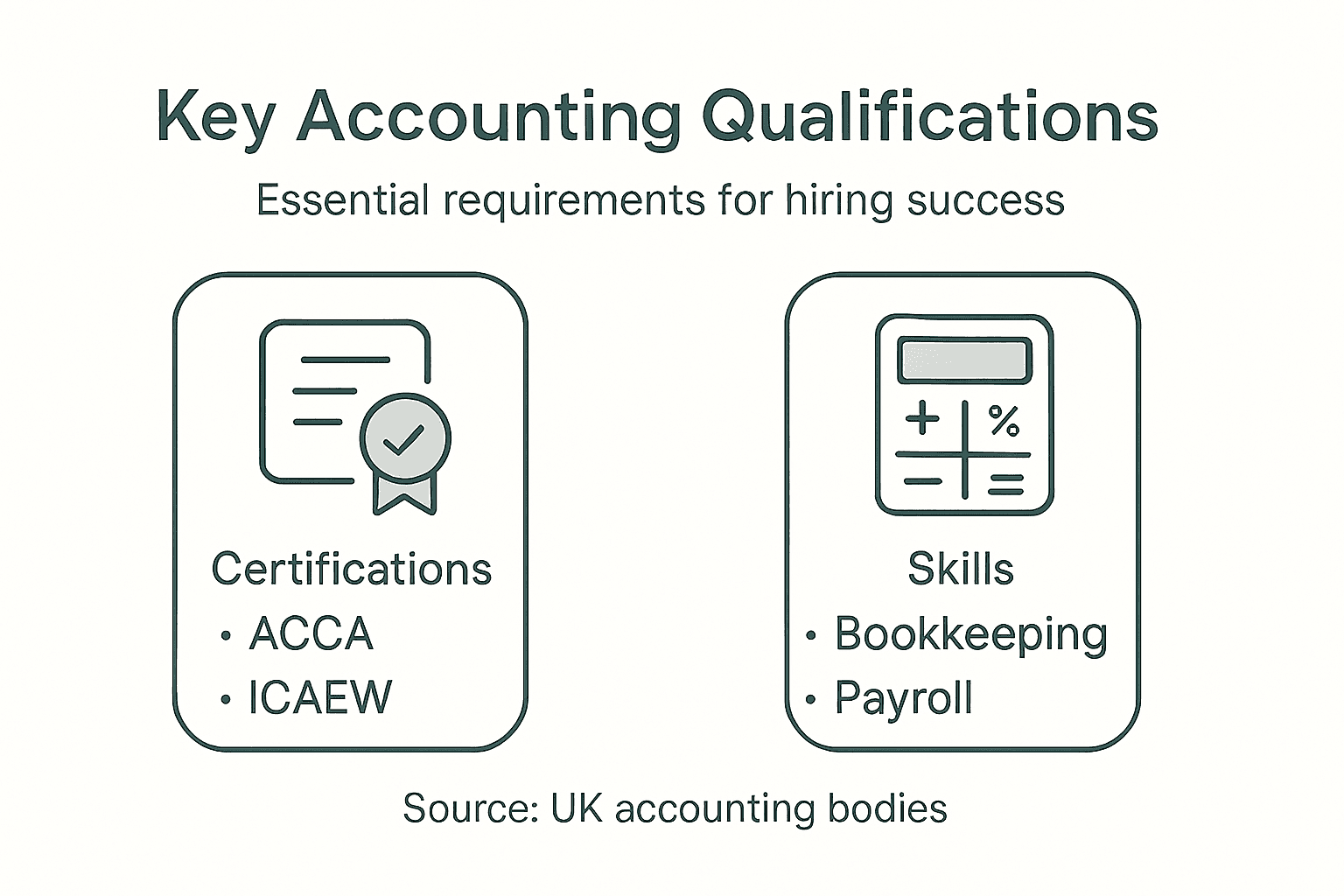
Don't fixate on degrees alone. Whilst a university qualification in accounting or finance looks impressive on paper, practical experience combined with professional qualifications often matters more for your hiring needs. A candidate with AAT certification and five years of real bookkeeping experience may outperform a recent graduate with a degree but no practical credentials.
Match qualifications to your actual gaps. A growing business needing accurate bookkeeping and payroll management requires AAT-qualified staff. A business preparing for expansion or needing tax strategy requires chartered-level expertise. Be honest about what your role demands, then seek candidates holding the appropriate credentials.
To clarify your options when hiring an accountant, here's a summary of major UK professional bodies and their specialisations:
| Accountancy Body | Area of Specialisation | Typical Roles Qualified For |
|---|---|---|
| ICAEW | Chartered accountancy in England & Wales | Audit, tax, financial reporting |
| ICAS | Chartered accountancy in Scotland | Audit, assurance, business advisory |
| ACCA | Global accountancy & finance | Financial management, compliance |
| CIMA | Management accounting & business finance | Financial planning, business strategy |
Your candidate's relevant qualifications should match the complexity of the financial tasks they'll perform daily.
Professional tip: Request evidence of active professional registration during interviews, not just historical qualifications. Active membership with bodies like ACCA or ICAEW means candidates maintain continuing professional development, staying current with changing tax laws and accounting standards relevant to Birmingham businesses.
Step 2: Review Relevant Work Experience and Software Skills
Resumes tell you what candidates claim they can do. Your job is to verify those claims through practical assessment. Work experience and software proficiency directly impact how quickly someone becomes productive in your finance team.
Start by examining the depth of their accounting experience. Look for candidates with at least 2-3 years in similar roles, particularly those who've worked with businesses comparable to yours in size and complexity. A candidate who has managed accounts for small manufacturing firms will understand your invoicing, stock control, and VAT requirements better than someone from a large corporate environment.

Check which accounting software they've actually used. Most Birmingham businesses run on Xero, Sage, or QuickBooks. If your role requires Xero expertise and a candidate only lists SAP experience, you'll face a learning curve. Ask specific questions about their hands-on experience with each system.
Pay attention to the variety of tasks they've performed:
- Bookkeeping and ledger management across multiple periods
- Payroll processing for different company sizes
- Bank reconciliations and financial reporting
- VAT compliance and tax submissions
- Spreadsheet work in Excel or Google Sheets
Beyond their CV, consider using skill assessments to evaluate technical knowledge and software literacy in real-world scenarios. Assessments often include spreadsheet simulations and practical accounting tasks that reveal whether candidates can actually perform the work, not just describe it. This approach validates their proficiency beyond what interviews alone can show.
Look for candidates demonstrating analytical reasoning and compliance awareness. Someone who mentions catching a discrepancy or improving a process shows critical thinking. A candidate who proactively mentions staying updated on tax law changes shows professional maturity.
Don't dismiss candidates with slightly different software experience. Someone skilled in Sage can typically transition to Xero within weeks with proper training. What matters more is their foundational accounting knowledge and ability to learn new tools.
Here's an at-a-glance comparison of top UK accounting software for Birmingham businesses:
| Software | Common Uses | Suitable Business Types | Typical Learning Curve |
|---|---|---|---|
| Xero | SME accounting, payroll | Small/medium businesses | Quick for new users |
| Sage | Bookkeeping, payroll, VAT | SMEs, manufacturing firms | Moderate for beginners |
| QuickBooks | Accounting, invoicing | Start-ups, micro businesses | Simple, user-friendly |
| SAP | Advanced ERP financials | Large corporates, global firms | Steep, requires training |
The best candidates show both software competence and the ability to think through financial problems independently.
Professional tip: During interviews, ask candidates to walk you through a specific spreadsheet task or accounting scenario they've handled. Request they show you screenshots or examples of reports they've created. Direct evidence of their work beats any claim on a CV.
Step 3: Evaluate Accreditation and Compliance with UK Standards
Accreditation matters because it signals that a candidate meets recognised professional standards. When you hire someone holding credentials from established accountancy bodies, you're hiring someone who has committed to ethical practice and ongoing professional development.
Familiarise yourself with the major UK accountancy bodies. ICAEW, ICAS, ACCA, and CIMA are the most recognised. These organisations set educational standards, establish ethical guidelines, and ensure their members comply with professional training requirements. When a candidate holds membership with one of these bodies, they've already been vetted by an external authority.
Understand what each body represents:
- ICAEW governs chartered accountants in England and Wales
- ICAS oversees chartered accountants in Scotland
- ACCA serves accountancy professionals internationally with a strong UK presence
- CIMA focuses on management accounting and finance professionals
Beyond professional bodies, candidates must understand the regulatory framework for UK accounting set by the Financial Reporting Council and other oversight authorities. This framework includes compliance with UK GAAP, IFRS standards, and requirements under the Companies Act 2006. A qualified candidate should understand these standards apply to your business.
Verify active membership rather than historical qualifications. A candidate claiming ACCA membership from 2015 needs current registration to prove they're maintaining professional standards. Ask for their membership number and verify it on the relevant body's website. Active members must complete continuing professional development hours annually, ensuring they stay current with changing regulations.
Check whether candidates understand VAT compliance, payroll legislation, and corporation tax requirements specific to the UK. These aren't optional knowledge areas. Someone practising accounting in the UK without understanding current tax legislation puts your business at risk.
Look for candidates mentioning compliance training or recent updates to their knowledge. Someone who has completed training on the latest MTD (Making Tax Digital) requirements shows they keep pace with regulatory changes affecting your business.
A candidate with genuine accreditation demonstrates they're serious about professional standards and regulatory compliance.
Professional tip: Ask candidates to explain a recent regulatory change affecting UK accounting. Their response will reveal whether they actively follow professional developments or simply have old qualifications. Genuine professionals stay engaged with their field.
Step 4: Verify Qualifications and References Before Hiring
Everything a candidate tells you needs verification before you make an offer. References and qualification checks are your final safeguard against hiring mistakes that could cost your Birmingham business time and money.
Start by obtaining written consent from your candidate to contact their references. This is both professional and a legal requirement under data protection legislation. Ask for at least two references, ideally including their most recent manager or supervisor. Avoid accepting only character references from friends or family members.
When contacting referees, speak directly with them rather than relying on written responses. A phone conversation reveals far more than an email. You can ask follow-up questions and pick up on tone and hesitation that might indicate concerns the referee feels awkward putting in writing.
Focus your reference check questions on job-relevant areas:
- Employment dates to confirm they actually worked there when they claim
- Job title and responsibilities to validate their experience matches your needs
- Technical skills in accounting software and financial tasks
- Reliability and attendance to assess their commitment
- Reason for leaving to understand why they moved on
During reference checks, verify employment history and job responsibilities thoroughly. Ask specific questions about their performance in areas directly relevant to your role. If you need someone strong with Xero reconciliations, ask the referee specifically about their proficiency with that task.
Verify professional qualifications directly with the issuing body. If a candidate claims ACCA membership, check the ACCA register yourself rather than accepting their word. Many bodies allow you to search their registers online. This takes five minutes and provides absolute confirmation.
Be cautious of candidates who are vague about references or claim they can't contact previous employers. Genuine candidates expect this process and cooperate fully. Someone hesitant about references often has something to hide.
Don't over-rely on candidate-selected references. These are naturally going to be positive. Ask whether you can contact someone from earlier in their career, not just their most recent employer. Previous managers often give you a more balanced perspective.
Thorough verification now prevents expensive hiring problems later.
Professional tip: Ask referees the same prepared questions consistently across all candidates. This creates fair comparisons and ensures you're evaluating them on identical criteria, not letting personality or rapport cloud your assessment.
Find Qualified Accounting Talent for Your Birmingham Business Today
Hiring the right finance professional requires more than just recognising qualifications like AAT, ACCA or CIMA. You need confidence in their practical experience, software skills, and up-to-date accreditation to avoid costly hiring mistakes. If the challenge of assessing accounting credentials while navigating UK standards and accounting software options feels overwhelming, you are not alone. Many Birmingham businesses struggle to distinguish between surface qualifications and genuine expertise.
At Ibaco Recruitment, we specialise in connecting local businesses with thoroughly vetted finance professionals who meet the exacting criteria highlighted in the article. Our deep knowledge of Birmingham and West Midlands markets ensures candidates not only hold valid professional qualifications but also have hands-on experience with Xero, Sage, QuickBooks and more. We handle the entire process from matching to onboarding so you can hire faster with total peace of mind. Visit our main site to submit a hiring request and secure your ideal accounting hire within weeks.
Frequently Asked Questions
What qualifications should I look for when hiring an accountant?
To hire an accountant successfully, focus on qualifications like AAT, ACCA, ICAEW, ICAS, or CIMA. Determine the complexity of the role you need to fill and match it with the appropriate qualification level.
How can I assess a candidate's practical accounting skills?
Evaluate a candidate's practical accounting skills by requesting skill assessments or practical tasks during the interview. This helps you verify their claimed abilities instead of relying solely on their resume.
Why is verifying professional qualifications important when hiring an accountant?
Verifying professional qualifications ensures that a candidate meets recognised standards and maintains their credentials. Always check their active membership status with professional bodies to confirm their compliance and commitment to ethical practices.
How can I effectively conduct reference checks for accounting candidates?
Conduct reference checks by speaking directly to previous employers to verify employment details and skills. Ask focused questions about the candidate's performance in relevant areas, and ensure you have their permission to contact referees.
What should I consider regarding software experience when evaluating candidates?
When evaluating candidates, pay attention to their experience with accounting software relevant to your business. Ensure they have practical knowledge of tools like Xero, Sage, or QuickBooks, depending on your requirements, as this can affect their productivity.