

Finding the right accountant for your West Midlands business shouldn't feel like searching for a needle in a haystack. Many SMEs struggle to identify candidates with the right qualifications, software skills, and local market knowledge needed for accurate financial reporting and UK compliance. This guide walks you through a proven, step-by-step approach to hiring permanent accountants who fit your business needs, from defining your requirements to onboarding successfully.
Table of Contents
- Understanding your hiring needs
- Prerequisites for hiring accountants
- The local recruitment process for accountants
- Interviewing and onboarding best practices
- Common hiring mistakes and how to avoid them
- Expected timelines, costs, and outcomes
- Find the right accountant with Ibaco Recruitment
- FAQ
Key takeaways
| Point | Details |
|---|---|
| Role clarity matters | Understanding the difference between accountants and bookkeepers prevents costly mismatches and ensures you hire for your actual financial needs. |
| Local agencies accelerate hiring | Specialist recruiters reduce vetting time by 50% and deliver higher-quality shortlists tailored to West Midlands SMEs. |
| Verification prevents failures | Checking qualifications and software competency avoids the 38% of hires that fail due to poor credential verification. |
| Structured processes boost retention | Competency-based interviews and onboarding plans increase selection accuracy by 42% and retention by 33%. |
| Timeline expectations | Traditional hiring takes six weeks on average, whilst specialist agencies compress this to two weeks with better outcomes. |
Understanding your hiring needs
Before posting a job advert, clarify exactly which type of finance professional your business requires. Accountants typically handle complex financial analysis, tax planning, and regulatory compliance, whilst bookkeepers focus on daily transaction recording and basic reconciliation. For most West Midlands SMEs, this distinction matters enormously.
Recent data shows 72% of local SMEs prefer permanent hires over contractors for finance roles, valuing the consistency and deep business knowledge permanent staff develop. Your choice depends on transaction volume, reporting complexity, and regulatory obligations. A growing manufacturing firm needing quarterly VAT returns and management accounts requires different expertise than a small consultancy tracking invoices.
UK accounting standards compliance isn't optional for SMEs. Whether you follow FRS 102 or simplified reporting frameworks, your hire must understand these requirements intimately. Consider your current and projected financial operations. Do you need someone to close monthly books, or manage audits and strategic forecasting?
Key factors to evaluate:
- Annual turnover and transaction complexity
- Regulatory filing requirements and deadlines
- Current financial systems and reporting needs
- Growth plans requiring scalable expertise
- Industry-specific compliance obligations
Defining your role precisely before recruitment reduces mismatches and saves months of frustration. Write a detailed position description that reflects actual daily tasks, not generic duties copied from templates.
Prerequisites for hiring accountants
Successful recruitment starts with preparation, not job postings. Establish clear minimum qualifications before reviewing applications. In the West Midlands market, AAT Level 4 represents the baseline for bookkeeping roles, whilst qualified accountants typically hold ACCA, CIMA, or ACA certifications. These aren't arbitrary standards but essential markers of competency in UK financial regulations.
Software proficiency determines whether your new hire contributes immediately or requires extensive training. Most West Midlands businesses use Xero, Sage, or QuickBooks as their primary accounting platforms. Verify candidates can navigate your specific software, not just list it on their CV. Practical demonstrations during interviews reveal genuine capability.

Budgeting realistically prevents mid-process surprises. Permanent accountant salaries in the West Midlands vary by experience and qualifications, typically ranging from £28,000 for junior roles to £50,000 for senior positions. Factor in recruitment fees, onboarding time, and training costs when calculating total investment.
Essential preparation steps:
- Document required certifications and continuing professional development expectations
- List must-have versus nice-to-have software skills
- Define reporting lines and team structure
- Set realistic salary ranges based on local market rates
- Prepare detailed job descriptions with specific responsibilities
Pro tip: Audit your existing financial processes before hiring. Understanding current workflows, pain points, and gaps helps you specify exactly what skills and experience your new accountant needs to succeed from day one.
Pre-defining these elements focuses your search and helps qualified candidates self-select appropriately, improving application quality significantly.
The local recruitment process for accountants
Choosing the right recruitment channel dramatically affects hiring speed and candidate quality. Using a local recruitment agency specialising in finance roles can reduce candidate vetting time by up to 50%, whilst improving the quality of shortlisted candidates compared to generic job boards.
Local specialist agencies understand West Midlands salary expectations, typical career progression paths, and which qualifications matter most for regional SMEs. They maintain active relationships with qualified candidates, often reaching professionals not actively job-hunting but open to the right opportunity. Generic platforms cast wide nets but require you to filter hundreds of irrelevant applications.
Trade-offs between approaches:
- Specialist recruiters: Higher quality, faster placement, expert vetting, typically fee-based but often with no upfront costs
- Job boards: Wider reach, lower initial cost, higher volume, more time intensive screening
- Direct networking: Potential cultural fit, relationship-based, unpredictable timelines, limited candidate pools
Implement pre-hire checklists focusing on qualification verification and software competency testing. Request proof of certifications directly from issuing bodies. Schedule practical software assessments where candidates demonstrate specific tasks in your chosen platform. These steps prevent the credential inflation common in finance recruitment.
Verify local market knowledge by asking specific questions about West Midlands business environments, regional industry clusters, and common compliance challenges SMEs face in Birmingham and surrounding areas.
Pro tip: Partner with agencies offering transparent fee structures and no upfront costs, aligning their success with yours. This model ensures agencies prioritise placement quality over volume, as they only earn fees for successful hires who pass probation periods.
Regular communication with your chosen recruitment partner accelerates hiring timelines and ensures candidate profiles match your evolving needs. Share feedback promptly after interviews to refine subsequent candidate selections.
Explore additional recruitment insights to optimise your approach based on current market conditions and emerging hiring trends in the region.
Interviewing and onboarding best practices
Competency-based interviewing increases selection accuracy significantly. Research shows this structured approach boosts hiring success by 42% compared to unstructured conversations. Focus questions on specific past experiences where candidates demonstrated required skills, not hypothetical scenarios.
Effective interview structure:
- Open with role expectations and company context to set the scene
- Explore technical competency through scenario-based questions about reconciliations, month-end closes, or VAT returns
- Assess software proficiency with live demonstrations in your accounting platform
- Evaluate problem-solving through case studies relevant to your industry
- Gauge cultural fit by discussing work preferences, communication styles, and team dynamics
- Close with candidate questions to assess genuine interest and preparation
Key question themes include:
- Specific examples of managing compliance deadlines under pressure
- Approaches to identifying and resolving discrepancies in financial data
- Experience implementing new accounting systems or process improvements
- Methods for communicating complex financial information to non-finance stakeholders
Onboarding plans improve retention by 33% when properly structured. New finance hires need clear 30-60-90 day roadmaps outlining learning objectives, relationship building, and deliverable expectations. Schedule training on your specific software configurations, internal processes, and reporting templates during the first fortnight.
Introduce new accountants to key stakeholders across departments, not just finance teams. Understanding how other functions use financial data improves report relevance and cross-functional collaboration. Regular check-ins during the first three months identify challenges early and demonstrate investment in their success.
Cultural integration activities matter as much as technical training. Include new hires in team meetings, social events, and informal knowledge-sharing sessions. This builds belonging and accelerates their contribution to business objectives.
Review comprehensive onboarding guidance and explore proven interview frameworks to refine your selection process continuously.
Common hiring mistakes and how to avoid them
Poor qualification verification causes 38% of accounting hires to fail within the first year. Accepting certificates at face value without independent confirmation creates risk. Contact professional bodies directly to verify current membership status and confirm qualifications haven't lapsed. This simple step prevents costly mis-hires.
Software competency gaps affect 29% of placements, causing immediate productivity issues. Candidates often list software experience on CVs after minimal exposure or outdated training. Require live demonstrations during interviews where applicants perform actual tasks in your accounting system. Watch how they navigate, handle errors, and apply shortcuts revealing genuine proficiency.
Reference checking failures impact 45% of recruitment processes. Skipping this step or asking generic questions wastes the opportunity to uncover red flags. Prepare specific questions about punctuality, accuracy under pressure, ability to meet deadlines, and reasons for leaving. Speak with direct supervisors who observed daily performance, not HR departments reading from personnel files.
Common pitfalls to avoid:
- Rushing hiring decisions due to urgent needs without proper vetting
- Focusing solely on technical skills whilst ignoring cultural alignment
- Accepting generic references without probing specific performance examples
- Neglecting to verify right-to-work documentation thoroughly
- Skipping practical assessments in favour of theoretical knowledge testing
Cultural fit assessments during interviews prevent retention problems. Technical brilliance means little if working styles clash with your team's collaborative approach or communication preferences. Ask about preferred feedback methods, ideal work environments, and past team dynamics to surface potential misalignments early.
Implement mandatory verification protocols covering qualifications, references, software skills, and eligibility to work. Structured checklists ensure consistency across candidates and prevent oversights during busy hiring periods.
Learn from others' experiences by reviewing common recruitment mistakes and adapting your process to avoid these expensive errors.
Expected timelines, costs, and outcomes
Traditional permanent accountant hiring averages six weeks from job posting to signed contract. This timeline includes two weeks advertising and application collection, two weeks screening and initial interviews, one week final interviews and reference checks, and one week offer negotiation and contract preparation. However, specialist local agencies compress this to two weeks through pre-vetted candidate pools and streamlined processes.
Recruitment fees typically range between £3,000 and £5,000 for permanent placements, calculated as a percentage of first-year salary. Many West Midlands agencies now offer no upfront fee models, charging only upon successful placement and probation completion. This aligns agency incentives with hiring quality rather than speed alone.
| Recruitment method | Average timeline | Typical cost | Quality rating |
|---|---|---|---|
| Generic job boards | 6-8 weeks | £500-£1,000 (advertising) | Moderate |
| Specialist agencies | 2-3 weeks | £3,000-£5,000 (success fee) | High |
| Direct networking | 4-12 weeks | Minimal direct costs | Variable |
| Internal referrals | 3-6 weeks | £500-£2,000 (referral bonus) | High |
Structured onboarding and clear key performance indicators improve retention and performance measurably. New hires with formal 90-day plans show 33% better retention rates and reach full productivity 40% faster than those left to self-direct their integration.
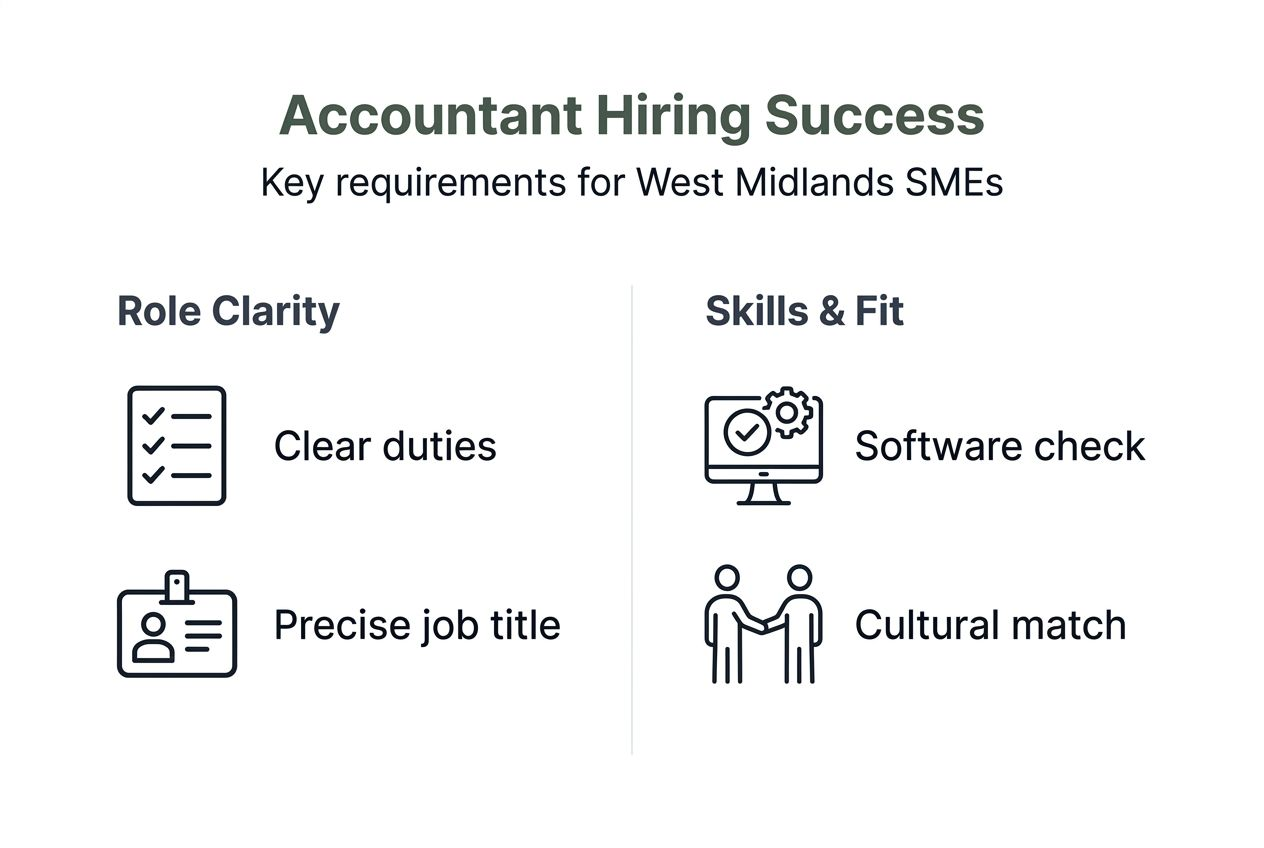
Benchmark success through selection accuracy (percentage of hires passing probation), time-to-productivity (weeks until independent contribution), retention rates at 12 and 24 months, and hiring manager satisfaction scores. Track these metrics to refine your recruitment approach continuously.
Budget adequately for the entire hiring investment, not just recruitment fees. Include onboarding time, training costs, reduced productivity during the learning curve, and potential overlap with departing staff. Comprehensive planning prevents mid-process budget surprises that compromise hiring quality.
Find the right accountant with Ibaco Recruitment
Applying this comprehensive hiring framework positions your West Midlands business for recruitment success, but partnering with local specialists accelerates results dramatically. Ibaco Recruitment focuses exclusively on placing permanent accountants and bookkeepers across Birmingham and the wider West Midlands region.
Their deep understanding of local finance recruitment trends means faster candidate matching and higher placement success rates. Unlike generic recruiters handling multiple sectors superficially, Ibaco's team knows AAT versus ACCA distinctions, typical salary expectations for qualified professionals, and which software skills matter most for regional SMEs. This expertise translates directly into reduced hiring timelines and improved candidate quality.
The no upfront fee model aligns Ibaco's success with yours, ensuring they prioritise sustainable placements over quick commissions. Their structured process delivers vetted candidates within days, comprehensive screening that verifies qualifications and software competency, and ongoing support through interviews and onboarding.
Whether you need a qualified accountant for complex compliance work or an experienced bookkeeper for daily financial operations, Ibaco's specialist recruitment approach removes the guesswork from hiring permanent finance professionals in the West Midlands.
FAQ
What qualifications must a West Midlands accountant have?
Minimum qualifications depend on role complexity, but AAT Level 4 suits bookkeeping positions whilst qualified accountants should hold ACCA, CIMA, or ACA certifications. These credentials demonstrate mastery of UK accounting standards and ongoing professional development. Always verify qualifications directly with issuing professional bodies rather than accepting certificates at face value.
How long does it realistically take to hire an accountant?
Traditional recruitment through job boards averages six weeks from posting to signed contract, including screening, interviews, and reference checks. Specialist local agencies typically compress this timeline to two weeks by maintaining pre-vetted candidate pools and streamlined processes. Timeline variations depend on role seniority, salary competitiveness, and current market conditions.
Why choose a local recruitment agency over general job boards?
Local specialist agencies reduce vetting time by up to 50% whilst improving candidate quality through deep market knowledge and established professional networks. They understand West Midlands salary expectations, typical career paths, and regional compliance requirements that generic platforms miss. The trade-off involves higher fees but significantly better placement success rates and faster hiring.
What are key software skills to verify before hiring?
Most West Midlands SMEs use Xero, Sage, or QuickBooks as primary accounting platforms, so verify genuine proficiency in your specific system. Request live demonstrations during interviews where candidates perform actual reconciliation tasks, generate reports, or process transactions. Listed experience on CVs often reflects minimal exposure rather than working competency, making practical assessments essential.
How can SMEs ensure cultural fit in new finance hires?
Ask specific questions about preferred work environments, communication styles, and past team dynamics during interviews to surface potential misalignments. Discuss how candidates handle feedback, approach collaboration, and manage conflicting priorities. Include team members in the interview process to gather diverse perspectives on cultural compatibility. Technical brilliance delivers little value if working styles clash with your existing team's approach. Explore additional hiring guidance for deeper insights into assessing cultural fit effectively.