

Finance managers and small business owners in the West Midlands face mounting pressure from Making Tax Digital (MTD) mandates digital record-keeping and submission affecting over 780,000 UK taxpayers. Manual bookkeeping no longer meets regulatory standards. Accounting software has become essential for compliance, accuracy, and operational efficiency in 2026.
Table of Contents
- Introduction to Accounting Software in the UK Context
- UK Compliance and Regulatory Imperatives
- Automation and Error Reduction Benefits
- Real-Time Financial Visibility and Decision Support
- Feature Prioritization for Small Businesses
- Common Misconceptions and Corrections
- Emerging Technology and Future Trends
- Implementation Challenges and Solutions
- Discover Top Finance and Accounting Talent in Birmingham
- Frequently Asked Questions
Key Takeaways
| Point | Details |
|---|---|
| MTD Compliance | Making Tax Digital mandates require digital record-keeping and submission for VAT and income tax. |
| Time Savings | SMEs save up to 20 hours monthly by automating bookkeeping tasks with accounting software. |
| Real-Time Insights | Cloud solutions provide instant financial visibility enabling better cash flow decisions. |
| AI Integration | Machine learning enhances forecasting accuracy and fraud detection capabilities. |
| Error Reduction | Automated systems eliminate 70% of manual data entry errors in financial records. |
Introduction to Accounting Software in the UK Context
Accounting software transforms how UK businesses manage financial operations. These digital platforms handle bookkeeping, invoicing, VAT calculations, and compliance reporting automatically. The regulatory landscape in Britain demands precision that manual methods struggle to achieve.
Making Tax Digital represents the most significant shift in UK tax administration in decades. HMRC now requires businesses to maintain digital records and submit returns through compatible software. This isn't optional for VAT-registered businesses with taxable turnover above £85,000.
Accounting software reduces manual errors in financial records by automating bank reconciliations, invoice tracking, and VAT calculations, improving accuracy and audit readiness. The difference between compliant and non-compliant operations often determines whether a business faces penalties or operates smoothly.
Key capabilities matter most for UK SMEs:
- Automated bank feeds connecting directly to business accounts
- Real-time VAT calculations with digital submission to HMRC
- Multi-user access with role-based permissions for team collaboration
- Invoice generation and tracking with payment reminders
- Expense management with receipt capture via mobile apps
- Payroll integration supporting PAYE and pension auto-enrollment
- Financial reporting tailored to UK GAAP and FRS 102 standards
Meeting legal requirements drives adoption more than any other factor. Businesses recognize that leading UK accounting software solutions provide the infrastructure needed to satisfy regulators while improving internal processes. Working with professionals who understand both software and compliance, like when you hire a local Birmingham accountant, ensures maximum benefit from technology investments.
UK Compliance and Regulatory Imperatives
Regulatory changes in 2026 make accounting software non-negotiable for UK businesses. Making Tax Digital (MTD) mandates digital record-keeping and submission for VAT and income tax, fundamentally altering how businesses interact with HMRC. Sole traders, landlords, partnerships, and limited companies all face these requirements.
MTD for Income Tax Self Assessment rolled out to self-employed individuals and landlords with annual business or property income exceeding £50,000. This threshold will drop to £30,000 in future phases, capturing even more businesses. The penalties for non-compliance run steep, starting at £400 for late digital submissions.
Financial reporting standards also evolved significantly. Proper accounting software supports compliance with updated UK financial reporting standards like FRS 102 Section 20, which affects lease accounting on balance sheets. These amendments require businesses to recognize operating leases as assets and liabilities, changing how financial statements present obligations.
Critical compliance functions software handles:
- Digital VAT return preparation and submission through MTD-compatible bridges
- Quarterly income tax updates for self-employed individuals under MTD ITSA
- Payroll processing with Real Time Information (RTI) submissions to HMRC
- Construction Industry Scheme (CIS) calculations and reporting
- Making Tax Digital record-keeping meeting HMRC's functional compatible software requirements
- Audit trails maintaining complete transaction histories for six years
VAT compliance alone justifies software investment. Quarterly submissions must include detailed transaction records showing input and output VAT. Manual calculations frequently miss eligible reclaims or miscategorize transactions, costing businesses thousands annually.
Audit readiness becomes straightforward when software maintains comprehensive records automatically. HMRC investigations require businesses to produce detailed financial documentation quickly. Digital systems generate reports instantly, demonstrating compliance and reducing investigation duration. Local accountants in Birmingham who work with UK accounting regulatory changes in 2026 guide businesses through implementation smoothly.
Automation and Error Reduction Benefits
Automation transforms tedious accounting tasks into background processes. Bank feeds import transactions automatically, matching them to invoices and expenses without manual data entry. This single feature saves finance managers hours each week previously spent reconciling statements.

Accounting software reduces manual errors in financial records by automating bank reconciliations, invoice tracking, and VAT calculations, improving accuracy and audit readiness. Data entry errors drop by 70% when businesses eliminate manual transaction recording. Every keystroke removed is one less opportunity for mistakes.
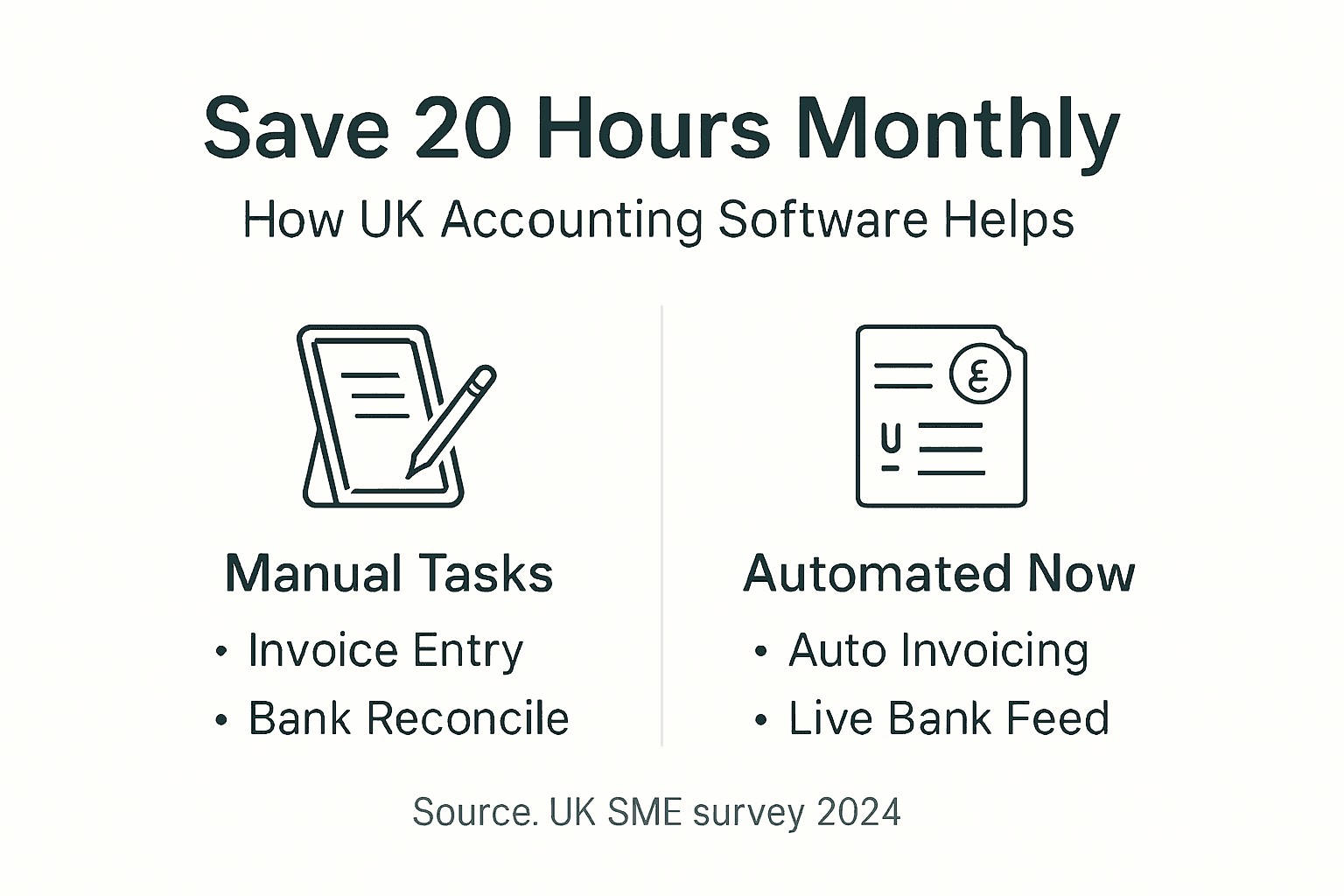
Invoice processing becomes effortless with automation. Software generates invoices from templates, sends them via email, tracks payment status, and issues reminders automatically. Late payments decrease because systematic follow-ups happen without anyone remembering to check. Cash flow improves when receivables convert faster.
VAT calculations run continuously in the background. Every sale and purchase updates VAT liability in real time. Quarter-end doesn't require frantic spreadsheet work or worried double-checking. The system knows exactly what's owed because it tracked every transaction as it occurred.
Key automation benefits include:
- Bank reconciliation completing in minutes instead of hours
- Invoice generation from quotes with one click
- Expense categorization using machine learning from past entries
- VAT calculations updating automatically with every transaction
- Payment reminders sending without manual intervention
- Financial reports generating instantly for any date range
Pro Tip: Prioritize software offering robust integration with your bank feeds and payroll system. The more processes that sync automatically, the less manual work remains. Look for platforms supporting open banking standards for secure, real-time financial data access.
Audit preparedness improves dramatically with automated record-keeping. Every transaction links to supporting documentation: invoices, receipts, bank statements. When questions arise, finding answers takes seconds instead of digging through filing cabinets. Accountants spend less time on basic record-keeping and more on strategic advice when working with clients using quality software. Consider partnering with professionals who hire accountants in Birmingham experienced with leading UK accounting software solutions for implementation support.
Real-Time Financial Visibility and Decision Support
Cloud-based accounting software revolutionizes financial management through instant data access. Cloud-based accounting software allows businesses real-time access to financial data anywhere, supporting better cash flow management and faster decision-making. Over 85% of UK SMEs now use cloud accounting, up from 58% just three years ago.
Real-time visibility transforms how you understand your business. Log in from any device and see current cash position, outstanding invoices, upcoming bills, and profitability. No waiting for month-end reports or asking your accountant for updates. The information exists now, accurate to the last transaction.
Cash flow monitoring becomes proactive instead of reactive. Dashboard alerts warn when balances drop below safe levels or when major payments approach. You spot trends early, identifying slow-paying customers or expense categories creeping upward. Strategic decisions improve when based on current data rather than outdated reports.
Analytics tools built into modern platforms reveal patterns invisible in traditional bookkeeping. Compare performance across time periods, analyze profitability by product line or customer segment, and forecast future cash positions based on current pipelines. These insights drive smarter resource allocation and growth planning.
| Feature | Cloud-Based Software | On-Premise Software |
|---|---|---|
| Accessibility | Anywhere with internet | Office computers only |
| Updates | Automatic, included | Manual, often paid upgrades |
| Collaboration | Multiple users simultaneously | Limited concurrent access |
| Data Security | Professional-grade encryption and backups | Dependent on local IT infrastructure |
| Initial Cost | Lower, subscription-based | Higher, perpetual license |
| Scalability | Easy to add users and features | Requires new hardware or licenses |
Strategic planning benefits from comprehensive reporting capabilities. Generate profit and loss statements, balance sheets, and cash flow forecasts instantly. Model different scenarios to understand the impact of hiring decisions, capital investments, or pricing changes. Financial data becomes a strategic asset rather than a compliance burden.
Risk management improves through early warning systems. Identify customers with growing outstanding balances before they become bad debts. Track expense categories that exceed budgets immediately rather than discovering overruns months later. The future of accounting software with cloud adoption continues advancing capabilities. Working with local accountants in Birmingham who understand cloud platforms maximizes the strategic value of real-time financial data.
Feature Prioritization for Small Businesses
Selecting the right accounting software requires focusing on features that matter most for UK SMEs. Not every capability adds equal value. Prioritize functionality supporting compliance, efficiency, and growth.
Must-have features for UK small businesses:
- VAT integration with Making Tax Digital submission capability ensuring regulatory compliance
- Payroll processing supporting PAYE, National Insurance, and pension auto-enrollment
- Multi-user access with customizable permissions controlling who sees sensitive financial data
- Invoice automation reducing administrative burden and improving cash flow
- Expense tracking with receipt capture via mobile apps simplifying claim processing
- Bank feed integration for automatic transaction imports and reconciliation
- Financial reporting meeting UK GAAP standards for year-end accounts
VAT and payroll integration eliminates duplicate data entry and reduces error risk. When these systems connect seamlessly, wage costs flow into accounts automatically, and VAT calculations remain current. Businesses avoid the common mistake of treating these as separate systems requiring manual reconciliation.
Multi-user access becomes critical as businesses grow. Finance managers need full access while sales teams require only invoice generation capability. Proper permission controls protect sensitive information while enabling team collaboration. Look for software offering granular role-based access rather than all-or-nothing sharing.
Invoice automation accelerates cash collection. Professional-looking invoices that generate automatically from quotes or recurring billing schedules leave better impressions than manual documents. Automated payment reminders reduce days sales outstanding without awkward phone calls.
Expense tracking through mobile apps captures costs in real time. Employees photograph receipts immediately rather than losing paper copies. Approvals happen digitally, and reimbursements process faster. This visibility helps control discretionary spending before it becomes problematic.
Scalability matters even for small businesses. Choose platforms that grow with you, adding users, features, or transaction volume without switching systems. Migration between accounting platforms disrupts operations and risks data integrity. Better to select software meeting current needs with room for expansion.
Vendor support quality varies dramatically between providers. Prioritize companies offering phone support, not just email tickets. UK-based support teams understand local regulations better than offshore centers. Check response time commitments and availability during your business hours. Training resources including video tutorials, documentation, and webinars help teams adopt new systems faster. When hiring accountants in Birmingham, ensure they have experience with your chosen software platform for maximum implementation efficiency.
Common Misconceptions and Corrections
Myths about accounting software prevent many small businesses from adopting beneficial technology. Let's address the most persistent misconceptions with facts.
Myth one claims small businesses with few transactions don't need software. This ignores Making Tax Digital requirements applying regardless of transaction volume. Even businesses with minimal activity must maintain digital records and submit returns through compatible software. Manual methods no longer satisfy HMRC standards.
Myth two suggests software costs exceed benefits for SMEs. Modern cloud platforms start under £15 monthly, less than an hour of bookkeeper time. When software saves 20 hours monthly through automation, the return on investment becomes obvious. Calculate time spent on bookkeeping currently and multiply by your hourly rate. Software pays for itself quickly.
Myth three believes manual bookkeeping provides adequate accuracy. Manual bookkeeping errors are estimated to cause 30-40% of small business tax penalties. Human error in data entry, calculation mistakes, and overlooked transactions create costly compliance failures. Automated systems eliminate these risks through consistent rule application.
Myth four claims software is too complex for non-accountants. Modern platforms prioritize user-friendly interfaces designed for business owners without accounting backgrounds. Setup wizards guide initial configuration, templates simplify common tasks, and contextual help explains features where needed. Most users become proficient within days, not months.
Common misconceptions include:
- Software requires expensive IT infrastructure (cloud solutions need only internet access)
- Implementation takes months (most SMEs operate fully within two weeks)
- Data migration risks losing historical records (professional conversion preserves all information)
- Subscription costs keep rising unpredictably (pricing remains stable with clear published rates)
- Software becomes obsolete quickly (automatic updates maintain current capability)
Pro Tip: Evaluate total cost of ownership including time saved, penalties avoided, and better financial decisions enabled. Compare this against subscription costs and implementation expenses. Most businesses find software pays for itself within three to six months through efficiency gains alone.
Long-term ROI extends beyond direct cost savings. Better cash flow management through timely invoicing and payment tracking improves working capital. Accurate financial data supports growth planning and funding applications. Audit readiness reduces accountant fees during year-end and HMRC investigations. Understanding common misconceptions about accounting software helps businesses make informed decisions based on facts rather than outdated assumptions.
Emerging Technology and Future Trends
Technology continues reshaping UK accounting software capabilities. AI and machine learning integration in accounting software enables predictive cash flow analytics, fraud detection, and strategic forecasting for UK businesses. These aren't distant possibilities but current features in leading platforms.
Predictive analytics use historical patterns to forecast future cash positions. Machine learning models analyze payment behaviors, seasonal trends, and growth trajectories to project cash flow three, six, or twelve months ahead. This foresight enables proactive decisions about hiring, inventory, or capital investments rather than reactive crisis management.
Fraud detection algorithms monitor transactions for unusual patterns. Sudden changes in vendor payment amounts, duplicate invoices, or transactions outside normal business hours trigger alerts. These systems catch errors and fraudulent activity that manual reviews miss. Security improves without adding workload.
Strategic forecasting capabilities help model business scenarios. What happens to profitability if you raise prices 10%? How would adding three employees affect cash flow? AI-powered tools run these projections instantly, considering historical data, industry benchmarks, and economic factors. Decision-making becomes data-driven rather than intuition-based.
ESG reporting integration emerges as businesses face growing sustainability requirements. Software tracks carbon footprint from business activities, monitors supply chain sustainability metrics, and generates reports meeting developing disclosure standards. This functionality positions businesses ahead of regulatory requirements.
Emerging capabilities include:
- Natural language queries allowing questions like "What was profit last quarter?" without navigating menus
- Automated accounts payable matching invoices to purchase orders and receipts
- Smart categorization learning from corrections to improve transaction classification
- Blockchain integration for secure, tamper-proof audit trails
- API ecosystems connecting accounting with CRM, inventory, and e-commerce platforms
| Capability | Traditional Software | AI-Enhanced Software |
|---|---|---|
| Cash Flow Forecasting | Based on manual assumptions | Predictive models using historical patterns |
| Fraud Detection | Manual review of transactions | Automated anomaly detection |
| Expense Categorization | Rule-based or manual | Machine learning from past entries |
| Report Generation | Template-based standard reports | Natural language queries for custom insights |
| Compliance Monitoring | Periodic checks | Continuous real-time validation |
UK accounting firms increasingly adopt AI tools. Industry surveys show 68% of practices now use or plan to implement AI-powered software in 2026, up from 34% two years prior. This adoption rate signals mainstream acceptance of intelligent automation in financial management.
The competitive advantage shifts toward businesses leveraging these capabilities early. While competitors manually analyze spreadsheets, AI-equipped businesses spot opportunities and risks immediately. This speed difference compounds over time, creating widening performance gaps. Staying current with AI and future accounting tech trends ensures your business remains competitive in evolving markets.
Implementation Challenges and Solutions
Adopting new accounting software presents real challenges despite clear benefits. Understanding common obstacles and proven solutions ensures successful transitions.
Data migration ranks as the most cited implementation concern. Businesses worry about losing historical records or corrupting data during transfers. Professional migration services minimize these risks through systematic validation and testing. Most platforms offer guided import tools accepting standard file formats from existing systems.
User training determines whether staff embrace or resist new software. Inadequate training leaves team members frustrated, reverting to familiar manual methods despite software availability. Invest in comprehensive training covering not just button-clicking but understanding why processes work as designed. Many vendors offer free onboarding sessions maximizing this resource.
Change management addresses human resistance to new workflows. Staff comfortable with existing methods resist learning different approaches. Involve users in selection decisions, highlight personal benefits like reduced tedious work, and celebrate early wins publicly. Leadership commitment to the transition signals its importance to the entire organization.
Integration with existing systems creates technical hurdles. Accounting software must exchange data with bank feeds, payroll services, e-commerce platforms, and CRM systems. Prioritize platforms offering pre-built integrations with your current tools. API availability enables custom connections when needed.
Implementation checklist:
- Audit current processes identifying pain points new software should address
- Define requirements including must-have features and nice-to-have capabilities
- Research platforms meeting requirements with strong UK compliance support
- Request demos from shortlisted vendors testing actual workflows
- Check references from similar businesses about implementation experiences
- Plan data migration including historical record cutoff dates
- Schedule training sessions before going live
- Run parallel systems briefly to validate accuracy
- Monitor adoption addressing user questions immediately
- Review processes quarterly optimizing software utilization
Pro Tip: Engage professional help for data migration and initial setup. The cost of expert assistance pales compared to lost productivity or data errors from DIY attempts. Many small business tax checklist resources emphasize proper record-keeping as foundational to compliance, making clean migration critical.
Ongoing optimization matters as much as initial implementation. Software capabilities expand through updates adding new features. Regular training refreshers ensure teams leverage advancing functionality. Monitor usage analytics identifying underutilized features that could improve efficiency.
Vendor support quality becomes apparent during implementation. Responsive, knowledgeable support teams resolve issues quickly while poor support leaves businesses struggling. Test support responsiveness during evaluation by submitting pre-sales questions and noting response quality and speed. This preview indicates post-purchase experience.
Continuous improvement mindset maximizes software value. Review processes quarterly asking what manual work remains and whether software features could automate it. Join user communities sharing tips and best practices. Attend vendor webinars learning advanced techniques. Technology investments deliver returns proportional to utilization effort.
Discover Top Finance and Accounting Talent in Birmingham
Implementing accounting software successfully requires skilled finance professionals who understand both technology and compliance. Building a capable team that maximizes software benefits starts with recruiting qualified talent.
Ibaco Recruitment specializes in connecting Birmingham businesses with experienced finance recruitment in Birmingham professionals who bring expertise in Xero, Sage, QuickBooks, and other leading platforms. Our deep understanding of the West Midlands market means we identify candidates with the right mix of technical skills and local regulatory knowledge.
Whether you need bookkeepers who can manage daily transactions, accountants who optimize tax positions, or finance managers who drive strategic decisions, our accounting recruitment agencies in Birmingham network provides vetted candidates within two weeks. We focus exclusively on finance roles, ensuring every candidate understands UK accounting standards, possesses relevant qualifications like AAT or ACCA, and has proven experience with modern accounting software.
Explore our services to hire qualified accountants in Birmingham who will leverage technology investments fully, ensuring your business maximizes efficiency, compliance, and strategic financial management capabilities.
Frequently Asked Questions
What is Making Tax Digital and how does it affect my business?
Making Tax Digital requires UK businesses to maintain digital records and submit tax returns through compatible software. VAT-registered businesses with turnover above £85,000 must comply now, while MTD for Income Tax Self Assessment applies to sole traders and landlords earning over £50,000 annually. Non-compliance results in penalties starting at £400 per late submission.
Which accounting software is best for small businesses in the West Midlands?
The best software depends on your specific needs, but prioritize platforms offering Making Tax Digital compliance, VAT integration, payroll support, and bank feed connectivity. Sage, Xero, and QuickBooks dominate the UK market with strong compliance features and local support. Consider working with Birmingham accounting professionals familiar with regional business needs for implementation guidance.
How much time can I realistically save with accounting software?
UK SMEs typically save 15 to 25 hours monthly after implementing accounting software, with the average around 20 hours. Time savings come from automated bank reconciliation, invoice generation, expense tracking, and VAT calculations replacing manual data entry. Larger transaction volumes produce proportionally greater time savings.
Is AI integration important for future-proofing my financial management?
AI capabilities provide significant competitive advantages through predictive cash flow forecasting, automated fraud detection, and intelligent expense categorization. While not essential immediately, AI-enhanced features improve decision-making quality and speed. Platforms with AI integration offer better long-term value as these capabilities become standard expectations rather than premium features.
What steps should I take to successfully implement new accounting software?
Start by auditing current processes and defining requirements. Research platforms meeting your needs, request demos, and check references from similar businesses. Plan data migration carefully, invest in comprehensive training, and run parallel systems briefly to validate accuracy. Engage professional help for setup and ongoing optimization to maximize your investment returns.